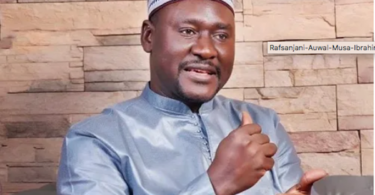
A former Chairman of the Independent National Electoral Commission (INEC), Attahiru Jega, has called for urgent amendment of some provisions of the 2026 Electoral Act, warning that certain clauses could undermine the credibility of future elections.
Jega said that although the law was intended to improve electoral integrity, it still contained “issues of serious concern” and ambiguous provisions that required immediate review.
Naijaonpoint reports that Jega made the remarks in a paper titled, Some Reflections on the 2026 Electoral Act and Nigeria’s Electoral Democracy, delivered at the public presentation of A Collection of Essays: Readings on the Legislature, authored by Prof Ladi Hamalai, in Abuja.
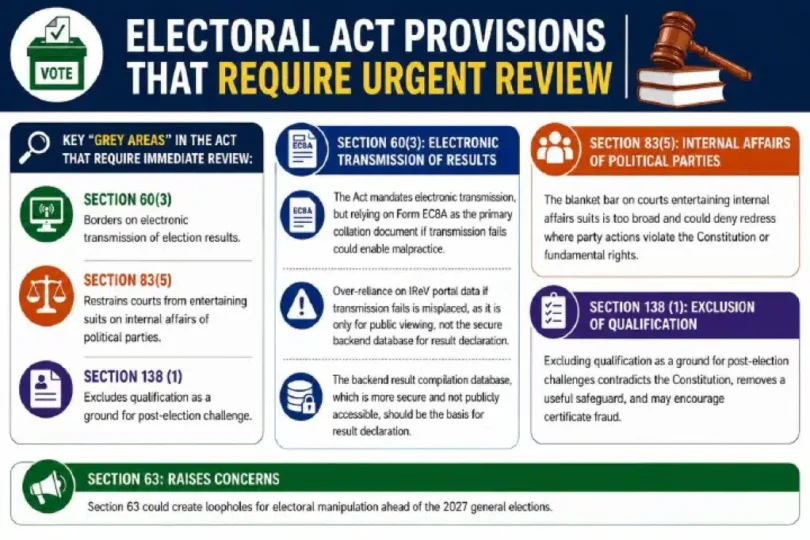
The former INEC chairman listed some provisions requiring urgent attention as Section 60(3), which deals with the electronic transmission of results; Section 83(5), which bars courts from entertaining suits on the internal affairs of political parties; and Section 138(1), which excludes qualification as a ground for post-election challenge.
Jega commended the Act for mandating electronic transmission of results but faulted the provision allowing Form EC8A to become the primary collation document where electronic transmission fails.
According to him, such a clause could be exploited by desperate politicians.
“Given what we know about the Nigerian environment and the desperation of the ‘do-or-die’ politicians, there shouldn’t be such a vague provision, which would be used to truncate electronic transmission, in favour of manual transmission of results, which is easier to fraudulently manipulate and exploit,” he said.
Jega also warned against over-reliance on data uploaded on the INEC Result Viewing Portal for final determination of results in cases of transmission failure.
He said the IReV was designed for public viewing, not as the primary database for result declaration.
“The data to be relied upon in result declaration should be the backend result compilation database, which ideally is more secure, not publicly accessible, and less susceptible to fraudulent intrusion,” he added.
Jega described Section 83(5), which prevents courts from hearing matters relating to the internal affairs of political parties, as too broad.
He questioned how courts could be denied jurisdiction where internal party matters violate constitutional provisions, fundamental rights or the rule of law.
He also faulted the removal of qualification as a ground for post-election challenge, citing constitutional requirements for candidates seeking elective offices.
“Besides, it is a very good provision in the previous acts, which has been put to good use, and there does not seem to be any rational justification for removing it; unless, of course, if some certificate fraudsters and qualification racketeers would like to have an unrestricted field day,” Jega said.
The former INEC chairman urged the National Assembly to amend the law within the timeframe allowed by AU and ECOWAS protocols, which require changes to electoral laws to be completed at least six months before general elections.
The 2027 general election is scheduled to begin with the presidential and National Assembly elections on January 16, 2027, while governorship and state assembly elections will be held on February 6, 2027.
Jega also called for broader reforms after the 2027 elections, including removing the power to appoint the INEC chairman and national commissioners from the President.
He said this would protect the commission from the perception that “he who pays the piper calls the tune.”
He further recommended the unbundling of INEC to allow the commission to focus on election preparation and conduct, while other agencies handle electoral offences prosecution, constituency delimitation, and political party registration and regulation.
Jega criticised the campaign finance limits in the Act, saying they were too high and could worsen the monetisation of elections.
The limits are ₦10bn for presidential candidates, ₦3 billion for governorship candidates, ₦500 million for senatorial candidates, ₦250 million for House of Representatives candidates, and ₦100 million for state assembly candidates.
He called for a downward review and stronger oversight by regulatory and law enforcement agencies.
Jega also expressed concern over court decisions affecting elections, warning that some judicial actions had damaged public confidence.