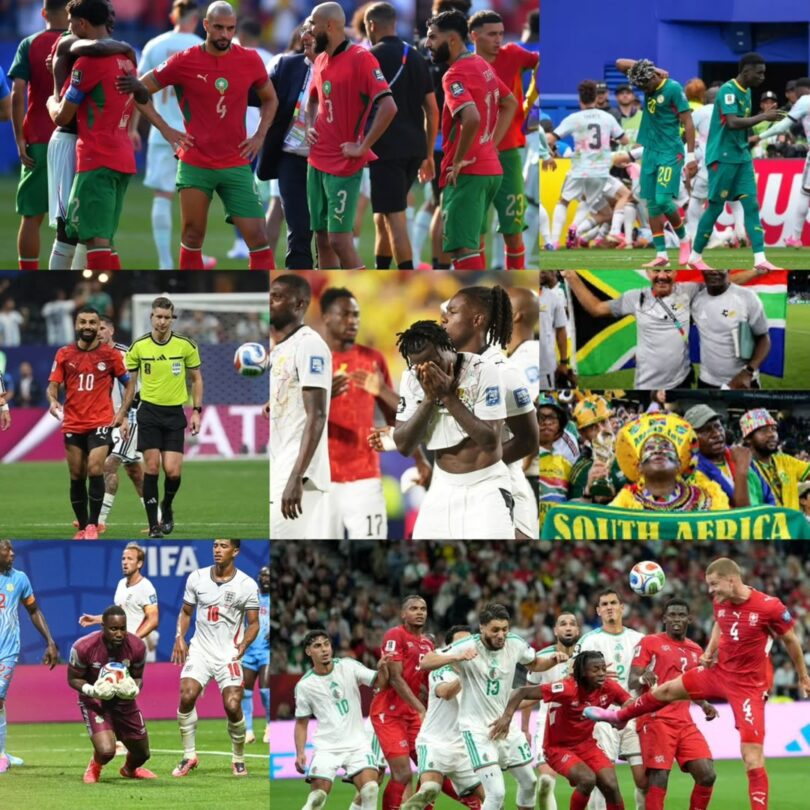
The conclusion of the 2026 FIFA World Cup has left African football with mixed emotions. While the continent once again demonstrated its ability to compete with some of the world’s best teams, none of its representatives reached the semi-finals, extending Africa’s wait for a first FIFA World Cup title.
Nine African countries qualified for the expanded tournament—Morocco, Senegal, Egypt, Algeria, Ghana, South Africa, Ivory Coast, DR Congo and Cape Verde—but only Morocco advanced beyond the Round of 16, eventually losing to France in the quarter-finals.
For many football observers, Africa’s overall performance reflected both progress and persistent shortcomings.
Morocco once again carried the continent’s hopes. After becoming the first African nation to reach the World Cup semi-finals in Qatar in 2022, the Atlas Lions reinforced their status as one of Africa’s strongest sides. Their disciplined displays and quarter-final finish suggested that their success is the product of sustained investment rather than a one-off achievement.
The rest of Africa, however, struggled to build momentum.
Senegal entered the tournament as one of the continent’s strongest contenders but fell in the Round of 16. Egypt showed resilience before losing to Argentina in the knockout stage, while Ghana, Algeria, Ivory Coast, South Africa, DR Congo and Cape Verde were all eliminated before the latter stages.
Although several African teams matched their opponents for long periods, many struggled to convert promising performances into victories. Defensive lapses, missed chances and an inability to manage crucial moments proved costly throughout the tournament.
The competition also highlighted the growing tactical demands of modern football. The teams that advanced deep into the tournament displayed tactical flexibility, discipline and consistency, while several African sides continued to rely heavily on individual brilliance and counter-attacking football.
Another recurring challenge was squad depth. Injuries and fatigue exposed the lack of quality replacements in several African teams, while the tournament’s leading nations were able to rotate players without significantly weakening their squads.
The campaign also raised questions about football development across the continent. While Africa continues to produce world-class players starring in Europe’s top leagues, many national teams still contend with inconsistent coaching, inadequate preparation and underdeveloped domestic football structures.
Nevertheless, there were positives. The qualification of nine African nations reflected the continent’s growing competitiveness, while Morocco’s continued progress demonstrated that African teams can compete with the world’s elite when supported by long-term planning, quality coaching and stable football administration.
Read Also:Ronaldo’s World Cup journey ends as Spain defeat Portugal 1-0 to reach quarterfinals
Speaking with SolaceBase, sports analyst Abdulkarim Tsoho said the gap between Africa and the world’s leading football nations is no longer about talent but about planning, structure and sustained investment.
According to him, Spain’s World Cup triumph was built on years of deliberate investment in youth football, coaching education, sports science and tactical development.
“Spain’s victory is a reminder that winning the World Cup is a long-term project. It requires strong football institutions, a clear football philosophy and continuous investment from the grassroots to the senior national team,” Tsoho said.
He argued that many African countries still rely heavily on individual brilliance, whereas successful football nations build their success around well-established systems.
Tsoho pointed to Morocco as evidence that African countries can compete at the highest level when the right structures are in place.
“Morocco has shown that success is possible. Their achievements should encourage other African countries to rethink how they develop football instead of focusing only on results during major tournaments,” he added.
Read Also:D’Tigers defeat Tunisia 84-81 in World Cup qualifiers
The analyst also identified weak domestic leagues as a major concern, arguing that stronger local competitions are essential for producing quality players, coaches and referees.
He further cited poor football governance, frequent coaching changes and inadequate investment in grassroots football as major obstacles to the continent’s progress.
As Spain celebrate their World Cup triumph, Africa’s campaign offers both encouragement and a reminder of the work still ahead. The talent is undeniable, but translating that potential into sustained success will require stronger football institutions, greater investment in youth development, improved domestic leagues and better tactical preparation.
The 2026 FIFA World Cup may not have delivered the breakthrough Africa had hoped for, but it has provided valuable lessons that could shape the continent’s future on football’s biggest stage.