
Advertisement
Advertisement
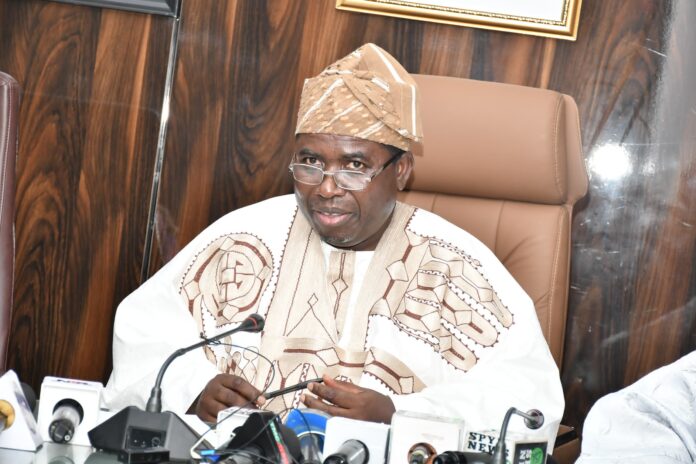
Chairman of Independent National Electoral Commission, INEC, Prof. Joash Amupitan, has warned that the growing Artificial Intelligence-driven disinformation poses major threat to the credibility of 2027 general election.
This is contained in a statement issued by the INEC Director of Voter Education and Publicity Victoria Eta-Messi.
Mrs Eta-Messi quoted Anupitan as giving the warning in a keynote address delivered at the 13th Annual International Conference of the Association of Communication Scholars and Professionals of Nigeria, ACSPN, in Abuja on Wednesday.
Mr Amupitan was was represented by a National Commissioner, Sani Adam, at the occasion.
NAN also reports that the conference had as its theme: “Media, Technology and Elections in Africa: Navigating Digital Disruption and the New Dynamics of Electoral Communication.”
Mr Amupitan said that generative AI had made it increasingly cheap and difficult to detect manipulated video, audio and imagery.
He citied documented cases of doctored political contents during recent electoral cycles in West and East Africa, including footage that circulated around Nigeria’s 2023 presidential contest.
He said that such contents could spread to millions of social media users before verification was possible, cautioning that the danger was not only about outright fabrication but also about algorithmic micro-targetting.
This according to him allows conflicting messages to reach narrow segments of the electorate without a shared factual foundation.
Mr Amupitan said that INEC’s credibility now rests as much on how information about its processes was understood and trusted, especially on the integrity of the ballot, the Bimodal Voter Accreditation System, BVAS, and result sheets.
He noted that the deployment of BVAS and the INEC Result Viewing Portal, IReV, was designed to close a long-standing credibility gap in the nation’s elections, giving citizens the ability to view polling unit results before they could be altered en route to collation.
The INEC chairman acknowledged that the 2023 general elections showed that such technology could become a source of public doubt when it underperformed.
He added that the legitimacy would be earned only when systems performed reliably, were well understood and explained honestly when they fell short.
Mr Amupitan disclosed that INEC was undertaking a comprehensive audit of its electoral technology systems, covering system redundancy, penetration testing and disaster recovery planning,
He said that the commission was also exploring the conduct of a mock presidential election ahead of 2027 to test accreditation, transmission and results viewing under conditions similar to election day.
On the commission’s preparations for 2027, Amupitan confirmed that INEC had proposed a substantial budget with significant allocations for technology and election operations, including new accreditation devices to replace those lost or damaged in the last cycle.
He said that while full release of the funds was still being awaited, the commission’s ICT team had already engaged manufacturers on procurement, with planning for the technology audit and mock election proceeding alongside budget finalisation.
Mr Amupitan, however, cautioned that solutions adopted elsewhere must be adapted to Nigeria’s own realities of internet access, language diversity and institutional trust.
He stressed that INEC’s response to disinformation would be to provide better and faster information than to restrict legitimate journalism or civic dissent.
The INEC chairman reaffirmed the commission’s commitment to strengthening its technology and transparency as Nigeria approaches the 2027 general elections.
NAN