The political realignment involving former Labour Party presidential candidate, Peter Obi, and former Kano State governor, Rabiu Musa Kwankwaso, has continued to generate debate across Northern Nigeria, as questions grow over how voters in the region will respond to their reported movement into the Nigeria Democratic Congress (NDC).
While the development is being described by party leaders as a step toward building a united opposition platform, reactions in the North remain uncertain, with analysts and residents divided on whether the alliance will strengthen or weaken its appeal in the region.
Recall that on Sunday, both Peter Obi, and Kwankwaso, formally joined the NDC in Abuja.
At the party’s national secretariat, NDC national chairman, Cleopas Moses Zuwoghe, presented membership cards to both politicians as they officially aligned with the opposition platform.
Speaking at the event, Kwankwaso said their decision followed wide consultations with NDC stakeholders, noting that they discovered strong ideological alignment.
“We came to discuss with the NDC stakeholders about the party and its ideology, and we realised that our beliefs are similar,” he said.
On his part, Obi said the party was focused on rebuilding Nigeria and restoring confidence in governance.
“This party would form a government that will rebuild Nigeria and ensure Nigerians live without fear,” Obi said.
He also urged party members to avoid internal disputes and litigation, stressing unity within the new platform.
“Let there be no litigation. Party members, please don’t go to court. We are not lawyers. We don’t want to spend our time on litigation,” he added.
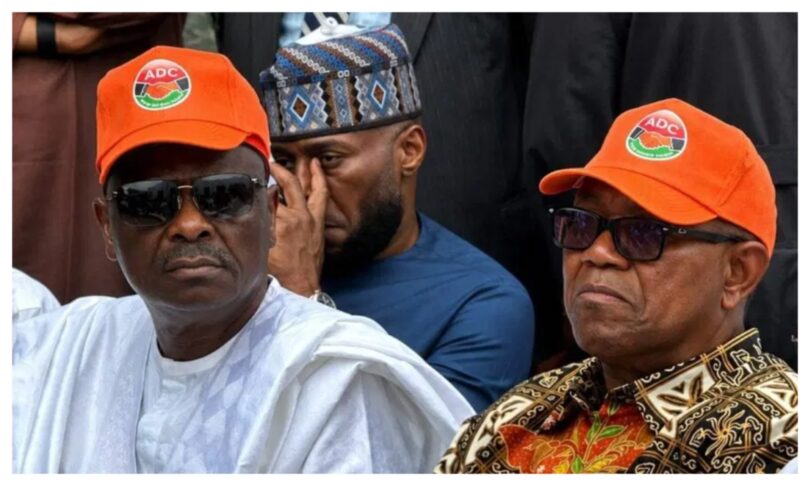
Also recall that both political leaders defected from the ADC, citing internal crises as their reason for leaving the party and joining the NDC.
We need safer platform – Kwankwasiyya
The Kwankwasiyya movement has said NDC is considered a safer political platform ahead of the 2027 general elections, citing internal crises and legal battles within the African Democratic Congress (ADC).
Speaking in an exclusive interview with DAILY POST on Sunday, the movement’s spokesperson, Habeeb Saleh Mohammed, said the decision was necessary to avoid political and legal uncertainties that could affect their chances in the next election.
“Well, I think first to be clear is that, like I told you, there are pending issues in ADC,” he said.
“And remember, we left our political party, NNPP, simply because of that external pressure and the internal issues we have or rather, an induced internal issue.”
Mohammed explained that the same problems that affected their former party (NNPP) are now troubling the ADC, making it difficult for the party to function effectively.
“This is a party that has multiple court cases. Even when there was an opportunity to clear all the issues at once, the case was referred back to the lower court, and it may still go to the Appeal Court and even the Supreme Court.”
According to him, the timeframe before the elections makes it risky to remain in a party entangled in legal disputes.
“Looking at the timeframe, I don’t think ADC will effectively be able to manage that particular case,” he added.
He further revealed that the ADC is also facing other legal threats, including a case seeking its deregistration.
“Outside this one, we have another case where the party itself is being asked to be deleted by INEC. We also have another case questioning the legitimacy of the leadership.”
Because of these uncertainties, Mohammed said, the movement is searching for a more stable political platform.
“For anybody who wants to offer Nigerians an opportunity to have a platform and an alternative political party, there is a need to look for a safer platform, one that does not have internal crisis or legal issues,” he said.
On the possibility of alliances, Mohammed suggested that a joint ticket involving Peter Obi and Rabiu Musa Kwankwaso could promote national unity.
“The best ticket you can have is to have Peter Obi and Kwankwaso on the same ticket. It will promote fairness and national unity.”
He added that such an arrangement may not face strong opposition in the North.
“I believe northerners are wise enough to take a rational decision. It is not just about where someone comes from, but about competence,” he said.
Mohammed also stressed that members of the Kwankwasiyya movement remain loyal to their leader and will support any decision he makes.
“Kwankwasiyya members believe in the ability, capacity, and judgment of our national leader. We are always at home with whatever he decides.”
He pointed to Kwankwaso’s past political influence as proof of his leadership.
“We have seen what he did with NNPP when nobody knew about the party. He made it strong, especially in Kano and other states like Bauchi and Taraba,” he said.
He concluded that the movement is focused on choosing a platform that is least likely to face disruption ahead of the elections.
“We are looking for a platform that does not have problems now. If anything comes up later, we will deal with it at that time.”
He also added that the NDC is still in its early stage of formation, arguing that it does not yet have a fully established leadership structure.
“Take NDC for example, it is a brand new party. We do not have even the complete leadership structure; the leadership structure is just evolving now. For somebody to even come and say he has a claim, we are going to be part of maybe the process building that structure,” he said.
APC may be overwhelmed, time not on their side – Kwankwasiyya
Mohammed, while responding to concerns that the APC could also destabilise emerging parties like the NDC, said the situation on ground suggests otherwise.
“Well, like I said, we believe the federal government has made it a duty to ensure that no political party survives,” he said.
However, he added that the current political timeline may limit such interference.
“But presently, I think we have to work with what we have. Is the time really not against them now?”
According to him, with only a few days to meet key electoral requirements, including submission of party membership lists, the ruling party would likely be preoccupied.
“When you have just less than three or four days to submit the list of registered members, and also do not have enough time to continue to intimidate or create discord in a party, especially when elections are around the corner,” he said.
Mohammed argued that the APC would also be dealing with its own internal political processes, which could further reduce its focus on opposition parties.
“I think they are going to be overwhelmed also with their own internal activities now that they are trying to sort out members that will emerge as their flag bearers,” he said.
They are pushing their luck too far, one bloc may strike deal with APC – Mahdi Shehu
A public affairs commentator, Mahdi Shehu, has criticised the recent political moves by Peter Obi and Rabiu Musa Kwankwaso, warning that their defection to the NDC may not translate into electoral success against the APC.
Speaking in an exclusive interview with DAILY POST, Shehu said the frequent movement of the two opposition figures across political platforms suggests they may be overestimating their political strength.
“Obi and Kwankwaso’s monthly pilgrimage and migration from one unregistered club, up to another association in turmoil, then to another non-existing platform seems to be overrating their popularity,” he said.
He argued that the political realities that shaped the 2023 elections have changed, warning that relying on past performance could be misleading.
“The votes distribution and sentiments of 2023 have been altered by changing dynamics. They seem to be pushing their luck too far,” he added.
According to Shehu, the ongoing realignments may be more about gaining political relevance and bargaining power than building a strong, united opposition capable of winning elections.
“They are looking for a bargaining power where their hope is for other opposition blocs to reach out to them,” he said.
He cautioned that such a strategy could backfire if other opposition groups decide to align with the ruling party instead.
“If care is not taken, one of the groups can easily reach out to APC, negotiate a power-sharing formula and reduce Obi and Kwankwaso into political and democratic lepers,” he warned.
Shehu stressed that the only realistic path to defeating the APC in 2027 is unity among opposition leaders, noting that division would weaken their chances.
“Harmony in-between the strong opposition leaders is the only winning formula. Anything short of that is called a political gamble,” he said.
Using local expressions to describe the risk, he added: “Casino, kalo-kalo, modi and cha-cha.”
Mixed reactions in North over Obi, Kwankwaso joint NDC ticket
DAILY POST gathered some mixed reactions from residents in exclusive interviews. While some believe the defection of Kwankwaso and Obi is a positive move that could challenge the APC, others hold a different view.
No matter the platform, I’ll follow him – Kwankwaso supporter
A Kano resident, Lukman Shuaibu, has expressed support for former Kano State governor, Rabiu Musa Kwankwaso, saying his style of politics continues to favour ordinary people at the grassroots.
Shuaibu said he would remain loyal to the political leader regardless of which party and who he chooses to run with.
He described his approach as one that carries everyone along.
I will continue to follow him wherever he goes from NNPP to ADC and now NDC. He has the interest of the people, especially those at the grassroots, at heart,” he said.
Also, Naziru Dalhatu, a Kano resident said that a possible joint presidential ticket between Peter Obi and Rabiu Musa Kwankwaso would not be about regional interests, but about the unity of Nigeria as a whole.
He explained that the idea of the so-called “OK ticket” would represent all parts of the country and not just the North.
He said, “The Obi and Kwankwaso ticket is not about bringing the North alone. It is about representing every part of the country.”
Dalhatu argued that given the current economic and political situation in Nigeria, almost any strong and credible political alliance could defeat the ruling government.
He said, “In the present condition of the country, even a ticket made up of people who are not as strong as Obi and Kwankwaso could still defeat the current government because of its failure in many sectors.”
He added that Nigerians are currently more concerned about change than political differences.
He said, “Nigerians are going through very difficult times. Everything has become worse, and people are only interested in removing the current government.”
Dalhatu expressed confidence that a joint ticket of Obi and Kwankwaso would lead to the formation of a new government.
“I strongly believe that the combination of Obi and Kwankwaso as candidates is the ticket that will defeat the current government and bring a new government in Nigeria.”
He also claimed that the NDC, is rapidly gaining popularity across the country.
He said, “I read in a report that in less than three days, over ten million people registered in the NDC.
“At the moment, there is no political party as popular as the NDC, where people are rushing to join.”
Dalhatu further claimed that even politicians and lawmakers may soon begin to join the party in large numbers.
“In the coming days, you will be surprised to see senators and members of the House of Representatives joining this party.
“I am confident that the Obi and Kwankwaso ticket will defeat the current government and bring positive change and development to Nigeria
However, a northern youth in Jigawa, Muhammad Rabiu Musa, questioned the credibility of the emerging alliance between Peter Obi and Rabiu Musa Kwankwaso.
According to him, he does not see them as a convincing alternative to the current administration.
Speaking while reacting to their defection to the NDC, Musa said many young people are asking what the alliance would do differently if elected.
“I think the very question ringing in most young minds is what will Obi and Kwankwaso alliance do differently from the incumbent if elected into office?” he said.
According to him, the alliance has not clearly shown how it plans to address Nigeria’s governance challenges.
“Because they don’t have a clear blueprint and implementation strategy that will ensure a total overhaul of the current tide of poor governance in the country,” he added.
Musa further alleged that the political move appears to be driven more by personal ambition than public interest.
“It’s crystal clear that they’re after serving their interest rather than that of the poor,” he said.
He also raised concerns about the role of identity politics, especially in northern Nigeria, warning that religious and ethnic sentiments could affect their chances.
“In addition, the religious and ethnic lines being preached among the younger and, of course, the aged, particularly in the core northern states, will make it difficult to sell a ticket that may likely bring an Igbo presidency,” he said.