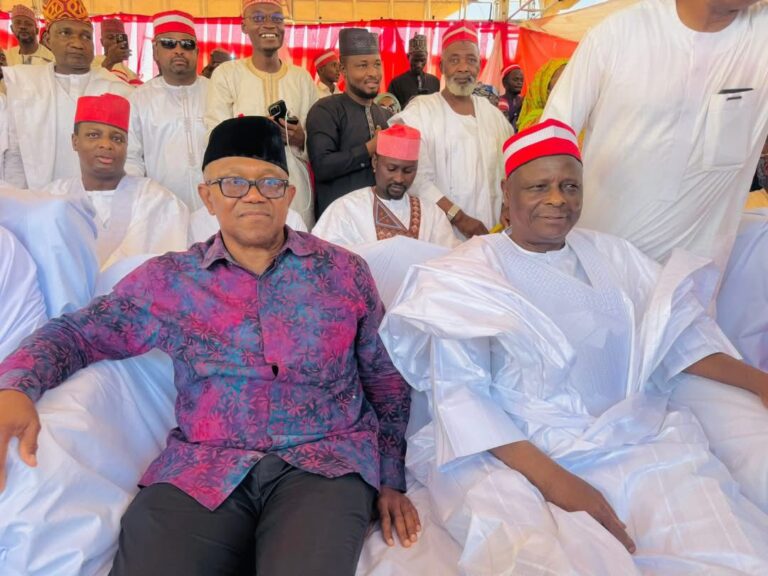
(Peter Obi and Rabiu Kwankwaso. Photo Credit: Punch news)
In anticipation of the 2027 general elections, supporters of former Anambra State Governor Peter Obi and former Kano State Governor Rabiu Musa Kwankwaso have urged the opposition to support a Southern presidential candidate, escalating discussions about coalition building.
On the question of whether the presidential ticket should be zoned to the North or the South, opposition parties such as the African Democratic Congress, the New Nigeria People’s Party, and the Social Democratic Party disagreed.
Bolaji Abdullahi, the ADC’s National Publicity Secretary, stated that the party was more focused on the candidates’ electoral viability than zoning.
Following a high-profile political event in Ibadan where opposition officials from various platforms allegedly considered the prospect of drafting a southern consensus candidate, there is a movement for a united front to challenge the ruling All Progressives Congress in 2027.
The meeting, attended by prominent political figures, including former Vice President Atiku Abubakar, Obi, Kwankwaso and former Rivers State Governor Rotimi Amaechi, among others, resolved to work toward presenting a single presidential candidate against President Bola Tinubu.
Since then, the decision has generated discussion in political circles. Growing demands for opposition unity have been met with arguments from the ruling party that such actions might be premature due to internal differences between the opposition groups.
In an interview with The PUNCH on Tuesday, Justin Ijeh, the National Publicity Secretary of the Obi-Kwankwaso Movement, and Dr. Yunusa Tanko, the National Coordinator of the Obidient Movement Worldwide, emphasized the importance of respecting Nigeria’s informal zoning arrangement for the sake of justice and national balance.
Given that the existing presidency is already zoned to the South, Tanko stated that the call for a Southern presidential ticket is based on equity and continuity.
Obi had agreed with this stance, he continued, by expressing a desire to serve just one four-year term.
“Yes, we are concerned about the zoning,” he stated. In light of the fact that the presidency has been allocated to the south, we have been requesting that the ADC zone the presidency to the southern region of our nation.
“We currently have a southern presidency as you speak. Therefore, having a president from the South merely implies that, in order for the current president to serve out their term, the successor must be from the South.
“I believe that is the only fair thing to do. For this reason, Mr. Peter Obi has likewise committed to serving a four-year term.
Tanko went on to say that he was sure Obi would show there as the consensus candidate if the opposition settles for a unified ticket, citing widespread public support, particularly among young Nigerians.
“That is because he’s the most popular candidate in the country at the moment. I’m being humble about it, and I thank God for it. He’s the most popular, especially among the youth. Anywhere he goes, he is adored.
“Let me give you an example. The other day, we traveled through both local and international airports on our route to Ibadan. You must witness the kind of love and joy that people bestowed upon him. It was incredible.
Nigerians were yelling “Obi, Obi, Obi” throughout the entire hall. For him and several of us who follow him, it was quite emotional. He said, “That’s to tell you the kind of love and support Nigerians are ready to give this man.”
Ijeh echoed this sentiment, saying that although zoning is not required by the constitution, it is nonetheless a useful tool for guaranteeing inclusion in Nigeria’s diverse political environment.
The Obi-Kwankwaso Movement spokesman emphasized that it is morally correct to let only one presidential candidate come from the South.
“Zoning is a practical approach to balanced representation and equity in a multipolar society like Nigeria, even though it is not embedded in the Nigerian constitution and competence and character are the ideal standards for leadership,” he stated.
Since democratic rule was reinstated, it has been a custom. However, when it does not align with their personal goals and interests, some politicians may decide to play to the gallery about it.
Given Nigeria’s recent political trajectory, it only makes reasonable to apply the zoning concept in the current calculation and for the presidency to remain in the South, in keeping with that convention.
“Anything else sets the country up for divisive complications in the near-term future, and nobody needs that.”
The ADC spokesperson, Abdullahi, stated that the party would prefer to put electoral viability first when discussing the demand that the presidential ticket be zoned to the South.
“ADC never declared its stance on zoning.” The existing alliance is viable because of this. “We’ll find the best candidate and help them win the election,” he declared.
According to Abdullahi’s stance, the ADC might support an open competition where regional power-sharing concerns are subordinated to political might, popularity, and strategic gain.
The NNPP, on the other hand, maintained that zoning was still a crucial political consideration in any agreement.
Opposition leaders must strike a balance between wider political sensitivities and national acceptability, according to Ladipo Johnson, the NNPP National Publicity Secretary.
“We can maintain zoning even if we have a joint candidate. Having a candidate who is acceptable to Nigerians in both the north and south is crucial.
“If we decide to collaborate, then certain factors must be taken into account. The challenge we face at this crucial moment is defeating Tinubu,” he stated.
He continued by saying that talks are still in their early stages and that coalition partners are still being consulted.
For now, it’s only a proposal. Although nothing is confirmed yet, I’m confident that discussions on this matter will go on.
“The party can still support zoning if a consensus candidate is chosen, provided that it promotes national unity. Zoning principles are not always superseded by the consensus arrangement, he continued.
In a similar vein, the Social Democratic Party agreed that zoning was still a valid political and constitutional factor, even though more comprehensive strategic calculations would ultimately determine the outcome.
“Zoning is about the collective decisions of political parties and is constitutional,” stated Shehu Gabam, the SDP’s national chairman. After that, national political interests take precedence. The choice to zone or not to zone is solely made by a political party.
Gabam declined to make a commitment when asked if the SDP will formally join the coalition supporting a single opposition candidate. He declared, “It’s too early to tell.”
Many believe that the opposition’s current quest for unity is a reaction to the lessons learned from the 2023 presidential contest, in which a number of opposition candidates split anti-APC support along party and regional lines.
Conflicts over zoning, party structure, candidate selection, and ideological differences continue to be big obstacles, according to analysts, even if a consensus candidate might drastically alter the 2027 fight.