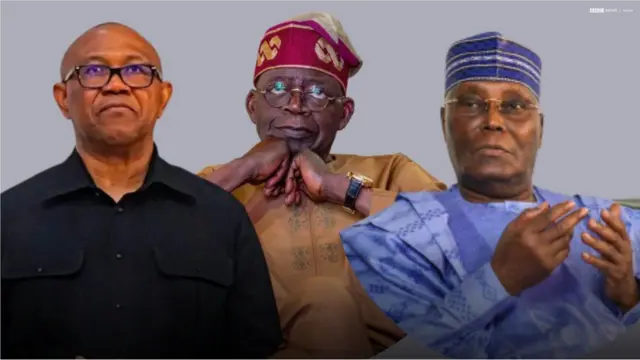
With party primaries concluded, the 2027 presidential race is taking shape as a contest dominated by familiar faces and familiar political battles. OLUFEMI ADEDIRAN writes
With party primaries concluded and campaigns set to begin in August, the contours of the 2027 presidential election are gradually becoming clearer.
While 11 candidates are expected on the ballot, political analysts believe the contest is already narrowing into a three-way race involving President Bola Tinubu of the All Progressives Congress, former Vice President Atiku Abubakar of the African Democratic Congress and former Anambra State Governor, Peter Obi of the Nigeria Democratic Congress.
Other candidates include Oyo State Governor, Seyi Makinde, contesting on the platform of the Allied Peoples Movement; Human Rights Activist, Omoyele Sowore (African Action Congress); former Governor of Cross River State, Donald Duke (People’s Redemption Party); Aliyu Bin Abbas (Action Democratic Party); and Adekunle Omoaje (Action Alliance).
While the Kabiru Turaki-led faction of Peoples Democratic Party picked former President Goodluck Jonathan as its candidate, the Abdulrahman Mohammed faction named an ex-senator, Prof Sandy Onor, as its consensus presidential candidate.
Tinubu’s incumbency advantage
Emerging the candidate of the ruling APC with 10.99 million votes, Tinubu is making a statement ahead of the 2027 election. In 2023, Tinubu defeated 17 other candidates, scoring 8,794,726 votes.
As the sitting president, Tinubu enters the race with the advantage of incumbency, a factor that has historically played a major role in presidential elections. Beyond the authority of office, he benefits from access to the Federal Government’s political and administrative machinery, resources that can shape mobilisation, outreach and visibility during campaigns.
The ruling party, with Tinubu’s backing, has won over 10 sitting governors from opposition parties, a development analysts say reflects a steady consolidation of political power ahead of 2027. Political observers note that such movements often reshape local party structures, influence grassroots mobilisation and tilt state-level machinery in favour of the ruling party.
However, some analysts caution that defections do not automatically translate into voter loyalty at the polls.
Atiku makes sixth attempt at presidency
Seventy-nine-year-old Atiku is making his sixth and perhaps final attempt at Nigeria’s presidency. His return once again places him at the centre of opposition politics, reinforcing his status as one of the country’s most persistent political figures.
Atiku, who served as vice president to former President Olusegun Obasanjo in 1999 and 2003, contested under the platform of the defunct Action Congress in 2007, sought the PDP presidential ticket in 2011, contested the APC primary in 2015, and flew the PDP flag in the 2019 and 2023 elections. He was defeated by Tinubu in 2023 after polling 6,984,520 votes to finish second. The protracted crisis within the PDP later forced him out of the party, leading him to ADC.
His supporters argue that his experience, national reach and deep-rooted connections make him one of the few candidates capable of mounting a serious challenge to the incumbent. His influence remains particularly strong in parts of the North-East and North-West.
However, critics say his repeated presidential bids may have created voter fatigue, particularly among younger Nigerians calling for generational transition in leadership.
Peter Obi seeks second breakthrough
The former Anambra State governor is one of the few politicians who have altered the country’s electoral landscape in recent years. His 2023 presidential campaign transformed him into a national political figure. He won 12 states, including the Federal Capital Territory, with 6,101,533 votes in his first presidential attempt.
Obi is hoping for a stronger performance in 2027 with the adoption of former Kano State Governor, Rabiu Kwankwaso, as his running mate. Analysts say the pairing could strengthen Obi’s appeal across the South and key northern blocs, particularly given Kwankwaso’s influence in Kano and parts of the North-West.
Jonathan’s potential comeback
The possibility of former president Jonathan returning to the ballot has generated considerable interest. Though he has yet to confirm or deny interest in contesting, his status as a former president gives him instant national visibility.
Jonathan continues to enjoy goodwill among many Nigerians who remember his administration as relatively stable compared to successive governments. However, political observers advised him against contesting, warning that the political terrain has changed significantly since he left office in 2015.
Candidates’ geopolitical standings
Like previous elections, geopolitical calculations are becoming central to campaign strategies, with candidates weighing regional loyalties, historical voting patterns and power-sharing expectations.
In 2023, Tinubu won three geopolitical zones — North-West, North-Central and South-West — while Obi won the South-South and South-East, and Atiku won the North-East.
Tinubu placed first or second in all six geopolitical zones, while Atiku and Obi each finished third or lower in three zones. Tinubu retains a strong base in the South-West, where his political influence remains entrenched. The region is expected to remain a reliable support bloc for the APC, bolstered by control of key state structures and longstanding alliances.
The ruling party is also banking on consolidating gains in parts of the North, where recent defections and coalition-building efforts have strengthened its presence.
Meanwhile, Atiku continues to command significant influence in the North-East and sections of the North-West. However, his challenge lies in expanding acceptance in the South, where observers say the zoning arrangement does not favour him.
Obi maintains a dominant presence in the South-East and parts of the South-South, as well as urban centres where his 2023 performance reshaped voting patterns. His support base remains particularly strong among young voters and professionals, although analysts say his path to victory depends on making deeper inroads into northern Nigeria.
Factors that may shape election
As political parties prepare for full-scale campaigns in August, analysts argue that several factors will shape the presidential election scheduled for Saturday, January 16, 2027.
Chief among these is the state of the economy. Rising poverty index, inflation, unemployment and increasing cost of living are expected to remain central issues in voter decision-making, particularly among urban households and young voters.
Closely tied to this is the performance of the incumbent administration. Tinubu’s ability to convince Nigerians that ongoing policy adjustments are delivering long-term benefits will likely play a major role in determining whether he secures re-election.
Analysts also point to opposition fragmentation as a critical factor. With multiple factions within major parties and competing presidential candidates across different platforms, the opposition appears divided, raising concerns about vote splitting that could favour the ruling party.
The Director-General of Strategic Planning and Implementation of Ohanaeze Ndigbo, Tony Obizoba, said the 2027 contest is shaping up as a repeat of the 2023 election, driven largely by opposition fragmentation.
He argued that the inability of opposition figures to sustain a united coalition has strengthened the position of the APC, particularly as competing factions continue to emerge across major parties.
Obizoba maintained that the ruling party currently holds a strategic advantage due to incumbency, access to resources and expanding alliances across key regions.
According to him, unless the opposition resolves its internal disagreements and builds a coherent alliance, the 2027 election may once again favour the incumbent.
“It is a smooth sail for the current government with the way things are going. It’s a smooth sail. I don’t think there is anything to be stressed about because they (opposition candidates) will end up dividing the votes, and the incumbent will also have his way because he has the resources to muzzle some of the battleground states,” he said.
Giving insights into the forthcoming election, a Professor of Comparative Politics at the University of Ilorin, Emmanuel Ojo, said although Tinubu remained a major political force, his political credentials had suffered due to his administration’s perceived inability to decisively address insecurity and worsening economic hardship.
He argued that rising inflation, unemployment and persistent security threats had continued to shape public perception of the administration.
“After being there for more than three years, it is unfortunate that his (Tinubu) democratic credential has suffered. The way APC administered the primaries, if a ruling party cannot manage internal crises and organize primaries, then what do we expect of INEC in the general election,” Ojo said.
On the major contenders, he questioned Atiku’s renewed ambition, citing age and repeated attempts at the presidency as potential disadvantages.
He also expressed skepticism about Obi’s political trajectory, describing his movement across platforms as political opportunism, while questioning the depth of his national policy proposals.
Turning to Jonathan, Ojo described him as a “gentleman politician” whose potential return would depend largely on legal clarity and personal willingness, although he advised against another presidential bid.
He argued that Nigeria is yet to produce an ideal candidate capable of addressing insecurity, corruption and economic instability.
On his part, political analyst Omenazu Jackson argued that the next election would largely be determined by Tinubu’s performance.
Jackson, who is the Chancellor of the International Society for Social Justice and Human Rights, stressed that the country’s next leadership must prioritise national dignity, economic stability and security restoration.
He warned that worsening insecurity and economic hardship were eroding citizens’ loyalty to the state and weakening national cohesion.
“If the issue of hunger and insecurity is not addressed in this country, I don’t see Tinubu coming back to power. Tinubu should use the remaining period left to address perennial hunger and insecurity. If these two issues are not addressed, I can tell you authoritatively, that there may be no Nigeria by next year.
“Anybody thinking that he can ride roughshod on Nigerians again, do all the abracadabra and go back to power, may be losing out completely because the strength of the commoners is the robe of the nobles,” Jackson said.
Offering a different perspective, the spokesperson for the 7th House of Representatives, Zakari Mohammed, argued that Tinubu may struggle to replicate his 2023 electoral performance, particularly in the North and parts of the South-West.
He contended that the political dynamics that delivered victory to Tinubu in 2023 had changed considerably, citing economic hardship, insecurity and the emergence of multiple southern presidential candidates as factors that could reshape voting patterns.
According to him, Tinubu benefited significantly from northern support in the last election but may find it difficult to secure a similar level of backing in 2027.
He argued that the North could become a major battleground between Atiku and Obi, with Atiku particularly well-positioned to benefit from his longstanding political networks and influence across the region.
Mohammed further predicted that the proliferation of presidential candidates from Southern Nigeria could fragment votes traditionally expected to favour the incumbent in the South-West.
“If you look at the northern part of Nigeria, 63 per cent of the votes that brought Tinubu to power came from Northern Nigeria. Will he get that number today? No.
“There is Sowore, Makinde, Donald Duke, Goodluck Jonathan, the president himself and others. You have not less than six or seven candidates from the South, while Atiku is virtually standing alone in the North,” he said.