
The Minister of Education, Dr Maruf Tunji Alausa, has said the Federal Government is deploying 41 University Innovation Pods (UniPods) to transform research and innovation in Nigerian universities into jobs, investment and measurable economic value….
The Minister of Education, Dr Maruf Tunji Alausa, has said the Federal Government is deploying 41 University Innovation Pods (UniPods) to transform research and innovation in Nigerian universities into jobs, investment and measurable economic value.
Alausa said the initiative was part of President Bola Ahmed Tinubu’s vision of using education, technology, research and innovation to move Nigeria from a resource-based economy to a knowledge-based economy and support the ambition of building a $1 trillion economy.
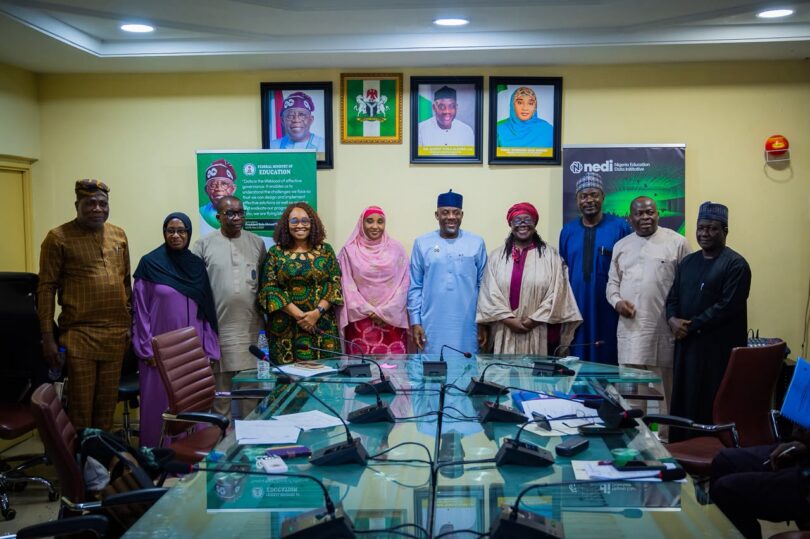
The minister spoke during a meeting with the United Nations Development Programme (UNDP) and seven vice-chancellors on the sustainability of the UNDP Innovation Hubs.
He said eight UniPods had either been commissioned or were ready for commissioning, with three already operational at the University of Lagos, Nasarawa State University and Michael Okpara University of Agriculture, Umudike.
Other specialised centres include the Blue Economy UniPod in Akwa Ibom, AgroTech at Benue State University, Resilience Tech in Borno State, GovTech at Ahmadu Bello University, Zaria, and Industrial Tech in Plateau State.
Alausa said the success of the initiative would not be measured by the buildings and equipment provided but by the solutions, businesses, jobs and economic value generated from them.
He said Nigeria must move beyond research conducted primarily for academic promotion and establish stronger pathways for taking discoveries from laboratories to the market.
The minister cited the MineTech UniPod at Nasarawa State University, where researchers have developed geospatial maps identifying deposits of lithium, gold and bauxite, including information on their locations and depths.
According to him, such discoveries could generate significant economic opportunities if researchers are connected with investors and given effective pathways to commercialisation.
He said government had reduced the initial risks by providing infrastructure, equipment and technical capacity, adding that private investment and commercialisation should now become a major focus.
Alausa said the Federal Ministry of Education, in partnership with UNDP and Tech4Dev, was working towards establishing about 41 UniPods across tertiary institutions over the coming years.
He stressed that the centres must not remain dependent on grants but develop sustainable revenue streams capable of supporting their operations, host universities and attracting talent.
The minister said the Ministry and UNDP were developing an appropriate governance framework for the UniPods, while eligible centres would be able to establish commercial accounts in line with existing government guidelines for university research centres.
He added that part of the revenue generated could be retained by the UniPods to sustain their operations, while another portion would support targeted technological development in their host universities.
The Minister of State for Education, Prof Suwaiba Sa’id Ahmad, said the UniPods should be positioned as instruments for accelerating Nigeria’s industrialisation rather than being viewed solely as academic facilities.
She urged universities to expose students and researchers to industrialisation and commercialisation, enabling innovative ideas to develop into products, services and businesses.
Ahmad also said the benefits of the UniPods should extend beyond host institutions, with students and researchers from other universities able to access the facilities under appropriate arrangements.
The UNDP Resident Representative in Nigeria, Elsie Attafuah, commended the Education Ministry for positioning education as a driver of jobs, competitiveness and innovation.
Attafuah said the changing global development environment required countries to generate their own wealth and competitiveness, describing the UniPods as potential drivers of Nigeria’s reform agenda and job creation.
She said UNDP was ready to facilitate South-South cooperation, including possible engagement with India, while supporting the emerging network of UniPods and strengthening their governance, financing and sustainability.
Alausa assured that the Federal Ministry of Education would continue working with UNDP, Tech4Dev, universities and other partners to establish sustainable centres of innovation, enterprise and economic opportunity.


He said the ultimate objective was to ensure that investments in education and technology translate into practical research, viable businesses, jobs and highly skilled young Nigerians capable of driving Nigeria’s transition to a knowledge-based economy.