
The market for high-end cellphones has shifted dramatically. While Apple has traditionally enjoyed a strong position, Android manufacturers have deliberately changed the rules.
With their massive image sensors, lightning-fast charging rates, and massive battery capacities, higher-end Android smartphones are pushing the boundaries of mobile electronics, making the current iPhone range appear a touch cautious.
Though many speculations about the forthcoming iPhone 18
imply that the phone would receive a basic hardware update, this may not be enough to compete due to major increases in raw specifications.Apple must deliver significant improvements that directly address the disparities between iOS and Android hardware. This is critical for the organization to maintain its market dominance and attract spec-conscious customers.
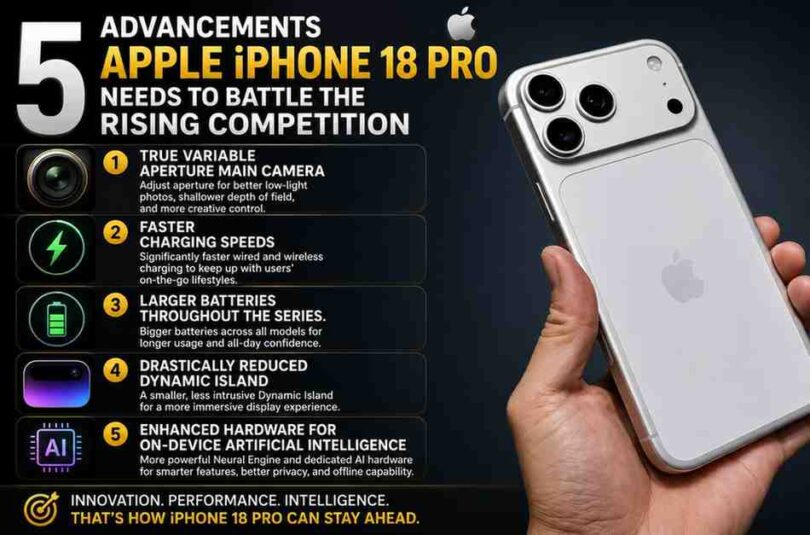
Apple iPhone 18 requires these changes to combat increased competition.
The following upgrades are the most important advancements that the iPhone 18 must make to deal with the fierce competition from competitor flagship devices:
1. True variable aperture main camera
While Apple iPhone 18 Pro image processing and video skills continue to lead the market, the physical technology behind the glass is under intense scrutiny.
Over the last few cycles, Android phones have included huge 1-inch sensors with a variety of physical apertures.
This allows them to mechanically control the amount of light that enters the lens. This, in turn, results in improved exposure control in difficult lighting settings and a natural background blur.
To reclaim the lead in mobile photography, the iPhone 18 urgently requires a variable-aperture primary camera. By adding this, it would be possible to manually switch between broad and narrow apertures.
This will assist overcome the problems (subject-losing focus, feathering effect, etc.) caused by software-driven portrait settings and reduce digital noise while taking images in low light.
2. Faster charging speeds
One of the most common concerns of long-time iOS users has been the incredibly poor top-up speeds in comparison to what Android smartphones provide.
Apple lags far behind competitors, who regularly need more than 80W, if not 100W, to fully charge a phone in less than 40 minutes.
The corporation needs upgrade its thermal design and charging architecture to allow significantly higher rates. This would make the iPhone 18 more suitable for power users than prior generations of Apple phones.
When comparable devices can acquire a 70% charge in almost no time, waiting more than an hour and a half for a full charge is a tough sell.
3. Larger batteries throughout the series.
The physical capacity of batteries has emerged as an important battleground for smartphones. Silicon-carbon batteries that can easily exceed 5,500mAh or even 6,000mAh without increasing chassis thickness are becoming prevalent in Android handsets.
Apple, on the other hand, has traditionally relied on software efficiency to get all-day endurance out of smaller physical cells.
According to early supply chain leaks, expanding the iPhone 18 Pro Max to 8.8 mm could modestly enhance its battery life to between 5,100 and 5,200 mAh.
If the firm can include this battery in the base model, it will provide unrivaled multi-day battery life by combining increased capacity. This will also be achievable due to the efficiency advantages of the rumored 2nm A20 CPU.
4. Drastically reduced Dynamic Island
When Face ID originally came out, the Dynamic Island was an innovative approach for concealing the physical cutouts required for the technology. Nonetheless, the pill-shaped cutout occupies a large amount of screen area.
This is most noticeable while watching widescreen videos or playing games. This isn’t ideal, given that Apple’s Android competitors have perfected small, inconspicuous hole-punch designs.
The iPhone 18 must shrink the island’s size. To restore screen real estate and upgrade the iPhone’s front face, the cutout must be decreased.
However, due to production challenges, properly integrating the TrueDepth camera technology behind the display may take several years.
5. Enhanced hardware for on-device artificial intelligence
Generative artificial intelligence is no longer a far-fetched concept; it is now a standard feature on mobile devices. Smartphones require a significant amount of high-speed memory to execute complex local processing without always relying on cloud servers.
Many competing flagships now come with 16GB or even 24GB of RAM as standard, allowing their AI models to run seamlessly in the background.
The iPhone 18 requires a big memory bump to compete with its predecessor, the iPhone 17, which only has around 8 GB RAM. Furthermore, the memory offered by the forthcoming gadget would require improved interaction between the RAM and the silicon architecture.
Apple may consider increasing the standard RAM to 12GB for non-Pro variants. Furthermore, there are rumors that Apple may use a new packaging approach to physically relocate the RAM closer to the processor on the A20 chip.
For the iPhone 18 to remain competitive in an AI-driven market, enhanced Apple Intelligence is required. It will be critical to ensure that Apple Intelligence capabilities can run entirely on-device with no latency.