“We are a nation of poets from head to toe, and when it comes to expressing and understanding our troubles, our sorrows, our joys, our heroism through poetry, we truly are among the few nations in the world who do this well.”
“That’s why taking refuge in poetry, the thing that holds these lands and this consciousness together, has always felt safe to me,” Ergur adds.
Related
The sound of the streets
The most widely known of the marches was written by Hanefi Soztutan, a writer, editor and poet, who wrote the words three days after the coup attempt, at the hour of morning prayer, after performing wudu and then picking up pen and paper as the lines came, according to his own account.
He gave it to his friend Necmi Cicekci, an advertiser who had spent the night of the coup standing on top of a tank at Istanbul’s Ataturk Airport, unable to fully explain afterwards how he had gotten up there.
Cicekci set the words to music, and within weeks it had become the sound of every democracy vigil in the country, sung in schools, played over loudspeakers, and performed at Istanbul’s Yenikapi on August 7 at the Democracy and Martyrs Rally, where an estimated 5 million people gathered, the largest political gathering in Turkish history.
Its refrain, “ya ozgurluk bundan sonra, yahut da zillet” (“freedom from here on, or else disgrace”), became something close to a second national anthem for that summer.
That night, before any of it had been written down, poet Gokhan Ergur and his friends went straight out to the nearest location, Taksim Square, the moment the coup declaration was announced on television.
“When I look at the photos I’d shared on social media that night, I see friends of mine who had been shot by the coup plotters. For the first time in my life, I felt, standing there, that death had become unavoidable,” Ergur says.
“We tried to talk the coup-aligned soldiers into surrendering, we even managed to convince two or three of them and handed them over to the police. I will never forget the rage, and the betrayal in their eyes.”

Related
To keep the memory of July 15 alive
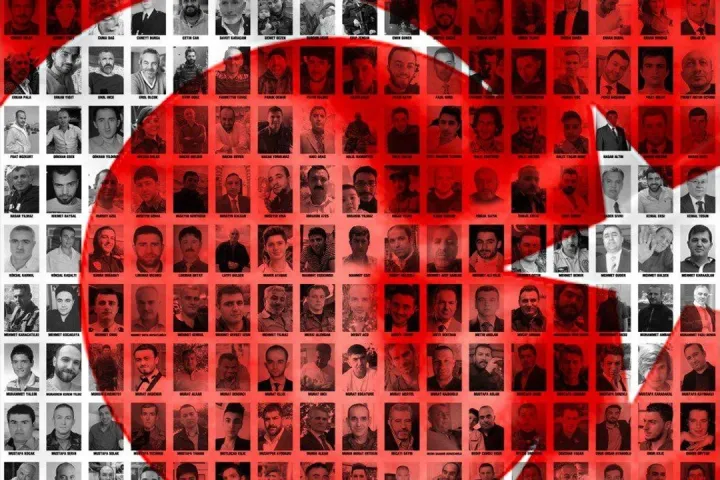
The instinct to name things after the martyrs runs through the whole map of the country now, nowhere more than where the fighting itself happened.
The then-Bogazici Bridge, where tanks blocked traffic and some of the worst violence of that night took place, was renamed the Bridge of the July 15 Martyrs.
Across Uskudar, the roads feeding into the Bridge, the very streets through which FETO-aligned tank crews moved, now carry the names of the people who died stopping them.
Elsewhere, streets and bus stops near a martyr’s home, or at the exact spot where they fell, have quietly taken on their names too, so that the geography itself remembers who died and roughly where, without needing a plaque to explain it.
The most deliberate attempt to hold all of this together opened three years after the coup attempt, when President Erdogan inaugurated the Hafiza 15 July centre in Istanbul.
It grew out of a museum workshop held in January 2017 by the Ministry of Culture and Tourism, the Istanbul Metropolitan Municipality and the July 15 Association, and was curated by architect Hilmi Senalp.
What makes it more than a single-night memorial is its scope: alongside July 15 itself, it guides visitors through the histories of coups, colonisation and foreign domination elsewhere in the world, placing that night within a much longer story of resisting outside control over one’s own homeland.
Books extended their role beyond the museum’s walls. After the coup attempt, over a hundred were published, including journalist accounts like Hande Firat’s -the anchor who held up her phone live on air so Erdogan could reach the nation through FaceTime-“24 Saat: 15 Temmuz’un Kamera Arkasi,“(“24 Hours: Behind the Scenes of July 15,”) and testimonies from survivors and martyr families, such as in “Demokrasi Kahramanlari” (“Heroes of Democracy”).
A growing collection of Destan-style (epic) novels and poetry also emerged to preserve the story.
Ten years in, all of this reads like an archive still being added to, a song here, a line of verse there, a street renamed this year that wasn’t last year.
And that, more than anything, is probably where the real memorialisation of July 15 will happen next, in what the next generation reads in a schoolbook, sees in a museum case, or hears in a song they didn’t know was written about a night they never lived through.
It will be the poems, the anthems, and the names on the street signs that carry the feeling and pass it on to those who weren’t there to feel it themselves.
“Very valuable books, exhibitions and productions have been made about July 15, and we should thank everyone behind each one. But it isn’t enough,” Ergur says.
“Whatever we do, we can never fully repay what those heroes are owed. Not only on anniversaries, but at every opportunity we must keep telling future generations about our nation’s precious martyrs, about the sela prayers that didn’t stop that night, and about the faith that made us walk toward the tanks,” Ergur adds.