SINGAPORE – What began as a student-led project at Finland’s Aalto University in 2012 to develop small satellites for high-quality Earth monitoring from space has now burgeoned into the world’s largest network of multiple orbiting radar satellites.
The students went on to form ICEYE in 2014 and launched the world’s first small synthetic aperture radar (SAR) satellite in 2018, breaking several barriers in space technology.
SAR is a radar imaging method that produces high-resolution images of the Earth’s surface even in total darkness and through thick clouds, rain and smoke.
Governments and space organisations typically use radar satellites for military and research purposes. Leveraging this capability gave ICEYE a competitive edge over traditional satellites, which use optical cameras and can capture images only in daylight.
Historically, SAR technology required bus-size, 1,000kg satellites that government space agencies such as NASA strictly controlled, took at least five years to manufacture and cost a few hundred million dollars each.
ICEYE’s alternative measures less than 80cm by 60cm by 50cm, takes a few months to build and costs less than US$10 million (S$12.8 million).
This made satellite imagery commercially accessible, especially by giving businesses the option to purchase data rather than buy an entire satellite.
An ICEYE Gen4 SAR Satellite in orbit over Japan and South Korea.
PHOTO: ICEYE
A shorter build time also meant the technology used in ICEYE’s SAR satellites was always up to date and not a few years old.
ICEYE provides near-real-time data – often in as little as 10 minutes – to help support responses to natural disasters such as wildfires and floods. Its satellite data is also used for environmental monitoring, maritime tracking and defence intelligence.
The company has secured more than €600 million (S$890 million) in financing and employs 1,000 people from over 70 nations. As at April, it had launched 70 satellites, with another 60 planned for 2027.

An SAR satellite image of Singapore’s coast captured by ICEYE satellites.
PHOTO: ICEYE
Dr Jaan Praks, a professor of space technology at Aalto University who oversaw the initial 2012 satellite project, said the university’s space programme is unlike traditional space technology, which has been conservative and cautious.
“We took a proactive, start-up-minded, forward-leaning approach from the beginning, and that attitude shift is now driving the entire Finnish space sector forward,” he said, noting that satellites have become increasingly essential to the functioning of society.
Ms Alexia Badescu, 26, a third-year digital systems and design student at the university, said what she learns in the satellite system course is not information easily found online.

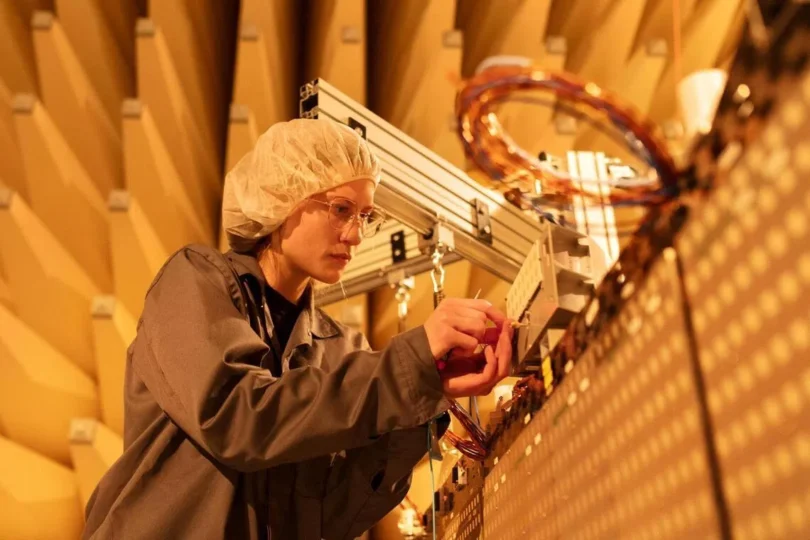
Aalto University students working on a satellite project in the cleanroom of the university’s Space Lab.
PHOTO: AALTO UNIVERSITY
“You get to learn from the people actively developing miniature satellites in the lab, learn from their experience and mistakes, and test the real engineering design choices they faced,” she said.
Ms Badescu added that the space tech boom in Finland further confirms how important this field is and gives aspiring students like her something to look forward to as a career.
“One thing that can be said with certainty is that space is vast, and there are many things to learn about and explore. It is unarguably a field that deserves our attention and should be studied and treated with care.”