BY IKE ABONYI
.
“ _To fight the raven, you may make an alliance with the serpent until the battle is done.”-_ Anonymous.
.
The euphoria that accompanied the permutation leading to the emergence of the O-K Political Movement clearly shows that Nigerians are eager to see its success. But the question on everyone’s lips is whether this OK can effectively sail in a leaking boat like the African Democratic Congress, ADC. Can OK successfully reach its intended destination within ADC? There is a real concern that the ADC, where OK and other opposition figures are uniting, is by all standards an unstable vessel.
.
If that’s the case, what are they still doing in ADC with all the Tinubu and Atiku pitfalls widening daily and the window for escape closing? Yet, the follow-up question remains: is there any political platform in Nigeria today whose roof is not leaking? This paints a stark picture of the health and status of democracy under President Bola Ahmed Tinubu and his ruling All Progressives Congress, APC, who ironically came to power riding on the same political process the then-ruling PDP had, but which is now being openly undermined.
.
The enthusiasm Nigerians showed for the Obi/Kwankwaso (OK) coalition is waning due to the uncertainty surrounding the ADC platform on which they operate. While ADC’s role as the main opposition coalition is undisputed, the reality remains that it is a leaking vessel. Its sail cannot be steady because water is entering the boat—some sneaked in by the ruling forces unsettled by the coalition’s success, and some from within by those driven by selfish interests rather than the common good.
.
ADC’s leadership has further fueled confusion by failing to do the necessary—zoning the presidency to the south in line with the prevailing just and equitable spirit of the polity. This deliberate oversight has prompted deep thinkers to speculate that the coalition may not be as committed as believed to wresting power from the underperforming APC.
.
All the unnecessary political re-engineering within ADC leads external observers to question whether the crusading OK movement can truly sail in a leaky boat. The energy and emotion expended in ADC could be better utilised elsewhere, allowing one to sleep peacefully.
.
As a matter of urgency, the unnecessary water in the ADC boat must be drained, and the crew must steer the vessel in the right direction. Failing to do so could mean that OK might jump into another boat and head straight for victory. OK’s departure from the current vessel would inevitably lead to its sinking.
.
The “Leaky Boat” metaphor is very fitting for the ADC at the moment. While it has successfully united the OK Movement (Obi and Kwankwaso) under one banner, the structure itself is taking on water from several sides—legal battles, power struggles, leadership disagreements, and the threat of “transactional” politics.
.
The clear picture is that ADC is not a united house as intended. The Independent National Electoral Commission’s (INEC) refusal to recognise its recent conventions has created a “phantom” leadership structure, even though it is obvious where the frustration originates—from the panicky, underwhelming ruling government.
.
A party with leadership in court cannot reliably submit candidates for the 2027 elections. If David Mark and his team do not secure a legal ceasefire this week, the OK Movement is likely to abandon ship—they cannot afford to sail in a vessel without lawful registration.
.
The coalition must therefore find a “Legal Safe Harbour”—either by resolving the leadership dispute through the Supreme Court or by preparing a backup plan (Plan B) before the 2027 window closes.
.
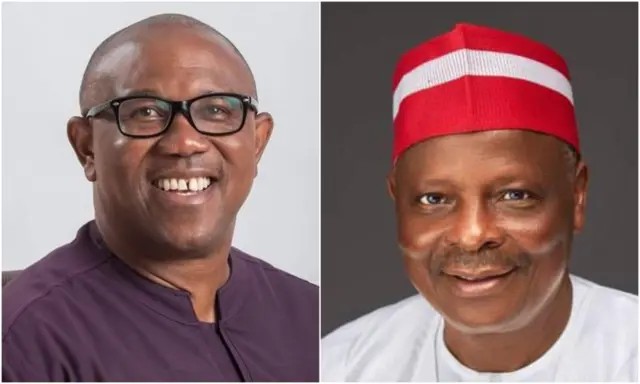
The driving force in the opposition platform in today’s Nigerian political environment is Peter Obi. In recent public remarks, he hinted at “dumping” the ADC if the primary process becomes transactional. What does that mean? If the ADC decides to hollow out its own structures for financial gain during election cycles, that is, if the party establishment attempts to sell primary tickets or compromise the process, then the “Obidient” and Kwankwasiyya core will most likely abandon ship immediately. The integrity of the OK Movement is its only currency; if that leaks, the boat sinks. The Obi-Kwankwaso Equilibrium creates a significant “weight” on the vessel. Kano’s Kwankwasiyya and the South’s Obidients are both high-demand voter blocs in Nigeria today. In a leaking boat, two captains cannot be fighting over the rudder.
.
If the opposition blocs are genuinely serious about wresting power, they must deliberately and swiftly establish a “Unity Ticket.” Delaying the decision on who will take the presidential and vice-presidential slots merely grants the ruling party more opportunity to deepen divisions through divisive propaganda and by buying off transactional figures willing to be bought.
.
The ruling APC is already exploiting the ADC’s internal fractures, which they are inducing. President Tinubu’s recent confrontational rhetoric strongly suggests a strategy of unsettling the opposition camp. The ruling party recognises its electoral weakness; if it cannot defeat the OK Movement at the polls, why not weaken it through a flurry of legal challenges that erode its legal standing?
.
The OK Movement possesses multiple variables that are heavy enough to give the APC sleepless nights over 2027. These include three key acronyms: Obi, / Kwankwaso; Obidient / Kwankwasiyya; and the Onitsha/Kano Connections. From any perspective, these are powerful because they shift the conversation away from abstract politics and ground it in Nigeria’s economic and cultural realities. They link the country’s two most vibrant commercial hubs, suggesting that a political alliance between Peter Obi and Rabiu Kwankwaso is effectively a “Union of the Markets.” The pressing question is whether the Onitsha-Kano Economic Corridor can become the salvation for Nigerian politics. From the Niger to the Sahel, the OK Movement is emerging as the new trade route to power.
.
Politicians in Abuja clearly speak the language of “zoning” and “allocations,” while the people of Onitsha and Kano speak the dialect of trade, transit, and tolls. The emerging alliance, therefore, is not just about two men; it’s about the two most entrepreneurial cultures in Nigeria uniting. If the markets of the North and South find a common language, the political map will naturally follow for good. It highlights the contrast between the lorry and the luxurious, the grain of the North and the commerce of the South. Ahead of 2027, the challenge is whether the red cap (Kwankwasiya) and the white shirt (Obidient) can share the same space. Can a Kano merchant cross the Niger in a canoe while carrying a Kano camel, or would he require a sturdy ship built on mutual compromise? The Onitsha-Kano connection is not a new creation of the political class; it is a centuries-old reality of the Nigerian marketplace that is finally demanding a seat at the cabinet table. If Peter Obi represents the ‘ledger’ and Rabiu Kwankwaso the ‘labour,’ their alliance creates a balance sheet that the current establishment cannot ignore. Obi already states that “Northern arable land is more valuable than oil.” To understand the OK Movement, one must look beyond the rallies in Abuja to the exchange of goods at the Bridge Head and Kurmi Market. The unique selling points are the “Market Voter”—the artisans, traders, and transporters most affected by inflation. This is their movement, effectively connecting the youthful “Obidient” digital energy with the grassroots discipline of the “Kwankwasiya.” Here, the “click” meets the “brick.” It is crucial to understand that the “Onitsha/Kano Connection” is not merely a political pairing but a structural realignment of Nigeria’s economic and electoral foundations. Addressing the leaks immediately or abandoning the ship should be a priority for the OK supporters. Undoubtedly, in Nigeria’s political landscape today, the Onitsha-Kano connection as represented by OK poses the most significant electoral threat to the status quo in a generation. However, the ADC currently functions more like a temporary raft than a battleship.
.
Consequently, the enthusiastic populace expects the OK Movement to transition to a new structure if the legal regularisation with INEC remains unresolved. And if an anti-transaction pact is not sincerely signed and enforced to demonstrate commitment to a transparent primary and a clear, unified policy document for the Kano-Onitsha economic corridor. God help us.
.
ABONYI, a Political Editor at Large writes from Abuja. (First published by New Telegraph on Thursday April 30, 2026)