
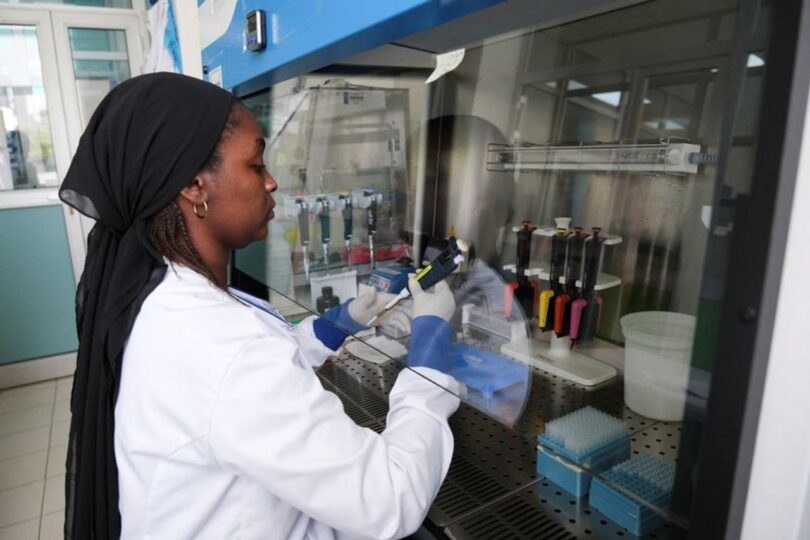
For centuries, global powers viewed Africa as a reservoir of gold, oil, and labour. Today, that extractive logic is evolving from beneath our feet to the laboratory bench.
In recent years, human cells from Africa have become targets of exploitation.
From the proposed Hepatitis B vaccine study in Guinea-Bissau to the halted $1.6 billion health data agreement between Kenya and the United States, this new frontier is taking shape.
One may call it bio-colonialism, but its proponents prefer the more benevolent term “universal medical progress.”
However, what demands an answer is why this data-gathering is concentrated in African populations rather than in the societies that stand to profit most from it.
The anonymity myth
When the Kenyan government defended its health data agreements with the United States, it invoked a shield: anonymisation. The assurance was that personal identities had been stripped away, leaving only statistics.
Contemporary science has exposed the fragility of this claim. A landmark study in Science showed that “anonymous” DNA can be traced back to individuals using nothing more than public genealogy databases, an age and a region.
Related
With advances in AI, algorithms can now reconstruct identities from fragments once considered negligible.
The uncomfortable reality that policymakers would rather sidestep is that DNA is a permanent biological signature. Unlike a compromised password, a genetic code cannot be altered once exposed.
What is shared today as aggregate statistical data could, tomorrow, become an instrument of surveillance — implicating not only an individual but their entire family lineage.
As the African Genome Variation Project, published in Nature, underscored, the continent has the world’s most genetically diverse population.
Without robust sovereign protections, anonymisation serves as a veneer over systematic data extraction.
The question of informed consent deserves equal attention. Imagine a rural farmer signing a complex legal document in a foreign language to provide a blood sample.
We must question how truly voluntary that agreement is.
Once data is digitised, its ownership — whether it belongs to the individual, the community, or the state — remains unclear under international law.
Little wonder this legal vacuum is being exploited.
From healthcare to algorithmic apartheid
Genetic data collection is invariably framed in the language of personalised medicine and scientific progress. However, the downstream applications of such data extend well beyond the clinic.
In the hands of insurance companies or financial institutions, a population’s genetic map ceases to be a tool of care and becomes a ledger of risk.
If DNA can predict a predisposition to illness, that information can exclude individuals from economic participation before they fall ill: insurance premiums tied to genetic markers, jobs decided by biological risk scores, entire communities written off as unprofitable.
In the criminal justice system, people could be labelled as dangerous or high-risk simply because of their genes, even before they have done anything wrong.
This is no longer just a theoretical concern.
The history of ethically compromised medical research in Africa includes Pfizer’s 1996 Kano trial, where children were tested with an experimental antibiotic during a meningitis outbreak without proper consent, resulting in death, deafness, or brain damage, and other trials seen as violations rather than science.
While the modus operandi of these operations once involved physical experimentation, it is now digital extraction.