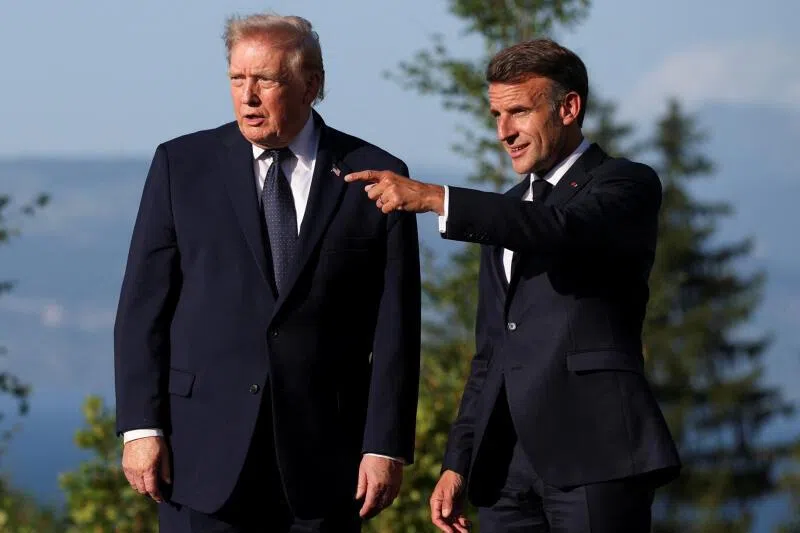
EVIAN-LES-BAINS, France – US President Donald Trump joined global leaders on June 15 at the Group of Seven summit at a French lakeside resort, where he touted his preliminary deal to end the Iran war and said he would now seek to end the fighting in Ukraine and Lebanon.
Trump’s arrival at the G-7 summit in Evian-les-Bains comes as global leaders grow increasingly wary of the United States. While many of them expressed relief over a deal that could bring closure to the Iran conflict, it was tempered by unease over new Trump tariff threats aimed at France and his warnings about the dangers of immigration.
In comments to the press alongside French President Emmanuel Macron, Trump said a memorandum of understanding aiming to end the war in the Gulf has already been signed by the United States and Iran, but he was unclear on when the text would be released.
Trump said some ships were already traversing the Strait of Hormuz, a major shipping route for global oil and gas supplies that Iran had effectively shut down, and that they would be passing toll-free.
With the Iran deal secured, Trump said he would now turn his attention to trying to secure peace between Ukraine and Russia, while also seeking to bring closure to fighting in Lebanon.
“We had a very good conversation yesterday with President Zelensky and President Putin, and I think maybe we can do something there. I really do. I think they’re both open to it,” he said.
The fallout from wars in Eastern Europe and the Middle East is just one of several issues G-7 leaders will wrestle with during the June 15 to 17 summit. They will also seek common ground on tackling global economic imbalances, sourcing critical minerals outside of the dominant supplier China and AI.
Trump is due to attend a working session with Ukrainian President Volodymyr Zelensky at the summit, whose hand has improved since Trump told him in the Oval Office in 2025: “You don’t have the cards.”
Russian advances in Ukraine have slowed and Ukraine is seeking more military funding from its allies amid a barrage of attacks on Kyiv.
Zelensky said on June 15 he had offered to meet Russia’s President Vladimir Putin at the G-7 summit for talks to end their more than four-year-old war, but Putin was not ready to speak.
It remains to be seen if Zelensky can secure greater US support while Trump prioritises drawing a permanent line under an Iran conflict that has dented his support domestically.
Securing guarantees from Trump may be hard.
He is viewed as a volatile partner by G-7 leaders, many of whom have been directly impacted by unilateral Trump decisions that have upended the Middle East, global trade and diplomacy, and prompted deeper soul-searching over the US commitment to the post-war global order it helped establish.
Underscoring the tensions, Trump told the New York Post before leaving for France he would “have no choice” but to apply 100 per cent tariffs on French wine unless Paris eliminates its digital tax on US tech giants.
Then, in a social media post just before arriving at the summit, he turned to a subject that has been a regular source of tension with centrist European allies: immigration.
“Sadly, if you import people from Third World Countries, you quickly become a Third World Country – And there’s not a thing you can do about it,” he wrote.
Macron, whose term ends next year, is increasingly seen as a lame duck at home but he was still able to lure Trump to a glitzy dinner at the Palace of Versailles on June 17 to mark 250 years of US independence.
The French leader told TF1 that France would not yield to Trump’s threats, adding, “tariffs don’t do anyone any good, especially tariffs between G-7 countries.” REUTERS