
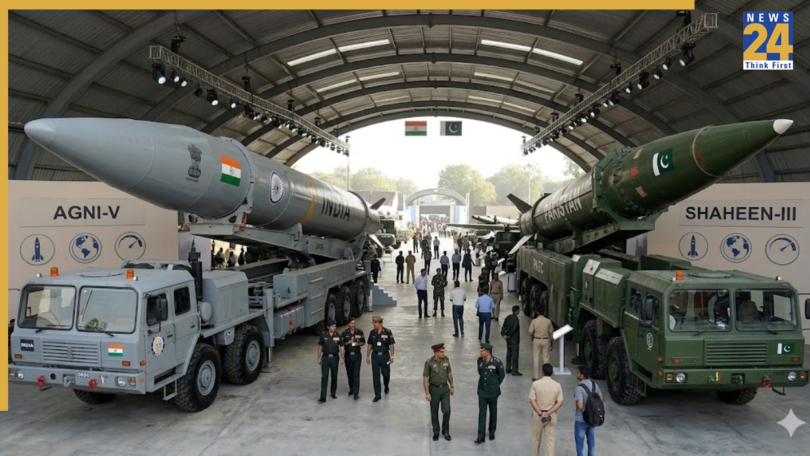
India and Pakistan possess nearly equal nuclear warheads, but India leads with stronger missile systems, nuclear triad capability, and modernization, while Pakistan relies on tactical deterrence strategies.
India vs Pakistan Nuclear Strength

2 / 6
India and Pakistan currently possess almost equal numbers of nuclear warheads, according to reports by the Bulletin of the Atomic Scientists. India is estimated to have around 172 nuclear warheads, while Pakistan has nearly 170. However, both countries follow very different nuclear strategies and military doctrines.
India’s Nuclear Policy and Agni Missiles

3 / 6
India follows a “No First Use” nuclear policy, meaning it officially promises not to use nuclear weapons first in a conflict. India’s arsenal is mainly plutonium-based and supported by the Agni missile series, including Agni-I, Agni-V, and the upcoming Agni-VI.
India’s Air and Naval Nuclear Capability

4 / 6
India’s fighter aircraft like Mirage-2000, Jaguar IS, and Dassault Rafale are capable of carrying nuclear weapons. At sea, submarines such as INS Arihant and INS Arighat are equipped with K-15 and K-4 submarine-launched ballistic missiles. These systems provide India with a strong second-strike capability.
Pakistan’s Shaheen, Babur and Nasr Systems

5 / 6
Pakistan has adopted a “Full Spectrum Deterrence” strategy and does not follow a No First Use policy. Its missile systems include Shaheen-I, Shaheen-III, Babur cruise missiles, and the short-range Nasr tactical nuclear missile. Pakistan also uses Mirage aircraft and JF-17 fighter jets capable of carrying nuclear weapons.
Agni vs Shaheen

6 / 6
Experts believe India currently has an advantage due to its stronger missile modernization, larger strategic reach, and operational nuclear triad. Pakistan, meanwhile, focuses more on tactical nuclear weapons and rapid response strategies to counter India’s conventional military superiority.