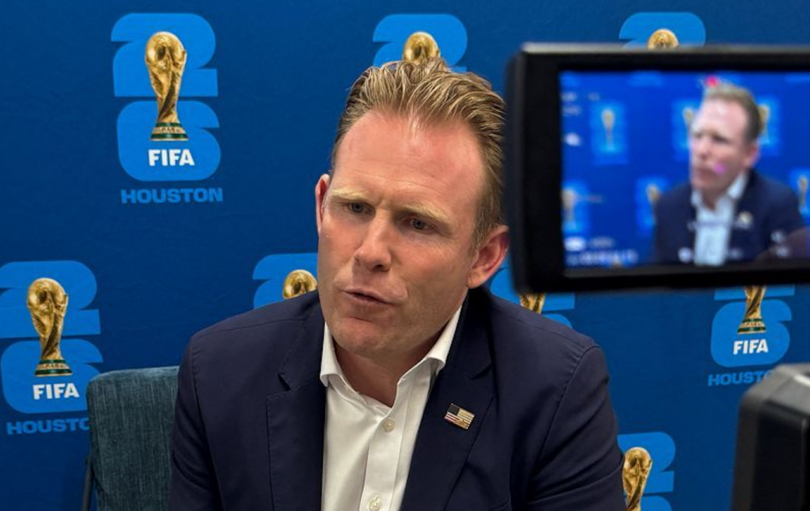
Washington DC — Andrew Giuliani, the executive director of the White House FIFA Task Force, has defended the US handling of the Iranian football team, saying that it was Iran’s decision to shift its training base from the US state of Arizona to the Mexican border city of Tijuana and that Washington had no role in that decision.
Giuliani was briefing the media in Washington DC on Wednesday about how the US is managing the ongoing 2026 World Cup as co-hosts.
In response to a question from TRT World regarding the issues that surfaced during the mega event, including the handling of the Iranian team, visa complications, high ticket prices, and inconsistent refereeing decisions — particularly during the Egypt-Argentina match — Giuliani said: “It was their (Iranians) choice to base in Mexico. They had a choice to (stay in Arizona).
Iran’s team had complained about the travel curbs and the challenges it faced since the outbreak of US-Israeli war against Iran in February. Ahead of their flight to US, they said that 15 members of the delegation were denied US visas.
In March, US President Donald Trump wrote on his social media site that “the Iran National Soccer Team is welcome to The World Cup, but I really don’t believe it is appropriate that they be there, for their own life and safety.”
Iran’s request to relocate its base camp from Tucson, Arizona, to Tijuana, Mexico, was approved by FIFA two weeks before the team’s arrival.
The Iranian team was only allowed to travel the day before their first two matches near Los Angeles, a restriction their coach Amir Ghalenoei at the time said disadvantaged the squad.
But Giuliani argued that Iran’s choice of Tijuana ensured fair play while preventing anyone with IRGC (Iran’s Revolutionary Guard Corps) links from entering the US under the guise of a football tournament.
“It’s important to point out that the Iranians chose to go to Tijuana. We were happy with that choice. I think the Mexicans were very happy with that choice. I think what we tried to do here on White House task force was apply common sense to making sure the athletes could have fair play on the pitch, while also making sure that anybody with IRGC connections was not going to get into the USA utilising a soccer tournament as that excuse,” Giuliani stressed.
Comparing the treatment of the US team, Giuliani noted that the American players, based in Orange County, California, had a longer bus journey to reach the stadium than the flight reserved for the Iranian team.
“They (Iranians) came in the day before the match for Los Angeles. For Seattle, it was two days because we knew that flight was a little over three hours. So we wanted to make sure they (Iranian) had that extra day so we could achieve the parity,” he said.
“We let all the players in. We let all the coaches in. There were some officials that we did not let in for that very reason that I gave you before. I think it was very fairly achieved in terms of who was able to come on the pitch. So, I stand by the work that we’ve done,” Giuliani added.
Related
Giuliani on high ticket prices
Giuliani did not comment on the controversy surrounding refereeing decisions in Egypt’s 3-2 defeat against Argentina in the World Cup round of 16, but addressed the reasons behind the sharp increase in ticket prices during the tournament.
“I think you can see in terms of the ticket prices, President Trump has said prices were expensive here, undoubtedly. I think that’s what happens when you have an event like the FIFA World Cup and ticket demand was, I think it was over 500 million ticket requests that FIFA ended up receiving for what is basically seven million tickets,” he said.
Giuliani said the demand for the World Cup is unprecedented, adding FIFA offered some $1000 tickets for just $60, but “many of those tickets went on the secondary market at $10, 20, 30 times the amount depending on who was playing.”