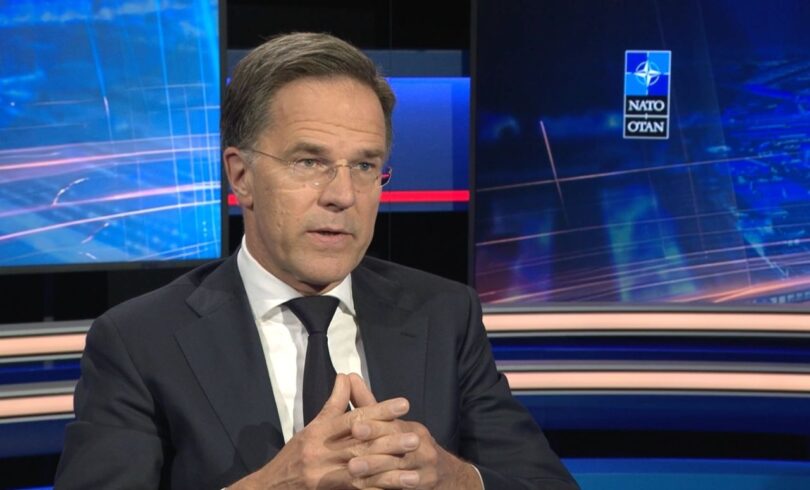
NATO Secretary General Mark Rutte has said next week’s NATO summit in the Turkish capital Ankara should be a “summit of delivery and implementation,” stressing defence spending, support for Ukraine, and defence industrial production as the alliance’s top priorities.
Speaking to Anadolu on Tuesday, Rutte said allies are expected to focus on delivering commitments made at last year’s NATO summit in The Hague, particularly on increasing defence spending.
Rutte said defence spending by European allies and Canada has risen significantly, noting that nearly $250 billion in additional spending has been committed over the past two years.
He said NATO must also maintain support for Ukraine while accelerating defence industrial production across the alliance.
Stressing the need to “build this NATO 3.0, a stronger Europe and a stronger NATO,” he said, “We need to really ramp up the defence industrial production, because it is an integral part of our deterrence,” adding that production timelines remain too long and that despite improvements, output remains insufficient.
He noted that while defence budgets are rising, allies also face challenges in expanding military personnel and boosting defence industry output to meet growing security needs.
Highlighting Türkiye’s role, Rutte said the country has become a major defence industry hub with around 3,000 defence companies.
“Türkiye is an important country here,” he said, citing its expanding defence industrial base and growing technological capabilities.
Rutte said progress has been made across all three priorities, but suggested one could emerge as the dominant issue during the summit.
“Things generally are getting better, but I think from these three priorities that one might come out as one of the biggest,” he said, adding that the issue is expected to be a major focus at the NATO Defence Industry Forum on the summit’s opening day.
Related
‘NATO 3.0 is different from NATO 2.0’
The Ankara summit, scheduled for July 7-8, will bring together heads of state and government from NATO member states. It will be the 36th summit of the alliance and the second hosted by Türkiye, following the 2004 summit in Istanbul.
On NATO’s future, Rutte described the alliance’s transformation as “NATO 3.0,” a concept centred on greater European responsibility within the alliance while preserving strong transatlantic ties.
He said NATO 3.0 differs from the previous model by reducing Europe’s overdependence on the United States.
“NATO 3.0 is different from NATO 2.0, where we were overly dependent on the US,” he said.
“The US will still be involved in Europe, conventional, and of course through nuclear, but you will see a stronger European-led NATO,” he added.
According to Rutte, this includes greater European leadership in NATO command structures and stronger financial support from European allies and Canada for Ukraine.
Asked about the alliance’s biggest long-term threat, Rutte identified Russia as NATO’s primary security challenge.
“Russia is the main threat now and in the longer term,” he said, pointing to the Russia-Ukraine war and its military buildup.
“We see this crazy war of aggression against Ukraine, where (Russian President Vladimir) Putin is willing to sacrifice 35,000 of his own, his own men, primarily men in Russia fighting there, being killed or seriously wounded by Ukraine,” he added.
Rutte also warned that NATO’s security challenges extend beyond Russia alone, pointing to growing strategic cooperation between Moscow and other countries.
“So I would say Russia, but Russia is working together with North Korea, with Iran, with China,” he said.
He also cautioned against underestimating China’s military rise.
“China is having a massive buildup of its own military, will have 1,000 nuclear warheads by 2030. So let’s not be naive about China,” he said.
He said the growing alignment among the four countries represents one of NATO’s main long-term security concerns.
“And again, in this foursome, working together with Iran and North Korea, it’s what Russia has to make, is the main long-term threat we face,” he added.
Related