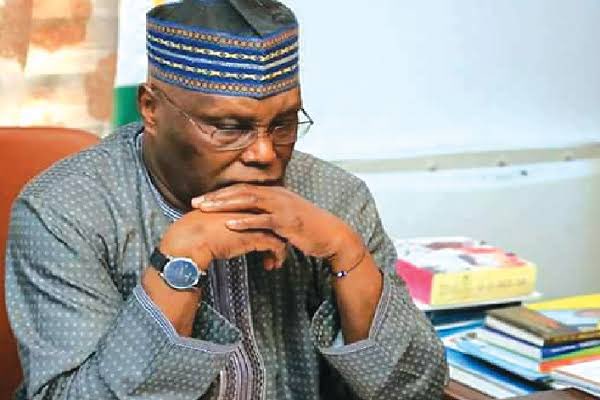
The All Progressives Congress (APC) Presidential Campaign Council has challenged former Vice President and African Democratic Congress (ADC) presidential candidate, Atiku Abubakar, to provide a detailed legal and fiscal explanation of his proposed “production subsidy” for locally refined petrol.
The campaign council, in a statement issued on Sunday by its spokesman, Dele Alake, said Atiku’s recent call for the federal government to subsidise locally refined petrol and reduce the pump prices of petrol and diesel lacked a clear legal and operational framework.
The APC said Section 205(1) of the Petroleum Industry Act (PIA) 2021 provides that wholesale and retail petroleum prices should be determined by unrestricted market forces, noting that the Nigerian Midstream and Downstream Petroleum Regulatory Authority (NMDPRA) had also clarified that it does not fix pump prices except under conditions of market failure.
The campaign council questioned whether refineries benefiting from Atiku’s proposed subsidy would be compelled to sell petrol at government-approved prices.
“If the answer is yes, he should identify the legal framework under which the government would impose that price condition and explain how it would operate consistently with the Petroleum Industry Act,” it said.
The APC added that if refiners were not required to sell at regulated prices, Atiku should explain how public funds spent on subsidies would guarantee cheaper fuel for consumers.
The APC also asked the former vice president to disclose the projected cost of the policy and explain how it would be financed.
The campaign council noted that providing crude oil to domestic refineries at discounted rates would reduce revenue accruing to the Federation Account and could affect allocations to the federal, state and local governments.
The council stated that, based on current refinery output and domestic fuel consumption, the proposed subsidy could cost between N17 trillion and N21 trillion annually, depending on its structure and scope.
It urged Atiku to disclose the proposed subsidy rate, annual spending limit, funding source, coverage, measures to prevent abuse and whether amendments to the Petroleum Industry Act would be required to implement the policy.
Tinubu to govs: Emulate Uba Sani on mass transit scheme
The APC further argued that Atiku’s latest position contradicted his previous support for fuel subsidy removal.
The ruling party recalled that the former vice president had described the subsidy regime as fraudulent during a lecture at the Lagos Business School in 2022 and pledged to complete its removal, but later announced in August 2026 that he would restore it.
The APC campaign council said Atiku should explain why he had changed his position and how his proposed subsidy would avoid the corruption, smuggling, fuel shortages, and fiscal losses associated with previous subsidy regimes.
Defending the President Bola Tinubu administration’s approach, the council said the government had instead focused on expanding compressed natural gas (CNG) and electric-powered mass transit systems to reduce transportation costs.
It stated that more than 120,000 vehicles had been converted to CNG nationwide, while several states had introduced CNG and electric buses that have significantly lowered transport fares.
It also referenced Tinubu’s recent announcement that more Nigerians would begin to experience noticeable reductions in transport costs from October 1 through the expansion of alternative-energy transport initiatives.
The campaign council maintained that deregulation had encouraged greater investment in Nigeria’s downstream petroleum sector, citing the Dangote Petroleum Refinery’s production capacity and ongoing public share offering as evidence of growing investor confidence.
It also expressed optimism that a reduction in global crude oil prices following a possible de-escalation of tensions in the Middle East could lead to lower petrol and diesel prices in Nigeria.
The APC campaign council, therefore, urged Atiku to publish a comprehensive policy document backed by an independent legal and fiscal assessment, stressing that until then, his production subsidy proposal remained “an uncosted promise without a clearly identified legal or operational framework.”