
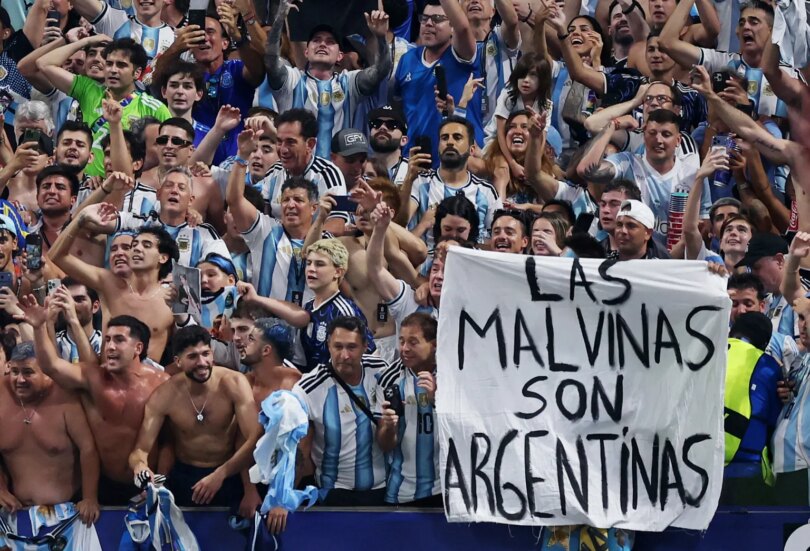

Argentina’s national team has sought to distance itself from responsibility for displaying a banner asserting the country’s claim to the Falkland Islands after its World Cup semi-final victory over England, as FIFA said it is reviewing reports from the match.
The controversy followed Argentina’s 2-1 victory over England, after players celebrated on the pitch with a banner reading “Las Malvinas son Argentinas” (“The Falkland Islands are Argentine”), prompting criticism from the British government and renewed calls for disciplinary action. A FIFA spokesperson said the governing body was “assessing match reports” as part of its “standard procedure” but did not confirm whether a formal disciplinary investigation had been opened.
Responding to the controversy, Argentina defender Gonzalo Montiel suggested the players had not planned the display. “They just threw one down from the stands and the boys grabbed it,” Montiel said. Argentine journalist Nelson Castro also claimed the banner originated from the crowd. “Someone threw it onto the field, and they gave it to the players,” he said. Argentina President Javier Milei defended the players’ actions, saying they were entitled to express themselves. “It is perfectly valid and legitimate for the players to want to express themselves and do so,” Milei said.

The Government of the Falkland Islands condemned the display, describing it as insensitive. “The Falklands government is disappointed, though regrettably not surprised – that the Argentine football team decided to tarnish the result of last night’s World Cup football semi-final – a game that did not in any case involve the Falkland Islands. That said, it is hardly news to anyone that the people of the Islands were victims of an aggressive invasion in 1982, which left many traumatised. The banner displayed by Argentina last night, therefore, was particularly insensitive for many people in the Falklands.” Ahead of the match in Atlanta, Argentine supporters had been warned not to bring flags or banners containing references to the Falkland Islands into the stadium.
Argentina’s National Security Minister Alejandra Monteoliva said before kick-off: “Argentine or English flags are permitted, but nothing that contains any message that could provoke any kind of incident. It will not be possible to enter with bottles or with any item that contains a provocative message: political, hateful, or promoting racial or religious intolerance.” However, she later added: “You can’t ban a chant or silence people.”
The British government has backed calls for FIFA to take action over the incident. “The World Cup might not be ours, but the Falkland Islands definitely are,” a spokesperson for Prime Minister Keir Starmer said.
Business Secretary Peter Kyle described the players’ actions as “entirely inappropriate.” Reform UK leader Nigel Farage said: “Whilst I am disgusted at the behaviour of some Argentinian players last night, the most important thing to do is build up the Royal Navy quickly.” Conservative Party leader Kemi Badenoch added: “The Falkland Islands are British. The Conservatives will always defend them.”
Liberal Democrat leader Ed Davey argued that Argentina’s players should face sporting sanctions. “In August 2024 Rodri and Álvaro Morata were rightly banned for one match for singing ‘Gibraltar is Spain.’ “Now the Argentine players who celebrated with the ‘Falklands are Argentine’ banner must be barred from the final.”
Under FIFA’s disciplinary code, political messages displayed during official matches are prohibited and can attract sanctions, although previous cases have generally resulted in fines and warnings rather than player suspensions. Argentina are scheduled to face Spain in Sunday’s World Cup final.
The Falkland Islands, known in Argentina as the Islas Malvinas, remain the subject of a long-running sovereignty dispute between the United Kingdom and Argentina. Britain has administered the South Atlantic archipelago since the end of the 1982 Falklands War, which followed Argentina’s invasion of the islands and claimed the lives of 255 British service personnel, three islanders and 649 Argentine troops.