
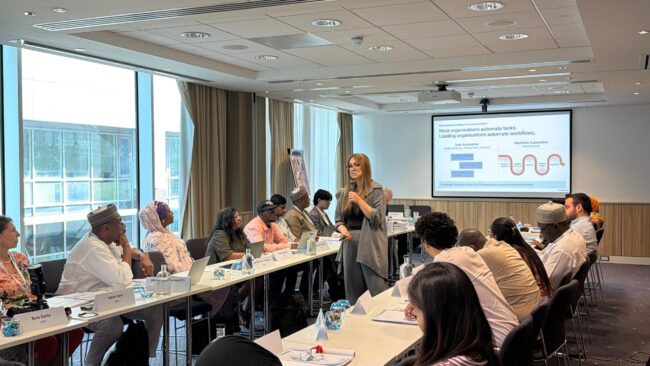
Artificial Intelligence (AI) emerged as a defining theme of the Executive Training on Organisational Performance Enhancement: Integrating Problem Solving, Sustainable Leadership and Artificial Intelligence Innovation for Executives and Board Members, as participants acquired practical knowledge and hands-on skills to transform organisational performance through responsible AI adoption.
The AI sessions, held on Wednesday, 8th and Thursday, 9th July 2026, formed part of the week-long executive programme organised by Prospects Development Services (PDS), United Kingdom, in partnership with the Women Farmers’ Advancement Network (WOFAN), at the Royal Institution, London.
SolaceBase reports that, facilitating the sessions, digital transformation and business management expert, Dr Ketrina Beta, challenged participants to see Artificial Intelligence not as a replacement for human intelligence but as a powerful assistant capable of enhancing decision-making, increasing productivity and improving service delivery across public and private sector organisations.
She explained that institutions which strategically integrate AI into their operations can complete tasks that once took hours or days within minutes, enabling leaders to devote greater attention to innovation, strategic planning and value creation.


Read Also:WOFAN joins global networks in driving strategic leadership in Regenerative Agriculture, positioning for Carbon Revenue
Dr Beta also emphasised that the success of AI depends on its responsible and ethical application. She warned against uploading sensitive organisational information into AI platforms, noting that poor data governance could expose institutions to privacy and security risks. She further stressed that AI-generated outputs should never be implemented without critical human review, reminding participants that while AI may generate recommendations, accountability ultimately rests with the user and the organisation.


Using practical demonstrations, case studies, live AI applications and group assignments, Dr. Beta guided participants through six key modules designed to equip executives with practical competencies for AI-driven organisational transformation.
She explained AI-Driven Organisational Performance and Decision-Making by demonstrating how AI can analyse information, identify patterns and support leaders in making faster, evidence-based decisions.
The Intelligent Process Automation and Performance Improvement module showed how repetitive administrative tasks can be automated to improve efficiency, reduce errors and free employees for higher-value responsibilities.


During the Responsible AI, Fairness and Trust session, participants explored how organisations can minimise bias, ensure transparency and build public confidence through ethical AI practices.
Read Also:London Halal Forum: ”We’re supporting over 1.2m rural farmers in Northern Nigeria” – WOFAN
On Data Governance, Privacy and Accountability, the trainer highlighted the importance of protecting organisational information, complying with data governance principles and maintaining human responsibility for every AI-assisted decision.
The AI Agents for Workflow Automation module demonstrated how intelligent AI assistants can automate routine workflows, coordinate multiple tasks and significantly improve operational efficiency.
Throughout the training, participants carried out practical exercises using a range of AI platforms, including ChatGPT, Microsoft Copilot, Gemini, DeepSeek and NotebookLM, where they developed prompts, tested AI capabilities and explored real-life organisational applications.
Speaking during the session, the Executive Director and Global Advocate of WOFAN, Dr Salamatu Garba, described the facilitator, Dr Beta, as an accomplished expert in digital transformation whose practical approach to AI would equip participants with skills that could immediately improve performance within their respective organisations. She encouraged participants to fully engage in the interactive exercises, expressing confidence that the knowledge acquired would translate into improved productivity, innovation and service delivery.

Read Also:WOFAN, UK partner empower youths with AI, EI skills to drive job creation, food security
Participants described the sessions as highly impactful and relevant to their professional responsibilities.
The Vice-Chancellor of Bayero University, Kano, Professor Haruna Musa, said the training broadened his understanding of how AI can be strategically deployed to improve institutional efficiency and organisational performance, particularly within the realities of resource-constrained universities.
Similarly, the Deputy Vice-Chancellor (Academics), Bayero University, Kano, Professor Ahmad Muhammad Tsauni, said the practical sessions provided valuable insights into how AI could simplify institutional processes and enhance productivity.
Deputy Director at the Federal Ministry of Agriculture and Food Security, Iyabo Lawal Mustapha, said the training equipped her with practical AI skills that would improve efficiency and service delivery in the Ministry.