
Emmanuel Addeh in Abuja
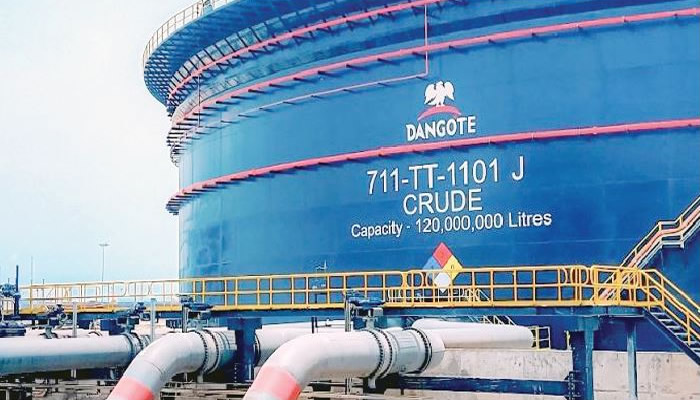
The renewed hostilities between the United States and Iran over the strategic Strait of Hormuz, have triggered fresh concerns across global energy markets, with indications that Nigeria’s Dangote Petroleum Refinery has resorted to dollar-denominated transactions effective today.
This followed the persistent failure of the Nigerian National Petroleum Company Limited (NNPCL) and International Oil Companies (IOCs) to meet local supply obligations, requiring domestic crude to be sold to the refinery in naira.
The result is that the refinery has had to import fuel at higher dollar prices.
Under the crude-for-naira deal, the refinery was to be supplied 15 cargoes a month. However, they barely meet up to five cargoes, resulting in having to import at high dollar prices.
The situation has been made worse by Nigerian Midstream and Dowstream Petroleum Regulatory Authority (NMDPRA)’s issuance of fresh import licences to marketers, putting a strain on the dollar exchange rate, which at the weekend, fell to $1 to N1450, and further putting pressure on Dangote’s import bills at higher exchange rate.
The latest escalation in the US-Iran war came after the United States launched another round of strikes on Iranian targets early Sunday, extending a pattern of military exchanges that have steadily eroded the fragile ceasefire reached between both countries last month.
According to reports, the strikes were aimed at degrading Iran’s capacity to threaten commercial shipping routes through the Strait of Hormuz, one of the world’s most critical energy corridors.
The development has once again placed global oil markets on edge, given that the Strait of Hormuz serves as a vital transit route for a significant share of the world’s crude oil exports.
Any disruption to shipping activities in the waterway has historically translated into higher energy prices and increased market uncertainty.
For Nigeria, the implications might extend far beyond international diplomacy.
Industry sources said the renewed instability in the Gulf region could complicate crude procurement arrangements for the Dangote Refinery, especially at a time concerns persisted over domestic crude supply commitments.
Should the refinery increasingly turn to imported crude feedstock to sustain operations, the attendant foreign exchange exposure might compel a shift toward dollar-based pricing mechanisms for refined petroleum products.
The development would represent a major setback for efforts aimed at reducing pressure on Nigeria’s foreign exchange market through local refining and the federal government’s crude-for-naira initiative.
The United States military confirmed that it carried out a second wave of attacks within hours after accusing Iran of targeting commercial vessels transiting the Strait of Hormuz. U.S. Central Command said the operations were intended to prevent further attacks on international shipping.
Iranian state media, however, reported that the American strikes extended beyond the Strait of Hormuz region and hit several locations across central and western Iran.
Among the locations reportedly targeted were Ahvaz and Khondab, while authorities in Khuzestan Province confirmed strikes in Omidieh, Mahshahr, Behbahan, Dezful, Andimeshk and Abadan.
The latest round of attacks followed days of escalating tensions after Iran allegedly intensified threats against maritime traffic in the Strait of Hormuz and commercial shipping routes across the Gulf.
According to U.S. military officials, Iran’s Islamic Revolutionary Guard Corps fired at commercial vessels transiting the waterway and deployed drones and cruise missiles in the area.
Captain Tim Hawkins, a spokesman for the U.S. Central Command, said American forces successfully intercepted at least one cruise missile and a one-way attack drone launched by Iranian forces.
The confrontation has heightened fears of a broader disruption to global energy supplies.
Brent crude, the international oil benchmark, rose sharply as markets reacted to the renewed conflict, with traders closely monitoring developments around the Strait of Hormuz.
Oil prices have remained volatile since hostilities resumed, reflecting concerns that any prolonged disruption could significantly impact global supply chains.
Shipping companies have also become increasingly cautious.
Reports indicated that maritime traffic through the Strait of Hormuz has declined significantly in recent days as operators assess the growing security risks associated with navigating the region.
The uncertainty has already begun to reverberate across emerging economies dependent on imported energy products and dollar liquidity.
For Nigeria, analysts warned that any sustained rise in crude prices and shipping costs could place renewed pressure on inflation, foreign exchange demand and domestic fuel prices.
The concern is particularly acute given the country’s ongoing efforts to stabilise the naira and reduce dependence on imported petroleum products.
Should crude sourcing challenges persist for local refiners, especially the Dangote Refinery, increased reliance on imported feedstock could further heighten demand for foreign exchange and potentially alter existing pricing arrangements within the domestic fuel market.
While the renewed conflict might boost Nigeria’s crude oil earnings in the short term through higher international prices, economists cautioned that the gains could easily be offset by rising import costs, exchange rate pressures and increased fuel prices at home.
With both Washington and Tehran showing little sign of backing down, the fate of the Strait of Hormuz once again appeared central to the stability of global energy markets—and by extension, to the fortunes of economies far beyond the Persian Gulf, including Nigeria.