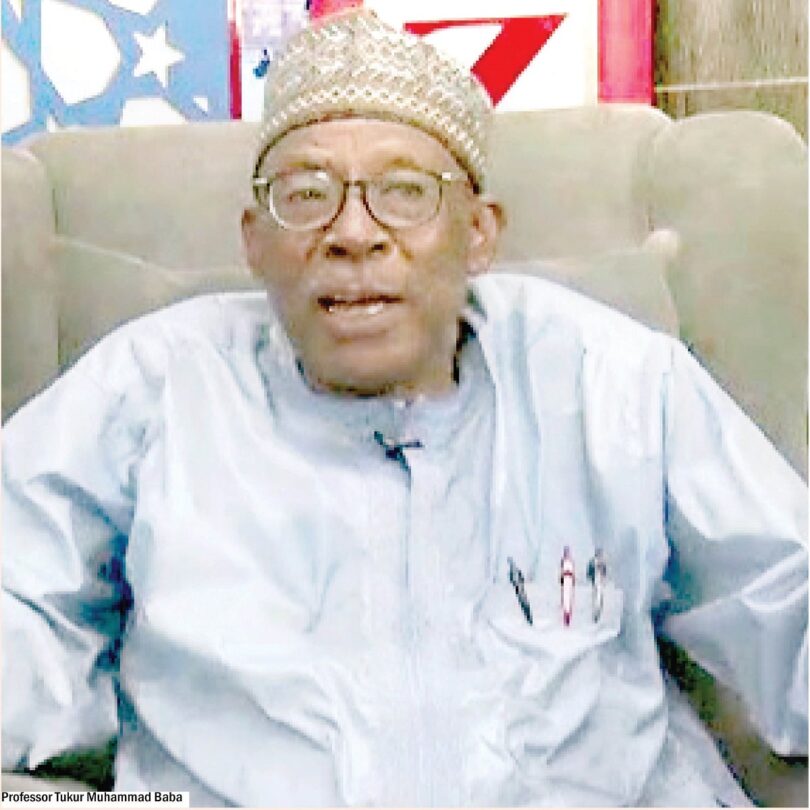
The National Publicity Secretary of the Arewa Consultative Forum, Prof. Tukur Mohammed-Baba, has said voters in Northern Nigeria are increasingly dissatisfied with the country’s political leadership and are yet to identify a presidential contender capable of inspiring confidence ahead of the 2027 elections.
Speaking during an appearance on Arise Television’s PrimeTime programme on Monday, Mohammed-Baba argued that neither the ruling administration nor prominent opposition figures had offered solutions capable of addressing the country’s pressing economic and security concerns.
According to him, many northerners have grown weary of politics centred on personalities rather than policies.
“I have not seen a party that articulates a clear policy ambition or an ideological standard. The average northern voter is disillusioned and has been for a long time.
“We have tried all kinds of permutations; northern candidates, Muslim-Muslim tickets, and so on. It seems to the average northerner that all this politics is about personalities and personal interests. It is not about people,” he said.
Mohammed-Baba maintained that President Bola Tinubu’s standing in the region has weakened since the 2023 election, largely because of the economic consequences of government policies and the persistence of insecurity.
“The impact of his policies on the economy and especially on individual lives has been highly disappointing, if not disturbing.
“Furthermore, the insecurity thing, no matter what the government says, is getting worse. Over a year ago, we talked about the ‘Forest Guards.’ It is only recently, with the event in Oyo and in Borno States, that they are talking of deploying 1,000 forest guards in some of the states but researchers have shown that there are over 30,000 terrorists operating in our ungoverned spaces,” he said.
He also expressed concern over reports that some communities have abandoned farming activities because of threats posed by armed groups.
“We are gradually normalising self-help, that unless you do something, the government will not be there to protect you. That undermines the essence of the role of the state,” he said.
Turning to opposition figures, the ACF spokesman questioned whether they had provided a compelling alternative to the current administration.
On former Vice President Atiku Abubakar, he said repeated presidential bids had not been matched by a clearly defined policy agenda.
“I don’t see anything from him that presents an alternative apart from saying this government has failed,” he said. “Where is the beef?”
He was equally critical of Labour Party figure Peter Obi, suggesting that his movement across political parties had created uncertainty about his political direction.
“He has moved to two or three parties. The question we ask is: what does he want?” he said.
Mohammed-Baba also took issue with comments linked to Rabiu Kwankwaso, arguing that references to revered northern historical figures in political rhetoric could alienate many people in the region.
“In the North, that is very irreverent. It would be highly delusional for him to go that far and say he presents an alternative.
“An alternative in terms of what? Has he articulated anything on the economy, security, or anything on infrastructure? When you keep talking about things in abstract terms that run counter-intuitive to what the people have held on to, you will run into trouble,” he said.
Despite his criticism of leading political figures, Mohammed-Baba declined to identify any individual currently capable of rallying broad northern support for the presidency.
“We are waiting to see,” he said.
He also cautioned the ruling All Progressives Congress against assuming electoral success is guaranteed in 2027.
“Nothing fails like success,” he said. “Be very careful, because sometimes complacency can spring surprises.”
Mohammed-Baba further stressed that the North should not be viewed as a single voting bloc, noting that the region contains diverse interests and political perspectives.
He added that issues such as insecurity, rising fuel costs and the growing population of out-of-school children are likely to influence voting decisions in the next general election.
“Is there anybody offering an alternative now?” he asked. “I don’t see anything.”