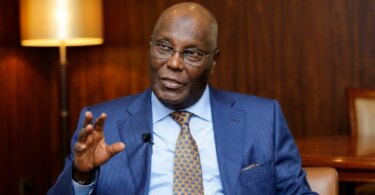

The African Democratic Congress (ADC) presidential candidate, Atiku Abubakar, has alleged that President Bola Tinubu could temporarily reintroduce fuel subsidy ahead of the 2027 presidential election before removing it again after securing re-election.
Atiku made the disclosure on Friday at a press conference in Abuja, where he also called on the Federal Government to review its petrol pricing policy and take steps to reduce the burden of rising energy costs on Nigerians.
The former vice president claimed that transport operators in Lagos were planning a protest which could provide the Tinubu administration with an opportunity to temporarily restore fuel subsidy.
“I’m aware that Lagos transporters are planning a protest that will provide Bola Tinubu the excuse to temporarily bring back fuel subsidy and, after being re-elected, go back to remove it. So, Nigerians, be guided,” Atiku said.
Tinubu announced the removal of petrol subsidy in May 2023 shortly after assuming office, a policy that was followed by a sharp increase in the pump price of petrol and heightened concerns over transportation and living costs.
Atiku argued that the consequences of higher petrol prices had spread across the economy, affecting farmers, traders, manufacturers, workers and households.
“When government makes energy expensive, it makes life expensive,” he said.
The ADC candidate recalled that when he previously advocated government intervention to reduce petrol prices, Tinubu had criticised the proposal as evidence of “serious ignorance” of governance and the economy.
Atiku said subsequent developments had strengthened his argument, pointing to concerns expressed by labour unions, petroleum marketers, manufacturers and Nigerians over the rising cost of living.
He urged the President to reconsider policies that have increased energy costs and to listen to calls for measures that would ease pressure on households and businesses.
“Leadership requires the humility to confront the consequences of policy and the courage to change course,” he said.
Atiku also faulted the Federal Government’s use of palliatives to cushion the effects of economic reforms, saying temporary interventions could not substitute for policies aimed at addressing the underlying causes of rising living costs.
“Palliatives manage pain. Good policy addresses the source of the pain,” he said.
The former vice president further raised concerns about the planned phasing out of electricity subsidies from 2027, warning that increased electricity costs could compound the financial difficulties faced by households and businesses.
He cited barbers, tailors, frozen-food sellers, welders and manufacturers as among those whose businesses depend heavily on electricity and other forms of energy.
“The lesson of petrol must not be repeated with electricity. Do not remove first and think later. Do not impose the pain first and search for palliatives afterwards,” Atiku said.
He also appealed to Tinubu to adopt any measure capable of reducing petrol prices, irrespective of who proposed it.
“Bola Tinubu should not be ashamed to do what is necessary to lower the price of petrol simply because Atiku Abubakar proposed a government intervention,” he said.
“He should just take the idea. Rename it if he wishes. And even take the credit. What matters to me is that Nigerians pay less.”
Atiku said he was willing to provide the framework for such an intervention to the Federal Government if requested.
Looking ahead to the 2027 election, the ADC presidential candidate outlined his proposed alternative, saying his administration would introduce a transparent production subsidy for petroleum products refined locally and sold to Nigerians.
According to him, the proposed arrangement would be restricted to petroleum products confirmed to have been refined in Nigeria, excluding imported products.
He said the scheme would operate under a fixed spending limit, require approval by the National Assembly and be subjected to independent audits.
Atiku maintained that the success of economic reforms should be measured by their effect on Nigerians’ purchasing power rather than government revenue, GDP growth and other macroeconomic indicators.
“Nigerians do not live on statistics. They live on what their hard-earned money can buy,” he said.