Advertisement
Advertisement
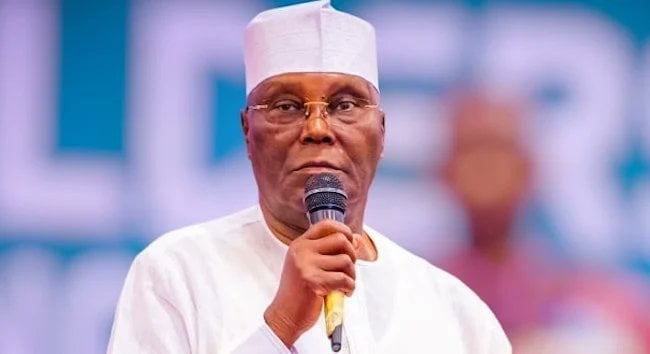
A former Vice President and presidential candidate of the African Democratic Congress (ADC), Atiku Abubakar, has criticised President Bola Tinubu over the high cost of petrol, saying Nigerians are bearing the brunt of economic reforms despite the country’s status as a major oil producer.
Mr Atiku’s Senior Special Assistant on Public Communication, Phrank Shaibu, made the criticism in a statement on Tuesday in response to Tinubu’s recent comments on Atiku’s economic proposals.
Shaibu said the major issue confronting Nigerians was not Atiku, but the inability of millions of citizens to afford basic necessities, including food, transportation, education and healthcare.
He said Atiku was advocating policies aimed at reducing the cost of living, particularly through lower energy costs.
According to him, Nigeria’s petrol price of about N1,400 per litre is significantly higher than prices in several oil-producing countries, including Saudi Arabia, Kuwait, Algeria and Angola.
“Saudi Arabia sells petrol at about N778 per litre. Kuwait is around N872. Algeria is about N475. Angola is about N441,” he said.
He added that the United Arab Emirates, despite having substantially higher average incomes than Nigeria, also sells petrol below Nigeria’s prevailing price.
Shaibu said the situation was even more striking when compared with Libya, where petrol reportedly sells for about N34 per litre despite the country’s prolonged political instability.
“How did your celebrated reform leave Nigerians paying vastly more for fuel while enjoying a lower standard of human development?” he asked.
The former vice president’s aide said the impact of high petrol prices extended beyond motorists, arguing that fuel costs had contributed to increases in transportation, food distribution and the prices of goods and services.
Using a tomato seller at Mile 12 in Lagos as an example, Shaibu said the cost of energy used by farmers and the cost of transporting farm produce to markets were eventually transferred to consumers.
He also argued that the current petrol price had placed an excessive burden on low-income workers.
According to him, a worker earning the N70,000 statutory minimum wage would need N56,000 to purchase 40 litres of petrol at N1,400 per litre, representing 80 per cent of the monthly wage.
Shaibu said Atiku’s proposed Atiku Economic Recovery Plan (AERP) would seek to reduce fuel costs at source rather than rely primarily on palliatives after prices had risen.
He said the proposal would involve targeted support for Nigerian crude supplied for domestic refining under a capped, transparently budgeted and independently audited framework.
He said the crude and refined products would be tracked, while consumer pass-through obligations would be imposed to ensure the benefit reached Nigerians.
“Reduce fuel costs and you reduce pressure on transportation. Reduce transportation costs and you reduce the cost of moving tomatoes, rice, yam, livestock and manufactured goods,” he said.
Shaibu also questioned the Federal Government’s handling of the funds it said had been mobilised following the removal of petrol subsidy.
He said the Tinubu administration had stated that subsidy removal mobilised about N15.8 trillion between June 2023 and December 2025.
“Nigerians surrendered cheap fuel. They paid more for transportation. They paid more for food. They watched the value of their wages collapse. So what measurable improvement reached the average Nigerian household in exchange for that sacrifice?” he asked.
He further demanded reconciliation of nearly N30 trillion identified across Federation Account revenues, deductions, savings, transfers and related entries.
He also called for transparency over Import Duty Exemption Certificate approvals reportedly covering about N34 trillion worth of imports in 2025.
Shaibu said Nigerians deserved to know the beneficiaries, values, legal basis and public benefits associated with the exemptions.
He accused the Tinubu administration of announcing relief measures only after years of economic hardship, describing the promised interventions as potentially politically motivated ahead of the 2027 elections.
“After more than three years of hardship, Nigerians are now being offered a temporary dose of political anaesthesia as 2027 approaches,” he said.
He said Atiku would continue to engage Nigerians on policies aimed at reducing the cost of living, insisting that the former vice president’s focus was on making life more affordable for ordinary citizens.