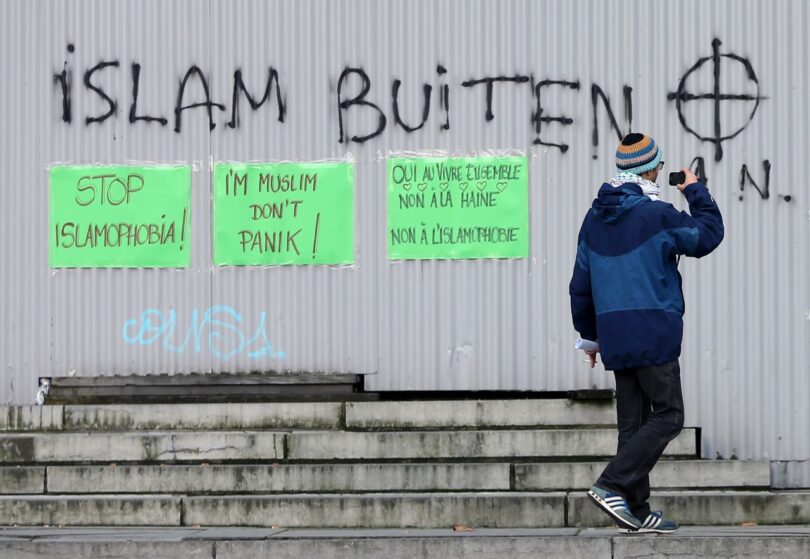
A new report from Austria highlights a sharp rise in anti-Muslim racism, with documented incidents reaching a record high in 2025.
According to the 11th Anti-Muslim Racism Report by the Documentation and Advisory Centre for Islamophobia and Anti-Muslim Racism, 1,684 incidents were recorded last year, up from 1,336 in 2024 and 1,522 in 2023.
As in previous years, most incidents occurred online. Digital platforms accounted for 63.1 percent of all documented cases, while 36.9 percent took place offline.
Although the share of online incidents declined from 74.9 percent in 2024, it remained significantly higher than offline cases.
The nature of the incidents has also shifted.
The category of “spreading hate” now accounts for the majority of documented cases, making up 62.6 percent of all incidents. It is followed by insults (11.3 percent) and unequal treatment (10.5 percent).
This marks a notable change from the previous year’s report, in which insults and unequal treatment accounted for a significantly larger share of recorded incidents.
What explains this shift?
According to the report, the rise in hate speech cannot be understood solely as the result of individual acts of prejudice. Instead, it points to the growing influence of political and media narratives that help normalise anti-Muslim rhetoric in public discourse.
Related
Political propaganda—including inflammatory speeches, campaign advertisements, videos and populist television programmes—accounted for 27.1 percent of documented incidents.
The report also found that a substantial share of incidents originated in media content, particularly newspaper articles, television reports and other forms of mainstream news coverage.
Taken together, the figures suggest that public statements and narratives promoted by political actors and media figures play a significant role in shaping anti-Muslim discourse.
According to the report, nearly 60 percent of documented hate speech cases were linked to political or media-related content.
The findings also point to a sharp increase in the category of “spreading hate.” Compared with 2024, reported cases in this category rose by 49.3 percent.
This raises an important question: who benefits from the normalisation of anti-Muslim rhetoric, and who is helping to sustain it?
The political factor
Critics argue that the Freedom Party of Austria (FPÖ) has played a central role in making anti-Muslim rhetoric increasingly acceptable in public discourse.
Over the years, the party has incorporated anti-Muslim messaging into its political identity and electoral campaigns.
Slogans such as “Home instead of Islam,” and “The West in Christian hands” have featured prominently in FPÖ campaigns and helped shape debates around immigration, identity and belonging.
For critics, these messages do more than mobilise voters. They contribute to a political climate in which anti-Muslim narratives are increasingly framed as legitimate political concerns rather than discriminatory rhetoric.
Like Germany’s Alternative for Germany (AfD), the Freedom Party of Austria (FPÖ) has invested heavily in social media, particularly platforms such as TikTok, to reach younger audiences.
Observers note that the party’s online strategy relies on highly targeted content designed to maximise visibility and engagement among young users, allowing it to reach audiences often less engaged with traditional political messaging.
One example emerged in Austria’s Tyrol region, where an FPÖ-affiliated social media account published videos promoting mass deportations and rhetoric centred on ethnic and cultural purity.
One such video sparked criticism across the political spectrum in the Tyrolean state parliament, drawing condemnation from representatives of multiple parties.
The focus on younger audiences is not accidental. As trust in political institutions declines and dissatisfaction with traditional politics grows, social media has become an increasingly important arena for shaping political attitudes and mobilising support.
Social media and the battle for young voters
Like Germany’s Alternative for Germany (AfD), the Freedom Party of Austria (FPÖ) has invested heavily in social media, particularly platforms such as TikTok, to reach younger audiences.
Observers note that the party’s online strategy relies on highly targeted content designed to maximise visibility and engagement among young users, allowing it to reach audiences often less engaged with traditional political messaging.
One example emerged in Austria’s Tyrol region, where an FPÖ-affiliated social media account published videos promoting mass deportations and rhetoric centred on ethnic and cultural purity.