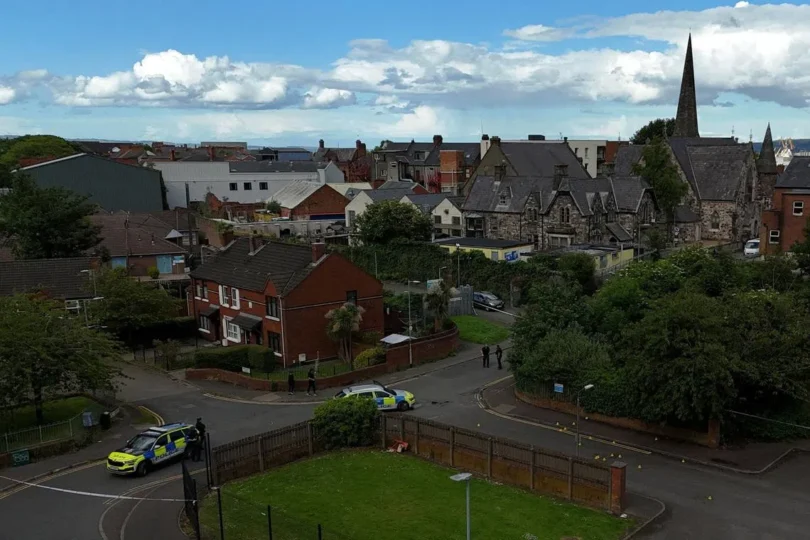
BELFAST, June 10 – Staring at the burned out shell of his Belfast home, Jamie Corry said he would never get over the sight of watching his house go up in flames, torched by anti-migrant protesters angry at the brutal stabbing of a man in Northern Ireland’s capital.
“I was actually standing right there watching my whole house just go up, slowly but surely, and that was it. There’s literally nothing I could have done about it,” the 33-year-old told Reuters as he surveyed the wreckage of his terraced home.
“I’ll never get over that feeling,” he said.
Corry’s property was one of those attacked by hundreds of masked protesters across the region after a video of the knife attack, in which the victim lost an eye, went viral on social media on Tuesday. A Sudanese man has been charged with attempted murder.
PEOPLE ARE ANGRY
Police and politicians said angry protesters had randomly targeted ethnic minorities as violence flared on Tuesday night. But those such as Corry found themselves caught up in the disorder.
On his street, bunting with British flags fluttered from the walls next to charred windows and doors, while burned wreckage from houses was piled next to destroyed cars.
Despite his own situation, he said he had some sympathy with the anger that people had felt.
“It’s people that’s angry, lashing out, you understand why,” he said. “I mean one of our own people’s basically been butchered in the middle of the street.”
ECHOES OF A SECTARIAN PAST
For 30 years, the British province saw violence – known as the “Troubles” – between mainly Catholic Irish nationalists seeking Irish unity, and predominantly Protestant pro-British “loyalists” wanting to stay in the United Kingdom, which led to the deaths of more than 3,600 people.
While some splinter groups remain active and trouble still often flares, the 1998 Good Friday Agreement mostly brought an end to the killings.
But for Methodist minister Reverend Brian Anderson, the violence was reminiscent of those dark days.
“I saw, particularly on these two streets, just violence upon violence. I think I could use the word anarchy,” he told Reuters. He said the influx of migrants had put pressures on employment and housing.
“There are issues to be dealt with and we need our politicians to step in and help that debate. But we cannot, cannot, cannot, cannot do it by violence,” he said. “It just takes us back to the old days and we don’t want to go back there.”
RISING TIDE OF RACE CRIMES
In recent years, the sectarian violence that blighted the region is starting to be replaced by growing incidents of racism.
Northern Ireland’s population is 97% white according to a 2021 census, but migration has been increasing in recent years, and with it, a growing hostility.
According to the Police Service of Northern Ireland, there were 2,367 race incidents and 1,507 race crimes in the year to March 2026, the highest since records began in 2004/05. In that same period there were 71 sectarian incidents.
There was anti-migration rioting in both 2024 and 2025, the latter sparked by accusations against two teenage Romanian boys over an alleged sexual assault, charges which prosecutors later withdrew.
“I’m afraid maybe I might be the next to be attacked on the street,” said Anselme Shima, 48, who moved to Northern Ireland from the Democratic Republic of Congo in 2013 and has lived on the street next to Corry’s for almost a decade.
“I was not able to take my son to school because I don’t know … if we’ll be able to reach the school. So we are locked in the house with my wife and my three children.” REUTERS