Donald Trump has extended the ceasefire with Iran, and at first look, it seems like he is trying to calm things down. But the real story is something different. According to a detailed report by India Today, just minutes after this announcement, a quiet message from US Treasury Secretary Scott Bessent made the actual plan clear. The US has not stopped its pressure on Iran. It has only changed its weapon. Instead of bombs, Trump is now using the economy to hurt Iran, and this move could damage Iran more deeply than any missile ever could.
The key point here is that the US naval blockade on Iranian ports is still in place. This blockade is what is slowly choking Iran’s oil business, especially at Kharg Island, which is the main place from where Iran exports its oil. Oil is Iran’s lifeline. If oil stops moving out, Iran’s money supply stops too. So while the ceasefire is extended, the real pressure continues silently through the sea.
Many people are calling this a “TACO” moment, which stands for “Trump Always Chickens Out”, meaning he backs out at the last minute. But this time, it looks like a planned strategy, not weakness. The Trump team understood that weeks of bombing and threats did not break Iran. So instead of more bombs, they picked a smarter path — hit the economy where it hurts the most.
Iran had clearly demanded that the blockade must be lifted before any fresh talks happen in Pakistan, which is trying to play the role of peacemaker. But the US refused to lift it. Trump has also openly said for the first time that Iran’s government is “seriously divided” from inside. Reports suggest the real power lies with Revolutionary Guard commander Ahmad Vahidi, who works quietly behind the scenes. The US knows this, and it believes the only way to weaken such a regime is by cutting off its oil money.
Now let us understand how serious this blockade is. The Strait of Hormuz is a narrow sea route through which nearly 20% of the world’s oil passes. The US is controlling the movement of Iranian ships here. So far, 27 ships have been turned back in just one week. US Marines even boarded and seized two Iranian cargo ships near the Gulf of Oman. Treasury Secretary Bessent also warned that any person, company, or ship helping Iran move oil secretly will face heavy US sanctions. This is full-scale economic warfare.
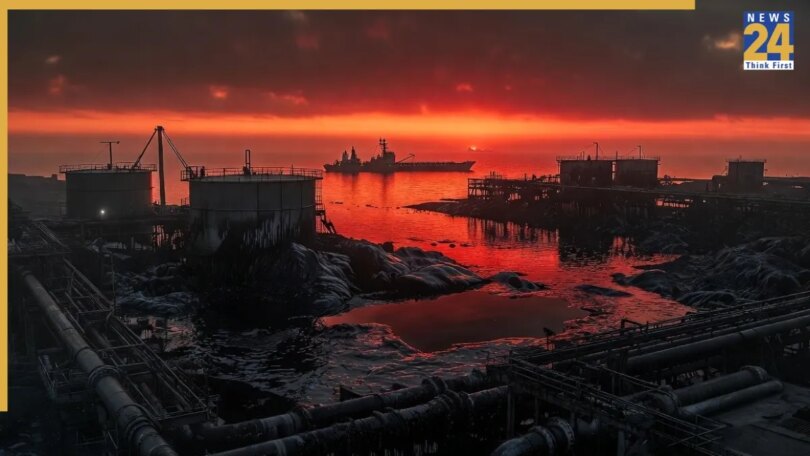
Here comes the most interesting part. Iran is still producing oil every day, but now it cannot sell or ship it out. So where does all this extra oil go? Into storage tanks. As per an April 13 estimate shared in the India Today report, Iran already had 50 to 55 million barrels stored on land. Around 60% of its storage is already full. Only 20 million barrels of free space is left, and Iran is adding 1.5 million barrels daily. Simple maths says the tanks will be completely full around April 26. After that, Iran will have no choice but to shut down its oil wells.
And this is where the real long-term damage begins. Shutting down oil wells is not like switching off a fan. When a well is stopped, the pressure inside drops, water enters, and the underground rock structure can get damaged forever. Iran’s crude oil is also heavy and sticky. If it sits unused, it hardens, forms solid blocks, and clogs the pipelines. One expert compared it to a blood clot blocking an artery. And since most of Iran’s oil fields are very old, this damage can be permanent.
Once a well is shut, restarting it can take years. And even after restarting, it may never give the same amount of oil as before. Experts say Iran could lose 3 to 5 lakh barrels per day, which means a yearly loss of 9 to 15 billion dollars, roughly 75,000 crore to 1.25 lakh crore rupees. For a country whose economy already runs mostly on oil exports, this is a huge blow.
Yes, Iran has been using “shadow fleet” tankers — ships that move oil secretly to escape sanctions. But this method handles only small amounts and cannot empty Iran’s overflowing storage tanks.
So the full picture is now clear. Trump has extended the ceasefire only on paper. The real war has shifted from the skies to the seas and into the oil tanks. By blocking exports and forcing wells to shut, Trump is trying to break Iran’s economy and push it towards accepting US terms. This is not chickening out. This is a calculated, silent, and very dangerous trap.
(Girish Linganna is an award-winning science communicator and a Defence, Aerospace & Geopolitical Analyst. He is the Managing Director of ADD Engineering Components India Pvt. Ltd., a subsidiary of ADD Engineering GmbH, Germany.)