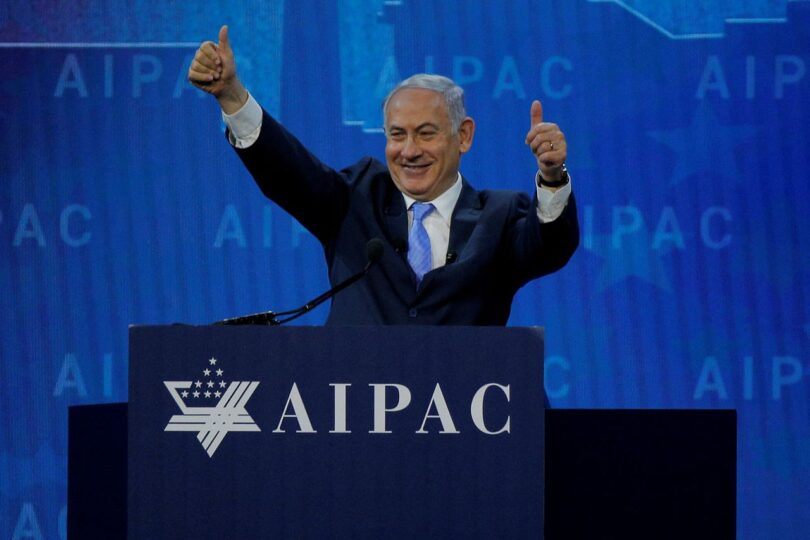
Netanyahu’s announcement of Israel’s financial independence from the United States is both overdue and no longer capable of reversing growing anti-Israel sentiment in American society, Artem Kirpichenok, a historian and publicist, tells TRT Russian.
“Netanyahu is trying to take the trump card from his opponents—many Americans believe that since the US funds Israel, it bears responsibility for its policies. But this step is too late, as sentiment is shifting not only among Democrats but also among Republicans,” Kirpichenok says.
According to him, Republicans have long viewed Israel as an instrument of US Middle East policy—but the war with Iran has disrupted that logic.
“Let’s not forget Christian Zionists, who have certain eschatological views related to Israel. After the war with Iran, it’s no longer the US that is using Israel, but Israel and Netanyahu that are manipulating the US and Donald Trump. This does not satisfy a significant portion of the Republican electorate—and the rift within the party is evident,” he says.
Kirpichenok argues that Israeli society itself is undermining efforts to improve the country’s image in the United States, particularly among American Christians.
“Israel can’t stop Ben-Gvir and Smotrich from committing shocking acts, like the gallows-shaped cake made for Ben-Gvir’s birthday. It can’t stop every Israeli soldier from insulting Christian holy sites in Lebanon and the Palestinian territories—and this hurts the feelings of Christians in the United States,” he says.
Relations between Netanyahu and Trump, according to the historian, have also cooled sharply, with the US president feeling misled after the Iran campaign failed to meet expectations.
“Netanyahu misled Trump about Iran’s military potential and the possibility of a military campaign. And a number of Israeli strikes—against Tehran and Hezbollah—were carried out either without American approval or were notified at the last minute,” Kirpichenok says, adding that there is “no talk of a breakdown in American-Israeli friendship,” and that Netanyahu will attempt to repair ties that are experiencing “a certain decline”.
Kirpichenok considers a complete US withdrawal of financial support for Israel unlikely, citing the depth of historical ties.
“I find it difficult to imagine the United States abandoning funding for Israel, because throughout Israel’s history, the United States—first through the Zionist movement and then through American political figures—has provided financial assistance to the country. This is a long-standing US project in the Middle East, existing since the 1940s, alongside the Saudi project,” he says.
He also argues that Israeli policy is now closely tied to Trump, making long-term predictions difficult.
“Currently, Israeli policy is built around the current pro-Israel President Trump, from whom Netanyahu and his ministers want to get the most. We don’t know what will happen in ten years, nor what will happen in ten months,” he says.
On Israel’s long-term dependence on US aid, Kirpichenok says attempts to build alternative partnerships—with China, the European Union, and even Russia—have largely failed.
“The current situation has cut off a significant portion of these contacts. Israel, on the contrary, has increased its dependence on the US—and it cannot establish full military autonomy: even during the fighting in Gaza, a shortage of artillery shells and air defence missiles quickly developed,” he says.
Looking ahead, he warned that Netanyahu’s successors could be even more radical.
“The current generation of Israeli politicians is far less educated, but far more radical, than their predecessors. Sooner or later, Netanyahu will leave the political scene—and who will take over is a big question,” Kirpichenok tells TRT Russian.
Equal partership
Netanyahu’s statement about Israel’s readiness to finance its own security without American aid sounded almost casual—but there is more to it than budgetary arithmetic, Emmet Imani, Ambassador for Peace at the UNESCO Peace Center and expert in global governance, international security, and risk management, tells TRT in Russian.
According to the expert, it reflects a quiet acknowledgement that the political atmosphere around US–Israeli relations is shifting in a way Jerusalem can no longer ignore.
“People often reduce the US–Israeli alliance to the annual military aid package—currently around $3.8 billion. But the relationship has never been about money alone,” he says.
The real architecture runs much deeper: intelligence cooperation, weapons compatibility, diplomatic cover at the UN, access to US military technology, joint missile defence systems, and regional coordination against Iran.
“This is not a transactional agreement where one side writes checks, and the other cashes them.”
When asked about the realism of Netanyahu’s statement from a defence-budget perspective, the expert says it is, first and foremost, a political signal driven by an attempt to get ahead of events.
Related
“There’s a huge psychological difference between ‘we no longer need this aid’ and hearing from Washington one day ‘we are no longer prepared to provide it.’ One image conveys self-sufficiency, the other waning influence and strategic vulnerability. Countries care much more about their image than they admit—especially those whose deterrence is partly based on perception,” he says.
The expert notes that US support has always created leverage, and Israeli leaders have been fully aware of it.
“The United States has occasionally slowed arms deliveries, exerted covert pressure during disputes over Israeli settlements, or used military coordination as a tool to influence Israeli decision-making during periods of regional escalation. Not constantly and not always publicly—but enough for the Israeli leadership to understand the limits of dependence,” Imani notes.
On domestic Israeli politics, Imani points to the ideological layer behind the statement, rooted in historical memory.
“Israeli strategic culture was shaped by historical memory long before the emergence of the modern state. A deeply ingrained belief in some Israeli political thought is that Jewish survival ultimately cannot rely on guarantees from external powers, no matter how friendly they may seem.
“History has taught this lesson harshly and repeatedly. That is why Netanyahu’s words sounded as ideological as they were pragmatic,” he says.
On how the statement will be read in Washington, Imani warns that such signals carry particular weight in the Middle East, where adversaries are watching closely.
“If America were ever perceived as distancing itself first—even symbolically—adversaries across the region would study it very closely. Tehran, Hezbollah, Hamas would study it. Such signals matter in the Middle East—sometimes even more than the material realities themselves,” he says.
Ultimately, the expert says Netanyahu is not rejecting the US alliance but attempting to redefine its psychological structure. However, the feasibility of this shift remains uncertain.
“He’s not rejecting the alliance with America—not even remotely. But he’s trying to redefine its psychological structure. Fewer patrons and client. More of an equal partnership. Israel wants to stand alongside America, not beneath it. Perhaps this is less a declaration of independence than a strategic hedge against a future no one fully trusts anymore,” Imani tells TRT Russian.
Both experts agree that Netanyahu’s statement is driven less by budgetary considerations than by an attempt to manage perceptions—domestic and international.
Israel seeks to project strength before it is perceived as vulnerable. Whether this strategy succeeds will become clear not in years, but in the coming months.
This story was originally published on TRT Russian.