
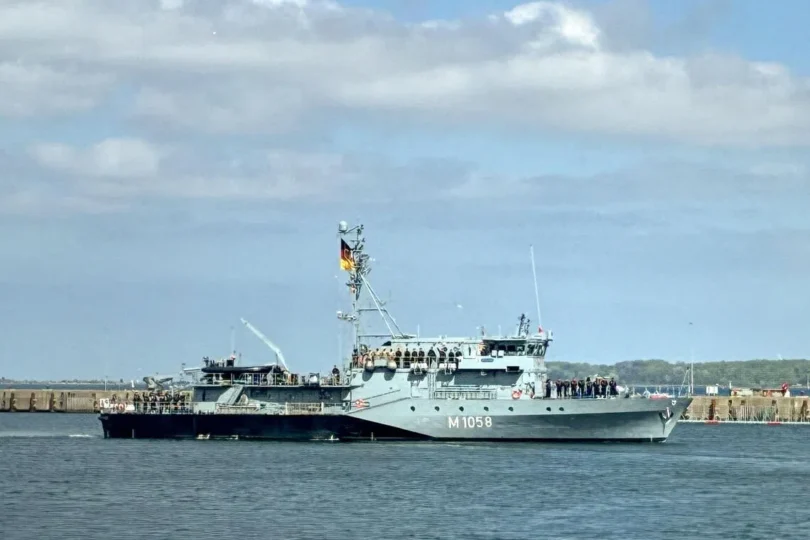
Britain and France have finalised plans to lead a multinational mine-clearing mission in the Strait of Hormuz within days of an agreement between the US and Iran to reopen the waterway, according to people familiar with the matter.
Shipping in one of the world’s most critical trade corridors remains at a near-standstill with the US and the Islamic Republic clashing in the Persian Gulf earlier this week amid fraught efforts to agree to an interim deal to restore maritime traffic to prewar levels.
Military planners in multiple countries are at an advanced stage in their plans to join efforts to rid the strait of naval mines laid by Iran’s Islamic Revolutionary Guard Corps, said five people familiar with the talks.
On June 3, US President Donald Trump downplayed the threat posed by Iranian sea mines to commercial shipping. He said US forces had “gotten most of them”. A day earlier, Secretary of State Marco Rubio told senators that Iran had mined large sections of the strait.
Trump added that the strait would reopen “immediately” once Iran signs a memorandum of understanding to end hostilities. Yet the two countries are struggling to agree to terms, and Iran’s Foreign Minister Abbas Araghchi said on June 4 that there has been no progress in their talks while Israel continued its offensive in southern Lebanon.
Three of the people familiar with the demining mission said it will involve a coalition of 15 countries, which have already committed military personnel and assets. They are likely to join the mission weeks after it starts in order to provide reassurance to commercial vessels and while planning is largely complete, they are still looking to source some additional equipment, particularly support ships, the people added.
Deployments will not start before there is an agreement between the US and Iran that restores full and unimpeded commercial navigation rights as well as a permissible environment for military assets in the strait, according to the people, who did not want to be named citing sensitive operational matters that have not been made public.
The advanced planning for the mission shows European powers want to take a key role in maintaining stability and security in the Persian Gulf once the US and Iran agree to end hostilities in the waterway. Europe has largely resisted supporting Trump’s war and he has heavily criticised the continent’s leaders and the North Atlantic Treaty Organisation (NATO) for not backing his offensive.
British Foreign Secretary Yvette Cooper told reporters this week the mission had been discussed with the US. Its aim was “to ensure we have additional demining capability wherever it might be needed, and also to have the support there to be able to provide escorts for shipping or reassurance for shipping if it is needed,” she said.
The Britain-France-led mission will be ready to open a line of communication with Tehran on operational matters, the people said, adding that while Iran has indicated it wants to demine the strait itself, Britain and France do not think it has the capabilities to do so and would prefer to manage the sweep themselves.
Britain’s Royal Navy sent RFA Lyme Bay, loaded with a suite of autonomous mine-hunting systems, from Gibraltar toward the strait in late May, the navy said.
The US does not have any purpose-built mine countermeasures ships in the region and is retiring its fleet of four remaining wooden-hulled Avenger class minesweepers. Two Littoral Combat Ships, the USS Tulsa and USS Santa Barbara, are in the Indian Ocean and Persian Gulf, according to US Naval Institute ship tracking data updated on June 1. Littoral Combat Ships can be fitted with a minesweeping mission package. BLOOMBERG