
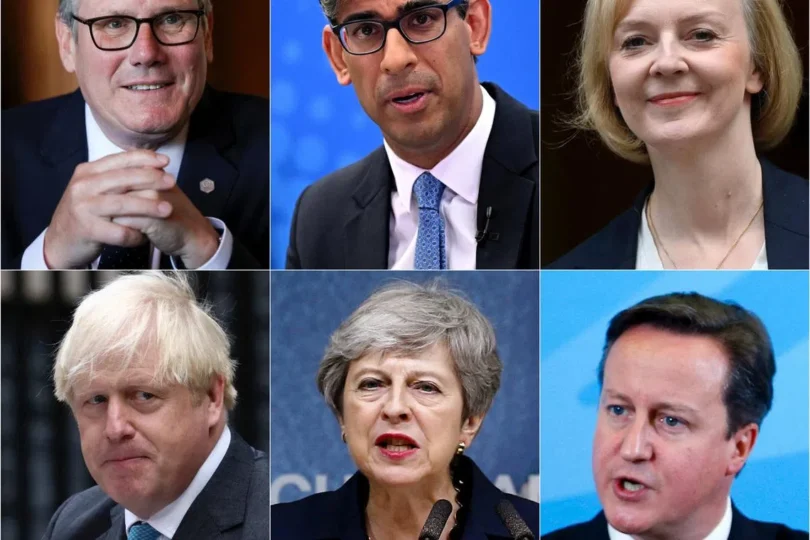
LONDON, June 22 – On Monday morning, Keir Starmer emerged into the sunshine in Downing Street flanked by his staff and wife, his voice thick with emotion as he said he was no longer the right person to lead Britain.
Starmer, who won one of the biggest landslides in British political history, is out after less than two years. The sixth leader to quit in 10 years. The highest rate of political turnover in almost two centuries.
Like his predecessors, Starmer failed to stem popular anger over living standards, which have stagnated since the 2008 financial crash, while ballooning national debt due to global shocks like the COVID pandemic has shackled government spending.
The failure to tackle illegal immigration has also sown deep political divisions.
Anthony Seldon, a historian who has charted the fortunes of UK prime ministers in books such as “The Impossible Office”, said Britain was in a very deep hole after Starmer and predecessors such as Liz Truss and Boris Johnson failed to inspire confidence and trust by setting out a clear narrative.
Referring to Starmer’s likely successor, he told Reuters: “If Andy Burnham fails as prime minister, the outlook for Britain is bleak.”
ONCE A PILLAR OF STRENGTH
Britain was once seen as a pillar of political and economic stability, home to leaders such as Margaret Thatcher and Tony Blair whose combined 21 years in power helped reshape modern Britain.
But the global financial crisis hammered Britain, which was hugely reliant on an outsized financial sector for its economic growth, while the public sector austerity that followed left the country ill-prepared for what came next.
The last prime minister to win an election outright, without the support of another party, and to serve a full term was Blair between 2001 and 2005. Where once Britain mocked Italy’s ever-changing roll call of leaders, it now looks at Giorgia Meloni with envy. She is set to become the longest-serving head of government in the history of the Italian Republic with nearly four years in power.
While many analysts link Britain’s instability to the Brexit vote 10 years ago this week to leave the European Union, Jill Rutter, a former finance ministry official and a senior fellow at the Institute of Government (IfG) think tank, said it started with the crash.
“There has just been a general sense that we don’t see our lives getting better and we don’t see the lives of our children getting better,” she said. “And each government since has seemed to be unable to change that.”
In 2016, Britain ripped up its long-term foreign policy model by voting to leave the EU, reigniting the independence movement in Scotland, where the electorate had voted to remain.
Its financial response to the COVID-19 pandemic and Russia’s full-scale invasion of Ukraine also pushed national debt levels to just below 100% of GDP.
While the likes of Japan, Italy, the United States and France all have higher debt to GDP ratios, Britain has higher borrowing costs in part due to sticky inflation and concern about its reliance on foreign investors to fund its deficit.
That constraint on spending has hit living standards badly.
Data in 2025 from supermarket Asda and the Centre for Economics and Business Research showed that while average real disposable income was rising in the UK, the lowest-earning 40% had less spending power then than they did in 2021.
WHY NOTHING WORKS
Sam Freedman, a former government adviser, argued in his recent book “Failed State: Why Nothing Works and How We Fix It”, that Britain was too centralised and its key offices of state too small to cope.
On top of that the IfG’s Rutter and Roger Gale, one of Britain’s longest-serving lawmakers who entered parliament in 1983, said the culture of British politics has got worse. Rolling television channels and social media force politicians to make decisions at speed.
Gale, a Conservative lawmaker, told Reuters government needed to slow down. “There is too much legislation. A lot of it is bad and a lot of it is badly drafted,” he said.
“We need more grown up government.”
Starmer has been criticised for arriving in government without much of a plan on how he would tackle everything from soaring electricity costs to the need to spur investment, improve the health service and spend on defence.
His rival Burnham, a career politician who was most recently the mayor of Greater Manchester, could potentially take over in a matter of weeks, and will need to install a cabinet and set out a clear vision for the country.
Rishi Sunak, the last Conservative prime minister who lost the 2024 election to Starmer, said Burnham needed a plan.
“Without that, he will become yet another prime minister lying awake fretting about why it isn’t working,” he wrote in the Sunday Times. REUTERS