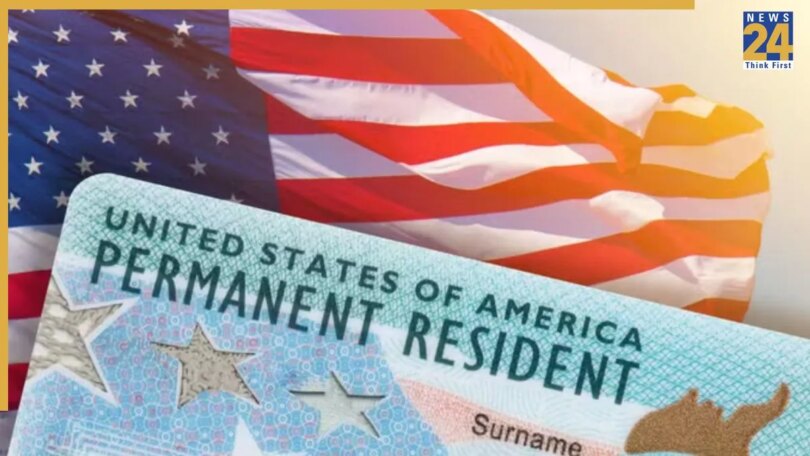
Foreign professionals living and working in the United States may not be required to leave the country while pursuing permanent residency if they can demonstrate that their work benefits the US economy or serves the national interest, according to a recent clarification from immigration authorities.
The statement comes after confusion surrounding a new policy interpretation issued by the US Citizenship and Immigration Services (USCIS), which appeared to suggest that many temporary visa holders seeking green cards would have to complete the process from their home countries.
The announcement had raised concerns among thousands of Indian professionals on H-1B visas, many of whom already face lengthy waits for employment-based green cards.
USCIS clarifies position
Addressing concerns in interviews with Newsweek and Semafor, USCIS spokesperson Zach Kahler said individuals whose work provides economic value to the United States or advances national interests would likely be allowed to continue their green card applications from within the country.
Read More: US-Iran peace deal remains uncertain, Trump lays out ‘red lines,’ demands…, Tehran says ‘no final agreement’ reached
However, he noted that decisions would be made on a case-by-case basis and some applicants could still be required to complete the process through US consulates abroad.
What prompted the confusion?
The uncertainty stems from a USCIS policy memorandum released earlier this month that revises how the agency evaluates adjustment-of-status applications.
Adjustment of status, filed through Form I-485, allows eligible temporary visa holders to apply for permanent residency without leaving the United States. For years, it has been a common pathway for workers seeking green cards while remaining employed in the country.
Under the updated interpretation, USCIS stated that adjustment of status should be viewed as a discretionary form of relief rather than a standard immigration benefit.
Read More: ‘Iran must agree to never…’: Trump to convene emergency meet in Situation Room on Iran peace deal, says will remove naval blockade if…
In its initial explanation, the agency said temporary visa holders would generally be expected to return to their home countries to complete green card processing unless exceptional circumstances justified remaining in the US.
The language triggered alarm among immigration attorneys, employers and foreign workers, particularly in the technology industry, where a large share of employees rely on H-1B visas.
Why H-1B visa holders may be less affected
The latest clarification suggests that H-1B workers remain in a stronger position because the visa category permits what is known as ‘dual intent.’
This allows individuals to legally maintain temporary work status while simultaneously pursuing permanent residency.

USCIS acknowledged that filing an adjustment-of-status application does not conflict with maintaining H-1B status. However, the agency emphasised that holding an H-1B visa alone will not automatically guarantee approval to continue the process from inside the country.
Immigration officers will have broader authority to assess each case individually. Applicants who can show that their work contributes significantly to the US economy or national interests are expected to receive more favourable consideration.
Read More: WATCH: Blue Origin’s New Glenn rocket explodes during ‘hotfire test’ at Florida launch pad, massive flames captured
The clarification may also benefit holders of other dual-intent visas, including L-1 intracompany transfer visas.
Why Indian professionals are concerned
The issue is especially important for Indian nationals employed in sectors such as technology, healthcare, engineering and finance.
Indian citizens account for the majority of H-1B visa approvals and face some of the longest waits for employment-based green cards, particularly in the EB-2 and EB-3 categories.
For many applicants, being forced to leave the United States during the green card process could disrupt careers, family arrangements and children’s education.

Immigration experts have also pointed out that overseas processing may lead to long waits for visa appointments at US consulates, potentially keeping workers separated from employers and family members for extended periods.
The uncertainty is even greater for individuals who lose their jobs, as H-1B workers generally have a limited period to find a new employer or leave the country.
Industry and legal concerns
The proposed policy shift has drawn criticism from parts of the business and technology community.
Reports indicate that LinkedIn co-founder Reid Hoffman described the move as potentially damaging to both technology companies and the wider US economy.
Read More: China builds massive nuclear fortress in desert, set to chokehold US with…, Beijing’s plan gets exposed due to…
Immigration attorney Todd Pomerleau also questioned whether the policy could withstand legal challenges, arguing that administrative agencies cannot override immigration laws established by Congress through policy changes alone.
Meanwhile, the Trump administration has defended the revised approach, saying it is intended to restore what it views as the original purpose of US immigration law and prevent misuse of adjustment-of-status provisions.
Advice for Indian H-1B workers
Immigration lawyers are urging applicants to remain cautious despite the latest clarification.
Experts recommend maintaining valid H-1B status whenever possible, even after filing Form I-485. Applicants are also advised to keep records demonstrating their economic contributions, professional expertise and value to their employers.
Read More: US-Iran war to end soon? Washington, Tehran agree on 60-day ceasefire extension, now waiting for…
They should closely monitor future USCIS announcements, as additional guidance is expected in the coming weeks, and seek legal advice before responding to any immigration-related notices.
While the latest clarification has eased fears that all H-1B workers would be forced to leave the United States during the green card process, significant uncertainty remains.
With immigration officers expected to exercise greater discretion in evaluating applications, many Indian professionals will continue to watch developments closely as USCIS rolls out further details on how the policy will be implemented.
First published on: May 30, 2026 07:25 AM IST
Get Breaking News First and Latest Updates from India and around the world on News24. Follow News24 on Facebook, Twitter.
End of Article
Related Story