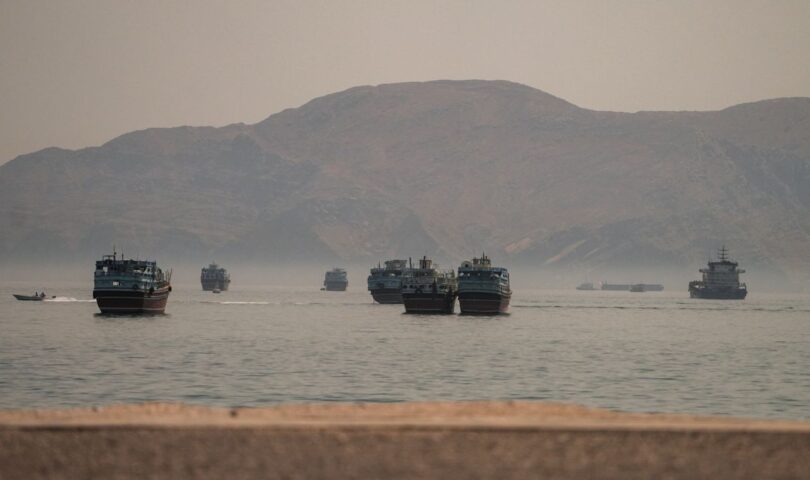
Around 80 mines still need to be cleared from the shipping channel in the Strait of Hormuz. This is one of the many reasons the waterway’s reopening bears little resemblance to the “Ships of the World, start your engines” moment US President Donald Trump promised when he announced the US-Iran deal.
A handful of vessels began transiting the waterway on Thursday, after the signing of the Memorandum of Understanding (MoU).
But most global shipping remains on hold, and nearly four months after its shutdown, the gap between the political announcement and reality on the ground remains wide.
According to tanker owners, the strait’s main shipping channel remains closed and unsafe.
The MoU commits Iran to making “best efforts” to ensure safe, toll-free passage for commercial vessels for 60 days, while aiming to restore full maritime traffic within 30 days. The agreement covers the shipping routes between the Persian Gulf and the Sea of Oman.
“The traffic of commercial vessels will immediately start, and considering the need for removing the tactical and military obstacles and de-mining by the Islamic Republic of Iran will be instated within 30 days,” the MoU stated.
Beyond that window, the MoU leaves the strait’s long-term management to further talks between Iran and Oman, to be conducted “in line with applicable international law”.
The guarantee of free passage is temporary. Tehran has already said it intends to charge ships fees to cover the cost of managing the waterway once the 60-day period expires.
Iran may be seeking changes to the security and political arrangements governing the strait, although doing so could prove difficult given the terms of the agreement, according to Moonis Ahmar, a scholar at the University of Karachi.
“The Iranian side will try its level best to maintain some sort of control, and that could create some problems or impediments. After all, this is a very fragile MoU, and there is a 60-day implementation period. Any misunderstanding or non-implementation of the agreement could create issues,” Ahmar tells TRT World.
“What Iran intends to achieve remains unclear. If it intends to impose tolls, that would not be acceptable to the US, the Gulf countries, or the wider international community.
“Another important point is that this MoU has to be formally endorsed by the UN Security Council,” he adds.
RELATEDTRT World – The Strait of Hormuz: The chokepoint that could shake the global economy
The numbers at stake
The Strait of Hormuz is an approximately 39-kilometre (21-mile) corridor between Iran and Oman, through which, before the war, a fifth of the world’s seaborne oil and gas passed daily.
Four months ago, between 120 and 140 ships travelled through the strait each day, about half of them tankers carrying a total of 20 million barrels of oil.
Iran has held a critical lever in the Gulf ahead of the talks, according to Professor Mesut Hakki Casin, a scholar at Yeditepe University Faculty of Law.
“A large portion of the world’s oil, around 75 percent, is located in this region, along with major gas reserves. Around 30 percent of global oil and a significant share of energy flows pass through these routes,” Casin tells TRT World.
“Iran has followed a consistent tactic since the start of the war. It managed to deceive Israeli and US air defence systems, inflicting significant damage,” Casin says.
Since the deal was announced, traffic has barely picked up. Just 26 vessels transited the Strait of Hormuz on Wednesday, according to shipping monitor Windward, while hundreds of others remain stranded on either side of the waterway.
Iran has never confirmed whether it mined the strait. However, Secretary of State Marco Rubio told Congress in early June that Iran had “mined large segments of Hormuz,” without providing further details. Clearing any mines is expected to take weeks.
Mines may be the most visible obstacle, but they are not the only one.
Insurance remains a major bottleneck. Although war-risk premiums have fallen from their wartime peak, they still range from 1 to 3 per cent of the vessel’s hull value, well above the roughly 0.25 percent that was typical before the crisis.
Underlying both issues is something far more difficult to resolve than a signed agreement: trust.
According to Ahmar, it will take time to address technical challenges and clear any mines that may have been laid during the conflict before shipping can fully resume normal operations.