
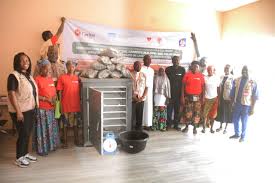
(Some of the donations. Photo credit: Punch Newspaper)
In order to provide them with sustainable livelihoods, the Catholic Bishops Conference of Nigeria has equipped and trained roughly 200 households in Ekiti State with equipment and inputs for adding value to agricultural outputs.
After training the beneficiaries in vocations and skills, such as rice processing, fish processing, tomato and pepper processing, cassava processing, and fish production in Ekiti West and Irepodun/Ifelodun local government areas, the bishops, through their humanitarian services delivery arm, Caritas Nigeria, provided start-up kits for them to engage in production.
Felix Ajakaiye, the Catholic Bishop of the Ekiti Diocese, gave a speech at Aramoko Ekiti on Wednesday during the graduation ceremony of vocational skills trainees and distribution of start-up kits to them, hailed Caritas for living up to its billing of ensuring people, particularly the poor and vulnerable, live meaningful lives.
Through the Catholic Sisters Initiative, Caritas and the Conrad Hilton Foundation organized a two-day program that distributed value chain inputs and agricultural capacity building to 200 households in Ekiti State as part of the Building Sustainable Livelihood for Vibrant Community (B-SLiC). The program took place in Aramoko and Igbemo Ekiti.
“The purpose of Caritas is to attend to the poor people in society, irrespective of your gender, your tribe, wherever you have come from, or your religion,” the Bishop stated through the Rev. Fr. Joseph Abegunde. Donors so have access to the society through them. It was founded by the bishops in order to provide humanitarian services to the community.
Ajakaiye, who said the impact of the training and agricultural processing tools distributed would be much on the community, advised the beneficiaries to make good use of the equipment to better their lives and those of others.
He said, “The benefits are so much. Number one is to alleviate poverty. With these, people will work to have sustainable livelihoods, and they will employ some people. It is not only the beneficiaries who will benefit from these, but some other people will also benefit. Some farmers will come around to grind or fry their cassava, process rice, etc. So it is a benefit to the communities.”
The Executive Secretary, Caritas Nigeria, Rev. Fr Babangida Aliyu, said the initiative “is not just merely about giving tools, it is about restoring dreams, strengthening families and reducing poverty. When one person becomes economically empowered, an entire household is also uplifted.
He said, “So, when many people gain sustainable means of livelihood, the society itself becomes more stable and more prosperous.”
The Caritas boss congratulated the beneficiaries, saying, “This is just a beginning for you. Use the knowledge you have gained and the tools and inputs appropriately.
I urge you to turn these tools into thriving businesses, these opportunities into lasting success, and this small beginning into inspiring testimonies”.
The Onigbemo of Igbemo Ekiti, Oba Adewumi Daramola, and the Regent of Aramoko Ekiti, Mrs. Adekemi Adeyemi-Owolabi, the traditional leaders of the two communities in the two local government areas, expressed gratitude to Caritas for the gesture, which they claimed would significantly aid in the eradication of poverty in their communities, local government areas, and state.
The regent urged recipients to make excellent use of the equipment to eradicate poverty, while Oba Daramola cautioned them against abusing the opportunity and selling the tools. Both traditional rulers promised to monitor the equipment at the various locations where it operates.
In a speech to the recipients, Nkese Udongwu, Director of Humanitarian Services at Caritas, added, “Take these seriously.” Make sure your livelihoods are sustainable by doing your own. From here, you may start hiring workers. We want people to be pulled out of poverty in a sustainable way, and we want you to succeed.
“Under the program billed for two local government areas in Lagos State and two LGAs in Ekiti, Caritas is training and empowering 400 households – 200 in Lagos, 200 in Ekiti,” stated Udongwu, who described the distribution of agricultural inputs and processing tools in the two local government areas in Ekiti State.
“B-SLiC is meant to lift people out of poverty through giving them sustainable agricultural livelihoods. We have also been able to empower people not only for fish production, but also for fish processing, i.e., the drying of fish to sell.
“For fish production, as they set up, we are going to give each group 250 fingerlings to start their production with the feed.
“We have also trained people and given them machinery to produce tomato paste, tomato powders and pepper powders, to brand them in bottles and containers and sell.
“We have also trained people on how to process garri (cassava flakes). So, we have given them the entire package from the grinding machine to the cassava pressing machine to the frying, the expansive frying pan where up to six people can stay to fry. And then we have given them the bags of processing and sealing and things to brand it.
Additionally, we have taught individuals in a number of other areas. As you can see, we are providing them with the entire bundle of machinery today.
We distributed food and livestock to locals at Ikogosi Ekiti in Ekiti West last month. Producers of cereals and crops like corn, cassava, and farm inputs are those who will make seeds for planting in the next season. Thus, we empower individuals and make sure they lead sustainable lives.
Additionally, we teach them climate-smart farming techniques so they can make their own fertilizer instead of having to purchase inorganic fertilizer. In order for them to be sustainable and not just dependent on a handout somewhere, we’re also teaching them how to make part of the feeds themselves, according to Udongwu.
Traditional leaders, state Ministry of Women Affairs personnel, and the chairs of the two local government regions were present at the celebrations.