
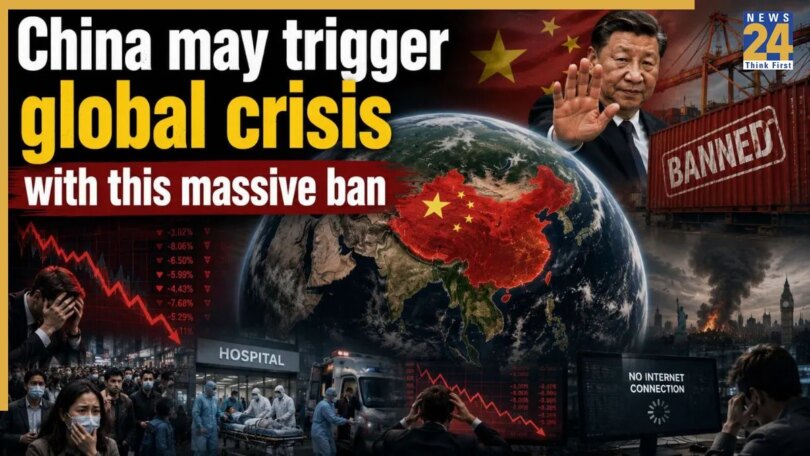
Amid rising geopolitical tensions, China has announced a ban on helium exports, a move that could disrupt the global semiconductor industry and put additional pressure on chip manufacturers worldwide.
China plays a major role in the global helium supply chain, accounting for nearly 80 per cent of helium exports. Industry experts warn that if the restrictions continue for an extended period, semiconductor manufacturers could face higher production costs and increased supply chain risks, potentially leading to higher prices for electronic products.
Why is helium important for semiconductor manufacturing?
Although helium accounts for only a small share of chip manufacturing costs, it is essential in several stages of semiconductor production. Experts say there is currently no practical substitute for helium in many critical manufacturing processes, making it a strategically important industrial gas.

Advanced semiconductor manufacturing also depends on specialised chemicals and industrial gases, with helium considered one of the most crucial because of its unique physical properties.
Qatar supply hopes face fresh setback
The latest disruption comes after earlier concerns surrounding Qatar’s Ras Laffan processing plant, one of the world’s largest helium production hubs, which was affected by military attacks earlier this year.
Read More: No Instagram, YouTube after midnight? This country plans social media curfew from midnight to 6 am for teens due to…
Although supply conditions were expected to improve after the conflict eased, China’s decision to suspend helium exports has once again tightened an already constrained global market.
Where is helium used?
According to TechInsights semiconductor analyst Manish Rawat, helium remains indispensable due to its high thermal conductivity, chemical inertness and ultra-low boiling point.
The gas is widely used for wafer backside cooling, leak detection, cryogenic systems, inert purging, ion implantation and metrology processes during semiconductor manufacturing.

Rawat noted that while helium contributes only a small fraction of fabrication costs, it represents a critical single-point dependency. Any disruption in supply can directly affect production.
Helium is also used in manufacturing GPUs, AI accelerators, logic chips, DRAM, NAND flash memory, High-Bandwidth Memory (HBM), automotive chips, RF components and power semiconductors.
Why China’s decision matters
Greyhound Research CEO and Chief Analyst Sanchit Vir Gogia said the global helium supply chain was already highly concentrated even before the latest disruption.
According to industry estimates, the United States supplied around 81 million cubic metres of Grade-A and gaseous helium in 2025, while Qatar produced nearly 63 million cubic metres out of the global total of around 190 million cubic metres. Russia, Algeria and Canada contributed significantly smaller volumes.

South Korea, one of the world’s largest semiconductor manufacturing hubs, sources nearly 65 per cent of its helium imports from Qatar, highlighting the industry’s dependence on a limited number of suppliers.
Although China is not among the world’s largest helium producers, it plays a critical role in refining, distributing and supplying helium to semiconductor manufacturers across Asia. Experts believe the latest export restrictions could further tighten global supplies and increase pressure on the semiconductor industry.
Read More: Iran downs MQ-9 drone, says US strikes hit children’s cancer hospital in Ahvaz
First published on: Jul 16, 2026 02:21 PM IST
Get Breaking News First and Latest Updates from India and around the world on News24. Follow News24 on Facebook, Twitter.
End of Article
Related Story