Colleagues, friends and associates of the late Retired Maj.-Gen. Abubakar Rabe have called for urgent reforms in Nigeria’s security architecture, following his death in the hands of bandits after being kidnapped in Katsina State.
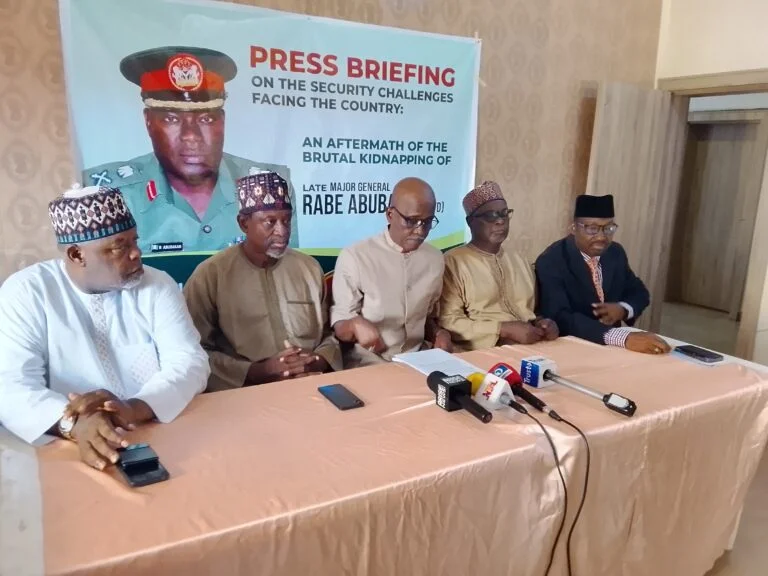
The group made the call at a press briefing on Thursday in Kaduna while mourning the retired military officer, who died after being abducted alongside his wife, Hajiya Amina, around the Matazu area of Katsina State.
Speaking on behalf of the group, retired Brig.-Gen. Ismaila Abdullahi described the late officer as a distinguished military professional whose career was defined by loyalty, integrity and dedication to national service.
According to him, the death of Gen. Rabe is not merely an isolated incident but a reflection of the broader security challenges confronting the country.
“Kidnappings, banditry and terrorism have become a daily reality for many Nigerians, while public confidence in government’s ability to protect lives and property continues to decline,” he said.
The group acknowledged the efforts of the Federal Government and the Katsina State Government, particularly the operation that led to the rescue of the late officer’s wife.
Read Also:Editorial: Abubakar Rabe’s death and Nigeria’s lingering insecurity crisis
They also commended the President and Commander-in-Chief of the Armed Forces for his strong reaction to the incident and his pledge to take an uncompromising stance against terrorism and kidnapping.
However, the group expressed concern over what it described as persistent shortcomings in the nation’s counter-insurgency and anti-banditry efforts.
According to them, insecurity has spread across the country to the extent that it is increasingly difficult to distinguish between conflict zones and peaceful regions.
They noted that successive administrations had struggled to implement effective measures against terrorism and banditry, resulting in recurring attacks, abductions and loss of lives.
The group cautioned against politicising the nation’s security challenges or giving them ethnic and regional interpretations, stressing that terrorism and kidnapping are national problems requiring collective action.
They urged Nigerians to engage in deeper reflection on the root causes of insecurity and support efforts aimed at strengthening national unity and security cooperation.
The retired officers and associates also called for stronger political will at all levels of government to address the security crisis.
While welcoming existing bilateral security partnerships between Nigeria and countries such as the United States, they maintained that the primary responsibility for securing Nigeria rests with Nigerians and their institutions.
Read Also:Gen. Rabe’s death exposes security failure, CISLAC demands probe of defence spending
“No foreign nation can defend Nigeria for us. Effective security strategies must be driven by strong national institutions, adequate funding and coordinated implementation,” the group stated.
They advocated improved border security and stronger regional cooperation with neighbouring countries, including Niger, Chad, Cameroon and Benin Republic, to curb the illegal movement of arms and criminal elements.
The group further called on the 19 Northern governors to develop and implement a regional security framework aimed at addressing banditry, terrorism and the proliferation of illegal weapons.
They also urged authorities to regulate and monitor logistics and support systems exploited by criminal groups to sustain their activities.
Drawing lessons from international experiences, the group cited examples of countries that successfully confronted terrorism through sustained political commitment and coordinated security operations.
They emphasised the need for governments at all levels to provide timely support to the families of serving and retired military personnel who die in service or become victims of terrorism and kidnapping.
The group also appealed for intensified efforts to secure the release of all persons currently held in captivity across the country.
They expressed optimism that with stronger institutions, political commitment and citizen cooperation, Nigeria could overcome its security challenges.
The News Agency of Nigeria (NAN), report that the press briefing was attended by retired Brig.-Gen. Ismaila Abdullahi, Amb. Mohammed Musawa, retired Air Commodore Yusuf Anas, retired Brig. General Abubakar Abdulqadir, Amb. Ibrahim Usman -Gafai-, Amb. Ahmed Musawa, retired Brig. General Maharazu Tsiga, and retired Deputy Comptroller General NSCDC – Aminu Abdullahi