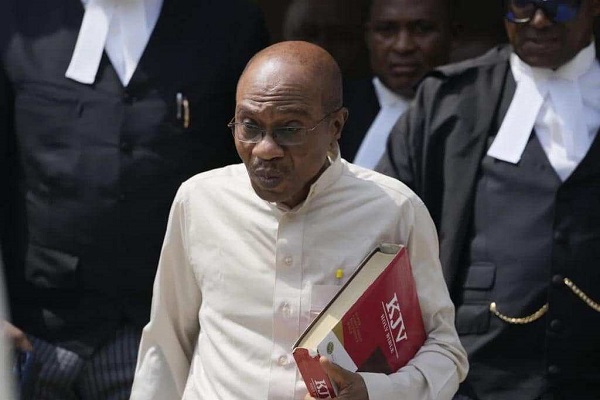
Proceedings in the trial of former Central Bank Governor, Godwin Emefiele, were stalled on Friday following a heated legal battle between prosecution and defence teams at the Ikeja Special Offences Court.
The presiding judge, Rahman Oshodi, fixed May 4, 2026 after both sides adopted their final written submissions in a trial-within-trial.
The dispute centres on whether an extra-judicial statement made by co-defendant, Henry Omoile, was obtained voluntarily.
Emefiele is currently facing a 19-count charge. The charges relate to alleged gratification, abuse of office, and corrupt demands linked to financial dealings during his time at the apex bank. Omoile, on the other hand, is being tried on a separate three-count charge over claims of unlawful acceptance of gifts connected to transactions involving the Central Bank.
According to the prosecution, the case involves transactions valued at about $4.5 billion and N2.8 billion.
During the session, defence counsel Adeyinka Kotoye (SAN), who represented the second defendant, argued strongly that the main issue before the court was the voluntariness of the statement in question.
“The issue before this court is whether the statement credited to the second defendant was made voluntarily,” he said.
Kotoye told the court that the process used in obtaining the statement did not comply with relevant provisions of the law. He cited sections of the Administration of Criminal Justice Law and Act, insisting that proper procedures were not followed.
“In situations where voluntariness is contested, video recording of the interrogation is essential. It is the most reliable way to establish compliance with due process,” he submitted.
He also questioned the credibility of the process, noting that there was no independent evidence to back the alleged confession. He raised concerns about the role played by the legal practitioner who was said to be present at the time.
“The mere presence of a legal practitioner is not enough where that counsel was unable to effectively discharge his duty,” Kotoye argued, suggesting the possibility of coercion or inducement.
Counsel to Emefiele, Olalekan Ojo (SAN), supported the position. He urged the court to reject the statement entirely.
“Any doubt regarding the voluntariness of a statement must be resolved in favour of the accused,” Ojo said.
He relied on provisions of the Evidence Act, maintaining that any statement obtained through pressure or improper means cannot be accepted in court. He added that the burden of proof lies with the prosecution once the issue of voluntariness is raised.
“The prosecution has not discharged this burden, particularly in light of the circumstances surrounding the making of the statement,” he said.
However, the prosecution, led by the Director of Public Prosecutions of the Federation, Rotimi Oyedepo (SAN), pushed back against the arguments.
“The first defendant’s counsel cannot challenge the admissibility of a statement he did not object to when it was tendered. That amounts to an abuse of court process,” Oyedepo argued.
He maintained that due process was followed in obtaining the statement. He admitted that the session was not video recorded but insisted it was done in the presence of the defendant’s lawyer.
“Though the statement was not video-recorded, it was made in the presence of the second defendant’s counsel,” he said.
Oyedepo further argued that the content of the statement itself showed that it was made freely.
“The second defendant refused to implicate the first defendant and denied committing the alleged offences. That clearly shows he was not under any form of duress,” he submitted.
He also dismissed claims of intimidation, stating that the process was open and involved multiple individuals. He said the defendant was properly cautioned before making the statement.
Following the arguments, Justice Oshodi adjourned the case to May 4, 2026, for a ruling on the admissibility of the statement. He also fixed June 26 and June 30, 2026, for the continuation of the main trial.