
…Technical, Commercial, Collection Losses Hit N606bn
Eleven electricity distribution companies (DisCos) lost more than N1.2tn to operational inefficiencies and weak revenue recovery in 2025, despite receiving indirect support from a Federal Government subsidy regime that cost N1.93tn during the year.
THE WHISTLER’s analysis of the four quarterly electricity market performance data of 2025 revealed that although revenue collection improved across the sector, significant losses persisted through unbilled electricity, energy theft, technical inefficiencies, poor metering and unpaid customer bills.
The figures highlight the continuing financial challenges facing Nigeria’s power sector, where government intervention remains substantial but structural inefficiencies continue to undermine market sustainability.
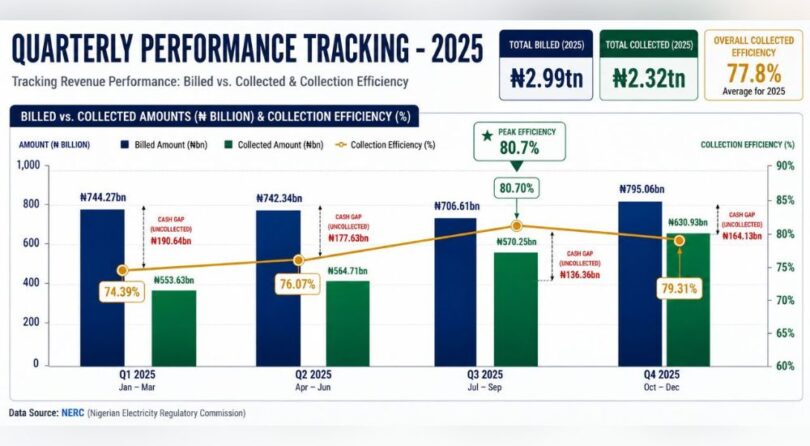
According to the data, DisCos billed electricity consumers a total of N2.99tn in 2025 and recovered N2.32tn, leaving N668.76bn in customer bills uncollected.
Collection efficiency improved steadily during the year, rising from 74.39 per cent in the first quarter to above 79 per cent by the fourth quarter.
However, the sector still failed to recover nearly one out of every five naira billed to customers.
In the first quarter, DisCos billed N744.27bn and collected N553.63bn, leaving N190.64bn outstanding.
Collections improved in the second quarter, with N564.71bn recovered from N742.34bn, while uncollected revenue fell to N177.63bn.
The strongest performance was recorded in the third quarter, when collection efficiency reached 80.70 per cent.
Out of N706.61bn billed, DisCos collected N570.25bn, leaving N136.36bn unpaid.
The further review of the data shows that by the fourth quarter, revenue collection climbed further to N630.93bn from a billed amount of N795.06bn.
However, unpaid bills increased again to N164.13bn.
Despite the challenges, the industry continued to lose substantial revenue because a significant portion of electricity supplied to consumers was never billed.
Market data showed that from the second to fourth quarters, electricity supplied to customers was valued at approximately N2.73tn, but only N2.24tn was billed, resulting in billing losses of N489.29bn.
However, the losses are largely attributed to energy theft, inadequate metering, weak energy accounting systems and the inability of some operators to fully bill customers at approved tariff rates.
Billing efficiency remained relatively stagnant throughout the year at around 82 per cent, indicating that nearly one-fifth of electricity delivered to consumers failed to translate into revenue invoices.
The industry’s Aggregate Technical, Commercial and Collection (ATC&C) losses also remained significantly above regulatory targets.
ATC&C losses stood at 39.61 per cent in the first quarter before improving to 37.92 per cent in the second quarter and 33.27 per cent in the third quarter.
However, the figure rose again to 34.90 per cent in the final quarter of the year.
Under the Multi-Year Tariff Order (MYTO), the regulatory benchmark for ATC&C losses is 20.54 per cent, meaning the DisCos consistently underperformed by wide margins throughout the year.
The financial impact was substantial.
During the year, the estimated revenue losses arising from ATC&C inefficiencies reached N200.50bn in the first quarter, N158.05bn in the second quarter, N108.75bn in the third quarter and N139.19bn in the fourth quarter.
Overall, the sector lost approximately N606.49bn through technical, commercial and collection inefficiencies during the year.
The data further showed that despite collecting more than N2.3tn from customers, DisCos did not fully settle their financial obligations to the electricity market.
Outstanding remittances increased steadily throughout the year.
In the first quarter, DisCos remitted N414.26bn out of a market invoice of N432.13bn, leaving N17.87bn unpaid.
The outstanding balance rose to N18.15bn in the second quarter and N19.18bn in the third quarter.
By the fourth quarter, unpaid obligations had jumped to N34.39bn after only N437.27bn was remitted against an invoice of N471.66bn.