By Aminu Abubakar
Despite widespread deprivation in access to clean drinking water across Zamfara State, budget performance documents have revealed persistently poor funding and implementation levels in the state’s water sector, raising concerns over the government’s response to one of the state’s most pressing social challenges.
Data obtained from the Zamfara State Government Budget Performance Reports for 2025 and the first quarter of 2026 showed that agencies responsible for water supply and sanitation recorded some of the weakest capital expenditure performances among ministries, departments and agencies in the state.
The development comes as national data on household access to clean drinking water ranked Zamfara among states with high levels of deprivation.
According to the distribution of households by deprivation in access to clean drinking water published by the National Bureau of Statistics (NBS) in its multidimensional poverty index, 51 per cent of households in Zamfara are deprived of access to clean drinking water, while only 49 per cent are classified as not deprived.
The figure places Zamfara among states with severe water access challenges, although some states recorded even worse conditions.
Nationally, 38 per cent of households were classified as deprived of access to clean drinking water, meaning Zamfara’s 51 per cent deprivation level is significantly higher than the national average.
Despite the alarming statistics, capital expenditure implementation for water-related agencies in Zamfara remained extremely low.
Read Also:Zamfara govt sponsors mass wedding for 100 vulnerable couples
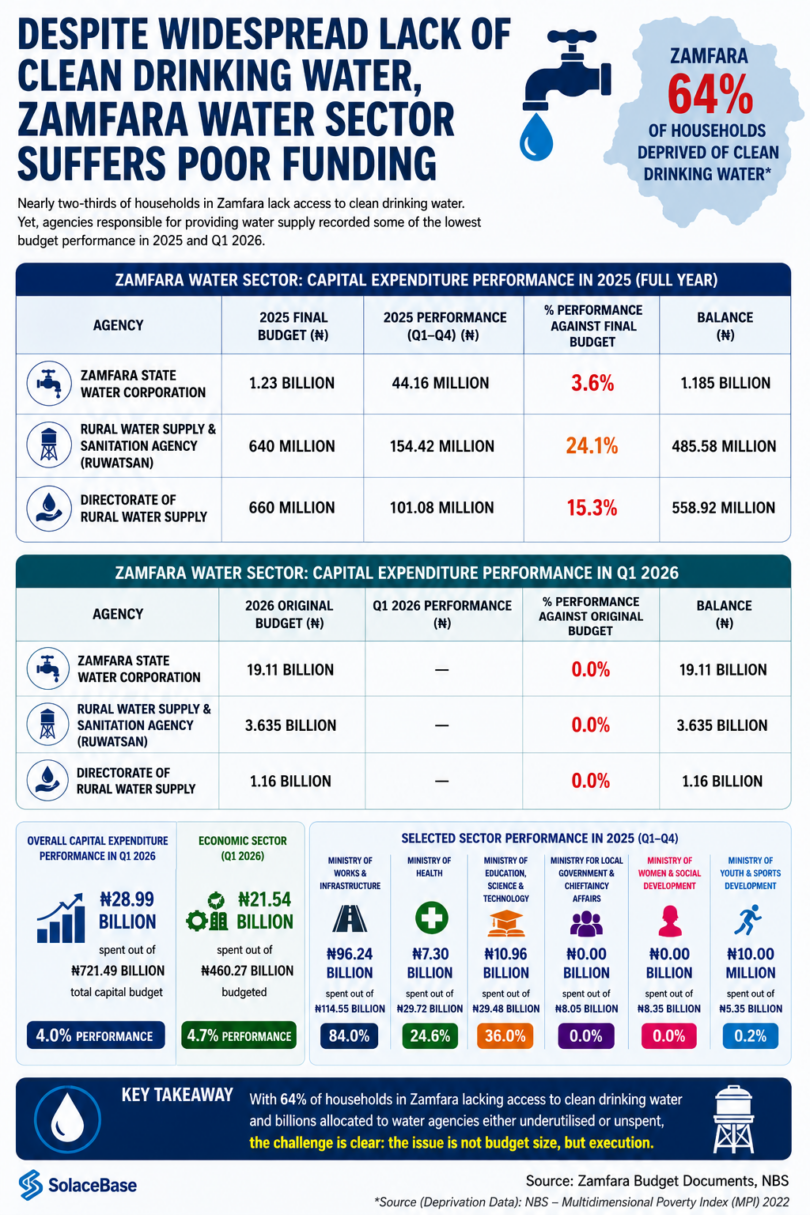
According to the 2025 fourth quarter budget performance report, the Zamfara State Water Corporation had an original capital budget of ₦730 million, which was later revised upward to ₦1.23 billion in the final budget.
However, only ₦44.16 million was spent throughout the year, representing just 3.6 per cent performance against the final budget, leaving an unspent balance of ₦1.185 billion.
The Rural Water Supply and Sanitation Agency (RUWATSAN), which is expected to provide water infrastructure in underserved rural communities, recorded slightly better but still weak implementation.
The agency had a final capital allocation of ₦640 million in 2025 but spent only ₦154.4 million, representing 24.1 per cent budget performance.
Similarly, the Directorate of Rural Water Supply spent ₦101.07 million out of its ₦660 million capital budget, translating to 15.3 per cent implementation.
The poor performance persisted into 2026 despite significant increases in allocations to the water sector.
The first quarter budget implementation report for 2026 showed that the Zamfara State Water Corporation received a capital allocation of ₦19.11 billion for the fiscal year but recorded zero expenditure in the first three months.
RUWATSAN also posted no capital expenditure performance despite receiving a budgetary allocation of ₦3.635 billion.
Likewise, the Directorate of Rural Water Supply, with a capital budget of ₦1.16 billion, recorded no spending in the first quarter.
The reports further showed that Zamfara recorded an overall capital expenditure performance of only four per cent in Q1 2026, after spending ₦28.99 billion out of a total capital budget of ₦721.49 billion.
Read Also:How Zamfara spent billions of naira on Govt House structure, furniture in 2025, plans over N2bn more in 2026
Within the economic sector, which includes critical infrastructure agencies, only ₦21.54 billion was spent out of ₦460.27 billion budgeted for capital projects, representing 4.7 per cent implementation.
In contrast, the Ministry of Works and Infrastructure posted stronger implementation figures.
The ministry spent ₦96.24 billion out of its ₦114.55 billion final budget in 2025, representing 84 per cent performance.
In the first quarter of 2026 alone, the ministry had already spent ₦11.68 billion out of its ₦192.15 billion capital allocation.
Over time, stakeholders have noted that the contrast between the high deprivation figures and low implementation of water projects raises serious questions about sectoral priorities in the state.