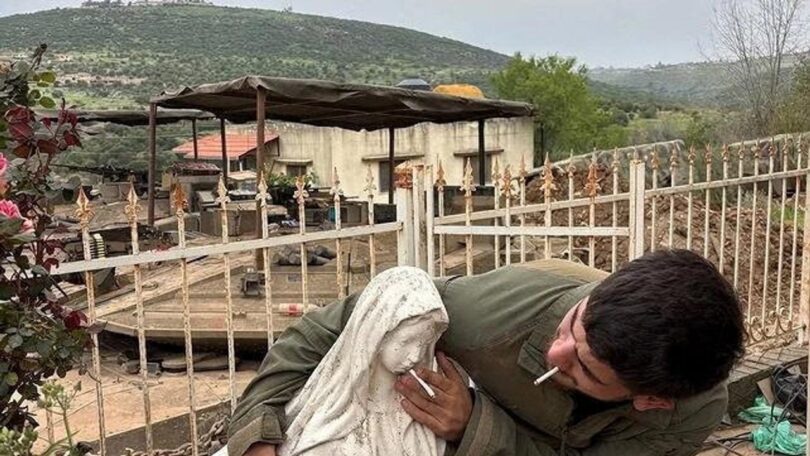
The Israeli military has once again been forced to confirm what it would prefer to explain away. A photograph shared online on May 6 showed an Israeli soldier holding a cigarette to the mouth of a statue of the Virgin Mary in Debel, a village in southern Lebanon.
Army’s spokesperson said the military “views the incident with utmost severity” and that the soldier’s conduct “completely deviates from the values expected of its personnel.”
It was, word for word, the same statement Israel issued less than three weeks earlier when another soldier was filmed destroying a statue of Jesus, also in Lebanon.
The language of official condemnation has become a ritual; predictable, hollow, and increasingly unconvincing to Christian communities watching a pattern take shape across Lebanon and beyond.
For some experts, the repeated desecration of Christian symbols and sites cannot be separated from the ideological foundations underpinning Israel’s conduct in the region.
“Zionism is an expression of settler colonial supremacism and is manifest in apartheid; separation, segregation, sequestration. It can only expand through ethnic cleansing and, where necessary, genocide,” according to Stephen Sizer, an expert on Christian Zionism and former vicar of the Church of England.
“The presence of indigenous people, seen as inferior, is problematic. Denigrating their ethnicity goes hand in hand with desecrating anything they hold dear, such as their faith,” Sizer tells TRT World.
“It is therefore not surprising that while Israel claims to protect and respect religious freedom, in reality it has, for more than a century, desecrated and destroyed Muslim and Christian places of worship,” he adds.
The latest desecration video by the Israeli army surfaced less than a month after another Israeli soldier was filmed smashing a statue of Jesus in Debel, a Christian village in southern Lebanon.
Related
Following the previous incident involving the statue of Jesus, the soldier who smashed the statue and the soldier who filmed him were removed from combat roles and sentenced to 30 days in military prison.
Six other soldiers who witnessed it and did nothing faced only disciplinary discussions, a response critics called wholly inadequate for an act that drew global outrage.
In a statement signed by Cardinal Pierbattista Pizzaballa, the Assembly of Catholic Ordinaries of the Holy Land expressed its “profound indignation and unreserved condemnation,” describing the act as a “grave affront to the Christian faith that adds to other reported incidents of desecration of Christian symbols by IDF soldiers in southern Lebanon.”
The assembly said the incident reflects a “disturbing failure in moral and human formation wherein even the most elementary reverence for the sacred and for the dignity of others has been gravely compromised.”
Over 150 Jewish leaders from multiple denominations around the world also signed an open letter condemning the act, calling it “a chillul Hashem, a desecration of God’s name,” and apologising to the global Christian community.
“In the ongoing sectarian and religious wars in the Middle East and North African region, it is the minuscule and extremely vulnerable Christian communities who have faced the brunt of the attacks,” according to professor Amalendu Misra, scholar of International Politics at Lancaster University, and an expert on religious radicalism.
“It is particularly ironic given Christianity was born here and most of the civilisations and cultural vestiges of this once powerful faith have been treated with extreme intransigence,” Misra tells TRT World.
“The greatest loss to the world community is the destruction of many of Christianity’s ancient places of worship and critical symbols in the land where it evolved more than two millennia ago,” he adds.
A clear pattern
Between the two statue incidents, another episode compounded the picture.
The Israeli military confessed it caused damage to a building within the compound of a Catholic convent near the village of Yaroun in southern Lebanon, though it disputed the extent, claiming the structure bore “no external signs indicating it was a religious building”.
The Catholic Church in Lebanon rejected the military’s false framing. “These are not military bases. These are places to spread peace, love and education,” said Abdo Abou Kassm, director of the Catholic Centre for Information.
The anti-Christian incidents which happened in the last weeks were very serious and are the work of a fanatic minority, according to William Shomali, Patriarchal Vicar for Jerusalem and Palestine.