
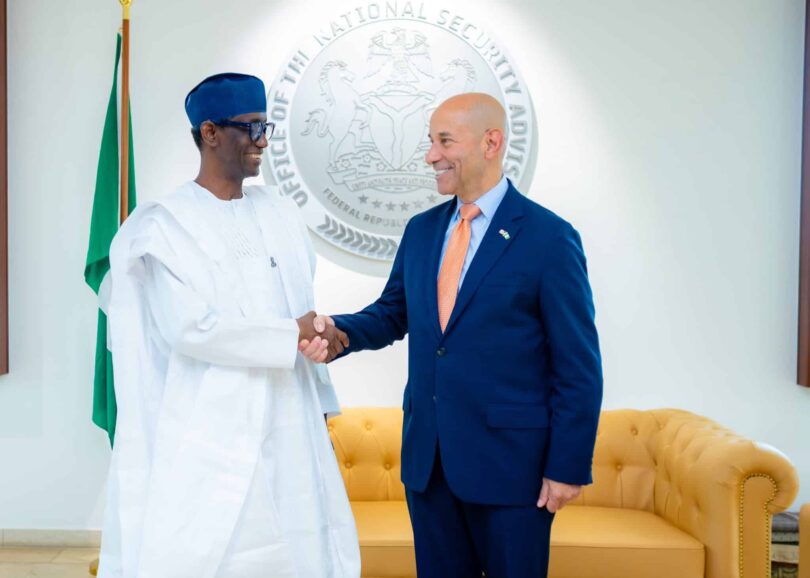
The National Security Adviser (NSA), Nuhu Ribadu, on Monday, held a high-level meeting with a delegation from the United States government led by Assistant Secretary for African Affairs, Frank Garcia.
The meeting was held in Abuja at the NSA’s office, Naijaonpoint reports.
Garcia’s visit to Abuja is his first to Nigeria since he was sworn into office on June 1, 2026, and forms part of a wider tour of West Africa that will also take him to Côte d’Ivoire and Mali between July 11 and 18.
Confirming the meeting, Ribadu said their discussions strengthened the strong and enduring Nigeria-US partnership and assessed progress under the Joint Working Group.
They also reaffirmed both countries’ commitment to closer dialogue and cooperation on mutual security priorities.
“In consolidating the gains of our partnership with the United States, I received a high-level delegation led by the new Assistant Secretary for African Affairs, Frank Garcia, on his first official visit to Nigeria since assuming office.
“My meeting with them strengthened the strong and enduring Nigeria–US partnership and assessed progress under the Joint Working Group, restating our shared commitment to deeper dialogue, cooperation and mutual security priorities,” Ribadu wrote on 𝕏.
Meanwhile, the NSA recently disclosed that porous borders are a major factor fueling terrorism, arms trafficking, smuggling, human trafficking and irregular migration in Nigeria.
Ribadu made the disclosure in Abuja at the opening of the 15th National Security Seminar.
The NSA was represented by the Director of Policy and Strategy at the Office of the National Security Adviser (ONSA), Amb. Yazid Gbemudu, at the seminar with the theme, ‘Strengthening Nigeria’s Border Security Architecture for National Stability’.
He asserted that Nigeria’s territorial integrity and national stability remained closely linked to the effectiveness of its border security architecture.
According to him, while Nigeria’s extensive land and maritime borders provide opportunities for trade, regional integration and socio-economic development, they also expose the country to a range of transnational security threats.