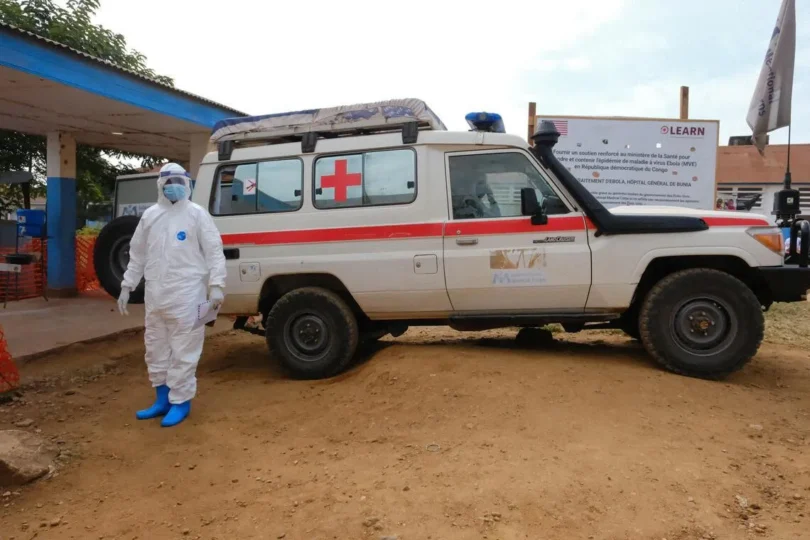
KINSHASA – Ebola patients are fleeing treatment centres in the Democratic Republic of Congo in search of food, underscoring how hunger has become one of the biggest obstacles to containing the virus.
Outbreak responders are “coming to us, knocking on our door and saying: ‘We need food assistance if we’re going to end Ebola,’” said David Stevenson, who runs the World Food Program’s operations in Congo and has spent three decades working in humanitarian emergencies.
“I’ve never seen anything like it.”
Government reports have documented more than 150 escapes from Ebola treatment and isolation facilities since late May.
In one incident, 11 suspected patients fled a hospital in Bambu, about 40km from the outbreak’s epicentre around the gold-mining town of Mongbwalu, because of inadequate nutritional support, according to the health authorities. Other reports have linked patient departures to food shortages and poor living conditions.
Even before the outbreak, eastern Congo was grappling with widespread displacement, conflict and one of the world’s worst hunger crises.
Now those pressures are colliding with efforts to contain a virus that has already infected almost 900 people, killing more than a quarter of them.
Food insecurity impacts almost 10 million people in the country’s eastern provinces, not only complicating efforts to isolate patients but also to monitor people exposed to the virus.
The health authorities are currently tracking about 6,400 people who may have been exposed to Ebola. Families asked to remain under observation often lose access to work, markets and other sources of income.
“If you confine people, they will need to be supported with food. And if they don’t get food they will move,” said Olivier Nkakudulu, head of field operations in Ituri, the province that accounts for more than 90 per cent of confirmed cases, for the World Food Program.
The consequences can be especially severe when the person under observation is the household’s main provider.
“Just imagine if we put a single mother into isolation, what will happen to the children?” said Godfrey Ayena, national director of Food for the Hungry in Uganda.
Similar challenges can arise in child-headed or elderly-headed households, he said.
In much of the region, families typically provide food for hospitalised relatives, meaning Ebola isolation rules can abruptly cut patients off from their usual support networks.
The United Nations’ food assistance agency is now providing hot meals at Ebola treatment centres and delivering food to patients, monitored contacts and affected families.
This week, 590 hot meals were distributed in a single day to suspected and confirmed patients, contacts under observation and caregivers.
Health workers recall encountering similar challenges in previous outbreaks.
“When people don’t have food, it causes them to be desperate,” said Kenneth Kobba, a Ugandan public health physician preparing to deploy to eastern Congo, where he will respond to his fourth Ebola crisis.
Kobba recalled that during Uganda’s 2022 outbreak, some people repeatedly came to treatment units claiming to have symptoms because meals were available there, potentially exposing themselves to infection.
“Someone will come and tell you I have fever and headache,” he said. By the time test results came back, the person would already have received several meals.
Years of conflict in eastern Congo have disrupted agriculture, displaced millions of people and made it difficult for humanitarian agencies to reach vulnerable communities. Recent cuts to aid budgets have compounded those challenges, forcing relief organisations to balance competing priorities.
“This requires making terrible choices between the extremely hungry who are next to starvation and those who are very hungry and do not know where they’re going to get their next meal,” Stevenson said.
Jacques, 52, who declined to give his last name for security reasons, said he has been relying on churches in Beni to help feed his 14 children after fleeing fighting around Bukavu in South Kivu province.
A little over a week ago, his 5-year-old daughter began vomiting and bleeding from her ears. He brought her to Beni’s main hospital, where she died a few hours later. His wife is now in isolation at the same facility with Ebola.
Since arriving at the hospital, he has received a food kit from the World Food Program.
“That’s enough for two weeks, and after that what are we going to do to eat?” he said.
WFP is seeking US$175 million (S$226.23 million) until November for its Congo operations, including US$32 million earmarked for Ebola-related activities, according to Stevenson. The agency’s budget in the country has fallen by about a third over the past two to three years.
“The need to address the wider population is crucial, and we’re just not going to be able to end Ebola unless we address those needs,” he said. “It simply will not work.” BLOOMBERG