
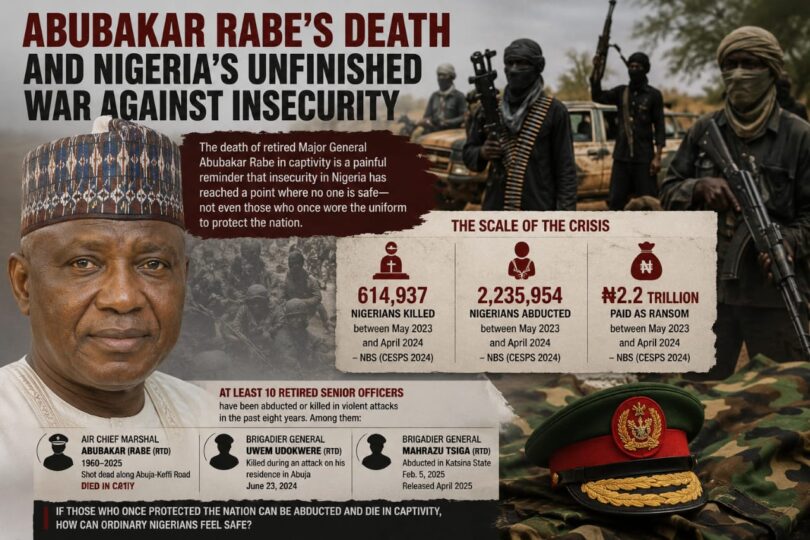
The death of retired Major General Abubakar Rabe in captivity should concern every Nigerian. Beyond the loss of a distinguished military officer, the incident underscores a painful reality that has become increasingly difficult to ignore: insecurity in Nigeria has reached a point where no one can confidently claim to be beyond its reach.
For many years, insecurity has remained one of the country’s most stubborn challenges. Although the crisis has become more visible in recent years, its roots stretch much further back.
Nigeria has long grappled with communal clashes, armed robbery, militancy, ethno-religious conflicts and weak state presence in some parts of the country.
Boko Haram itself emerged in the early 2000s before transforming into a full-scale insurgency around 2009. Since then, successive administrations have inherited the challenge and promised solutions, yet the problem has continued to evolve rather than disappear.
As one threat appeared to weaken, another emerged. While national attention remained focused on the insurgency in the Northeast, criminal groups found opportunities elsewhere.
Across large parts of the Northwest, cattle rustling, illegal mining, the proliferation of small arms and competition over scarce resources gradually gave rise to banditry.
What initially seemed like isolated criminal activities developed into organised networks capable of attacking communities, abducting travellers, rustling livestock and confronting security forces.

Read Also:Gen. Rabe’s death exposes security failure, CISLAC demands probe of defence spending
Meanwhile, communal and ethno-religious violence persisted in parts of the Middle Belt, while kidnapping-for-ransom spread across major highways and communities in different parts of the country.
Today, insecurity is no longer confined to any particular region. It has become a national concern affecting urban and rural communities alike.
The death of Major General Abubakar Rabe in captivity is particularly significant is because it is not an isolated case. Before him, retired Brigadier General Mahrazu Tsiga spent more than 50 days in captivity after being abducted by bandits in Katsina State.
Reports indicated that substantial ransom payments were made before he eventually regained his freedom. Years earlier, retired Major General Idris Alkali disappeared while travelling through Plateau State. His disappearance triggered a massive security search operation before his remains were eventually recovered from a well.
Viewed together, these incidents are more than individual tragedies. They suggest that criminal groups have become sufficiently emboldened to target individuals once considered among the country’s most protected and security-conscious citizens.
If retired generals can be abducted, held captive for weeks, forced to pay ransom or lose their lives at the hands of criminal groups, it sends a chilling message to millions of Nigerians who lack their experience, influence or resources.
The trend extends beyond these cases. A review by the International Centre for Investigative Reporting (ICIR) found that at least 10 retired senior military officers, including a former Chief of Defence Staff, major generals, brigadier generals, colonels and an air vice marshal, have either been abducted or killed in violent attacks over the past eight years.
Read Also:CISLAC urges presidency to investigate ICPC‘s military contractor’s discovery
Among them was former Chief of Defence Staff, Air Chief Marshal Alex Badeh, who was shot dead by gunmen along the Abuja-Keffi Road in December 2018. In June 2024, retired Brigadier General Uwem Udokwere was killed during an attack on his residence in Abuja.
There is a painful irony in the fact that some of the individuals who once occupied senior positions within Nigeria’s security architecture are now among the victims of the insecurity they spent their careers trying to contain.
The scale of the crisis is reflected in findings from the National Bureau of Statistics’ Crime Experienced and Security Perception Survey (CESPS) 2024.
The survey estimated that 614,937 Nigerians were killed and 2,235,954 others kidnapped between May 2023 and April 2024.
It further estimated that about N2.2 trillion was paid as ransom during the period, while rural communities recorded a higher number of killings than urban areas.
Similarly, SBM Intelligence reported that at least 4,722 Nigerians were abducted between July 2024 and June 2025, with approximately N2.57 billion paid as ransom.
Although the two reports cover different periods and employ different methodologies, both point to the same disturbing reality: kidnapping has become one of Nigeria’s most persistent security threats.
Beyond the loss of lives, insecurity has imposed enormous economic costs on the country. Farmers are abandoning fertile farmlands for fear of attack.