
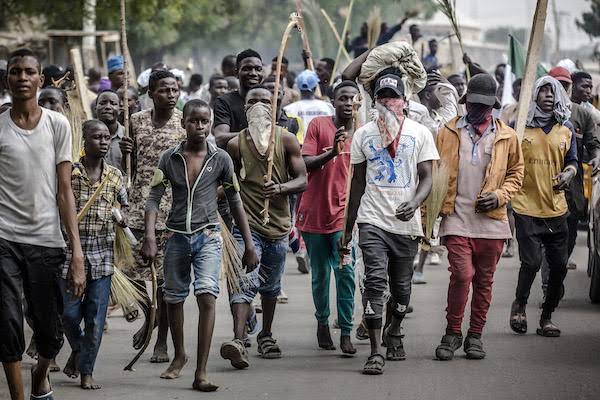
Political thuggery has remained a persistent feature of Kano’s political landscape, with youths frequently mobilised during rallies and public events, often leading to violence, destruction and fear among residents.
Across the state, political gatherings are rarely held without the presence of groups of young men, some reportedly under the influence of drugs and carrying dangerous weapons.
SolaceBase observes that their activities cut across party lines and have become normalised despite repeated condemnations by authorities.
In many instances, these youths clash with perceived rivals, attack innocent residents or loot property, turning what should be civic engagements into scenes of chaos. The trend continues to raise concerns about public safety and the effectiveness of government efforts to address insecurity.
A recent incident at the popular Farm Centre phone market further highlighted the growing menace. Traders were reportedly attacked and their goods looted by suspected political thugs who had gathered outside a nearby event, spreading panic across the area and neighbouring markets.
The recurring nature of such incidents has intensified questioning of the sincerity of political actors and institutions, as analysts argue that the same system condemning the violence may also be enabling it behind the scenes.
From “yan banga” to modern political thuggery
A political analyst and lecturer at Bayero University Kano, Professor Kamilu Sani Fagge, traced the current wave of political violence to the historical “Yan Banga” system, a traditional structure of youth groups originally mobilised to protect the interests of political leaders and their parties.
According to him, what once functioned as a form of organised political protection has gradually transformed into a more violent and uncontrolled network of youths exploited for political gain. He said the evolution of this system has been shaped by worsening socio-economic conditions and declining moral values.
He explained that poverty, unemployment and drug abuse have played a major role in pushing many youths away from their original responsibilities, making them easy targets for political manipulation. In many cases, he said, politicians take advantage of these vulnerabilities to mobilise them during political activities.
“That is why whenever there are political gatherings, these youths are hired, given money, weapons and drugs. That is why our politics has taken this dimension,” he said.
Read Also:Rising Thuggery and Gang Conflicts in Kano: A Growing threat to peace, development – AIG Salisu Fagge (Rtd)
Professor Fagge also raised concerns about what he described as political double standards in addressing the issue. According to him, political actors often publicly condemn thuggery while quietly benefiting from the same system.
He alleged that such groups are not only present at local political events but also seen accompanying politicians at different levels of leadership, which he said weakens genuine efforts to curb the problem.
He further argued that the failure to address underlying issues such as education, employment, and social welfare has contributed significantly to the persistence of political thuggery in the state.
Poverty, Unemployment and the Lost Generation of Youths
Another political analyst, Malam Sulaiman Ahmad of Aminu Kano College of Islamic and Legal Studies, said the growing involvement of youths in violence reflects a deeper crisis of identity, focus and moral direction within society.
He explained that many young people have been diverted from productive paths due to economic hardship and lack of opportunities, making them vulnerable to exploitation by political actors.
According to him, addressing the problem requires going beyond surface-level responses and focusing on its root causes. He warned that without such an approach, the cycle of violence would continue to regenerate itself.
“If you want to cut a tree, you don’t cut the branches—you cut it from the root,” he said, stressing that only fundamental reforms can bring lasting change.
Malam Sulaiman further called for the involvement of committed and patriotic stakeholders who can guide youths towards better opportunities and positive engagement in society.
Read Also:Thuggery and phone snatching in Kano : A menace demanding urgent attention
He emphasised that employment creation remains central to any meaningful solution, noting that idle hands often become tools for manipulation and violence.
He also highlighted the importance of education, but stressed that learning must be accompanied by strong moral values. According to him, some youths involved in such activities have passed through formal education systems but were not adequately shaped in character and discipline.
He warned that exposure to negative influences, whether in communities or learning environments, can significantly distort a young person’s sense of right and wrong if not properly guided.