
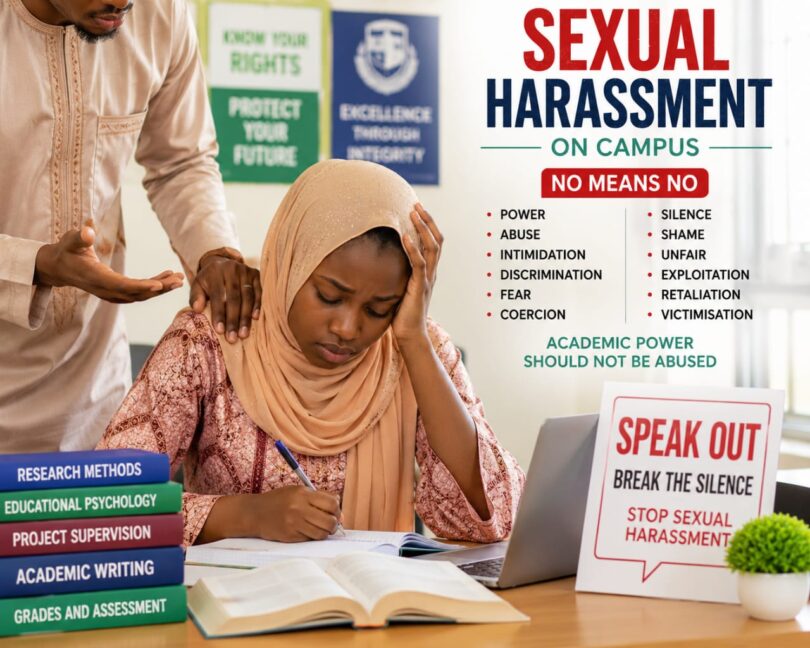
The recent controversy involving Dr Nasa’i Gwadabe of Northwest University has once again drawn public attention to the persistent problem of sexual harassment in Nigeria’s tertiary institutions.
Gwadabe, who was a visiting lecturer at the Maryam Abacha American University of Nigeria (MAAUN), was recently linked to allegations that he made sexual demands on a female student, triggering widespread outrage after the lecturer was allegedly assaulted by the husband of the student with others in a viral video.
Maryam Abacha American University of Nigeria (MAAUN), which was mentioned in reports surrounding the case, subsequently clarified that Gwadabe’s one-year appointment as a Senior Visiting Lecturer had expired in May 2026 and was not renewed.
While the allegations against Gwadabe require credible investigation and due process, the questions raised by the controversy cannot be confined to one lecturer, one student or one university.
They touch on a wider problem that has persisted within Nigeria’s higher education system for years. The latest controversy has attracted attention not because allegations of sexual harassment in tertiary institutions are new, but because it reminds Nigerians of numerous cases that have emerged from universities and polytechnics across the country.
The concern is supported by evidence. A 2018 report by the World Bank Group’s Women, Business and the Law project indicated that 70 per cent of female graduates in Nigeria had encountered sexual harassment during their academic journey, often involving lecturers and fellow students.
Read Also:Court jails varsity lecturer 5 years over sexual harassment
Recent findings also show that more than 50 lecturers across Nigerian public universities and polytechnics were implicated in cases of sexual misconduct between April 2021 and April 2025. Some were dismissed, others suspended, while several faced disciplinary proceedings.
These figures suggest that the problem cannot simply be dismissed as the misconduct of a few individuals. The recurrence of cases across institutions and regions points to a deeper crisis involving academic power, institutional accountability and the protection of students.
For Kano residents, concerns about sexual harassment in tertiary institutions are not entirely new. In 2019, Ali Shehu, who taught part-time at Kano State Polytechnic, was arraigned before a magistrates’ court over allegations of breach of official trust and sexual harassment involving a female student.
The polytechnic clarified that Shehu was not a substantive member of its staff but said it had constituted a disciplinary committee to examine the allegation.
More recently, a 2025 investigation at Bayero University Kano highlighted both the persistence and complexity of sexual harassment allegations.
Some female students reportedly expressed reluctance to openly discuss harassment despite the institution’s policy, citing concerns about possible consequences.
Read Also:Sokoto varsity sacks three staff over sexual harassment, result alteration
The same investigation examined an allegation by a former student against an unnamed BUK lecturer. The lecturer denied the accusation and presented messages, audio recordings and other documents which he said showed that the allegation was an attempt to damage his reputation.
The disputed account highlighted another dimension of the controversy. While the imbalance of academic power can make students particularly vulnerable, allegations must be independently investigated and determined on the strength of evidence rather than public outrage.
There have also been concerns that, in some instances, students may initiate inappropriate communication or make advances towards lecturers, sometimes in pursuit of academic favours.
Such situations do not excuse lecturers who exploit students. Rather, they reinforce the responsibility of academics to maintain professional boundaries regardless of a student’s conduct.
Read Also:Sexual Harassment: Publish investigation outcome- Ex-female soldier urges Army
Beyond Kano, similar cases have continued to emerge from tertiary institutions across the country.
In April 2025, Abubakar Tafawa Balewa University, Bauchi, dismissed Dr Usman Aliyu, a senior lecturer, after a disciplinary panel found him guilty of sexually harassing a married postgraduate student, Kamila Aliyu.
The student had accused the lecturer of coercion and threats to her academic progress. The case highlighted one of the most troubling dimensions of sexual harassment in tertiary institutions: the enormous influence lecturers can exercise over students’ grades, supervision and academic future.
Barely ten days earlier, the Lagos State University of Science and Technology dismissed three lecturers, Nurudeen Hassan, Kareem Arigbabu and Olayinka Uthman, over sexual harassment following deliberations by the institution’s Governing Council.
The pattern had already emerged in 2024. In November of that year, the Federal University, Lokoja, dismissed four lecturers over sexual misconduct.
Earlier, Abia State University, Uturu, suspended Dr Udochukwu Ndukwe following allegations of sexual harassment involving a female student.