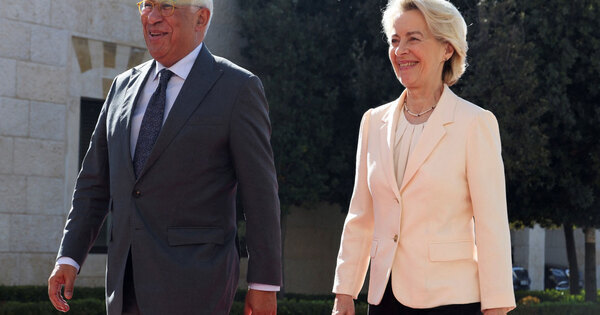
Brussels [Belgium], June 15 (ANI): European Union leaders Ursula von der Leyen and Antonio Costa have welcomed the peace agreement reached between US and Iran and urged its swift and full implementation by all parties. They called for the restoration of freedom of navigation, terming it essential for the global economy and said that the European Union is ready to contribute to advancing a comprehensive strategy for lasting peace across West Asia.
In a post on X, European Commission President Ursula von der Leyen called for the immediate toll-free reopening of the Strait of Hormuz.
‘This is essential for regional stability and the global economy. It opens the door to broader negotiations on peace and security in the Middle East,’ she said.
The EU Chief also called for ending ‘Iran’s nuclear and ballistic programmes and its destabilising activities in the region.’
She referred to the conflict in Lebanon and said, ‘Europe calls on all parties to respect Lebanon’s sovereignty and territorial integrity and implement a genuine ceasefire.’
She informed that at the G7 Summit slated to take place in the French resort town Evian, the G7 leaders will meet partners from the Gulf and the wider Middle East.
She gave a call for diversification of supply chains and said, ‘Once again, energy dependencies have been weaponised. We must diversify our supply routes and develop alternative export corridors to diversify away from the bottleneck of Hormuz. We will discuss this, and more, in Evian.’
https://x.com/vonderleyen/status/2066398099174531082?s=20
European Council President Antonio Costa called for peaceful resolution of outstanding differences in accordance with international law and said, ‘The European Union is ready to contribute to advancing a comprehensive strategy for lasting peace across the Middle East.’
https://x.com/eucopresident/status/2066388745444548764?s=20
Japan’s Foreign Minister Toshimitsu Motegi welcomed the diplomatic resolution and in a statement, said, ‘Japan has been making proactive diplomatic efforts based on its consistent position that what matters most is that de-escalation of the situation is steadily achieved as soon as possible. Japan has also been strongly requesting Iran to ensure as soon as possible the free and safe navigation of vessels of all countries, including Japan and other Asian countries, through the Strait of Hormuz, a strategic chokepoint for global logistics and an international public good.’
Leaders across Europe and the Indo-Pacific have welcomed the landmark peace agreement between the United States and Iran, describing it as a rare diplomatic opening to restore stability in West Asia, revive freedom of navigation through the Strait of Hormuz, and ease mounting pressure on global energy markets and economic growth and create momentum for a lasting resolution of concerns surrounding Tehran’s nuclear programme.
The major diplomatic breakthrough between Washington and Tehran was announced on Sunday, with President Trump saying that the agreement would bring ‘peace and security’ to West Asia and facilitate the reopening of the critical energy chokepoint Strait of Hormuz.
Following the announcement, Iran’s Deputy Foreign Minister for Legal and International Affairs, Kazem Gharibabadi, confirmed the peace deal and outlined Tehran’s conditions for moving forward with negotiations.
According to Iran’s state-affiliated Press TV, Gharibabadi said the official signing ceremony would take place on Friday, after which the text of the Memorandum of Understanding would be released publicly.
He stated that Iran would enter a proposed 60-day negotiation period for a final agreement only after verifying that the United States had fulfilled commitments related to ending hostilities, lifting the blockade and releasing Iranian assets.
The peace deal is set to be signed on Friday in Switzerland. (ANI)