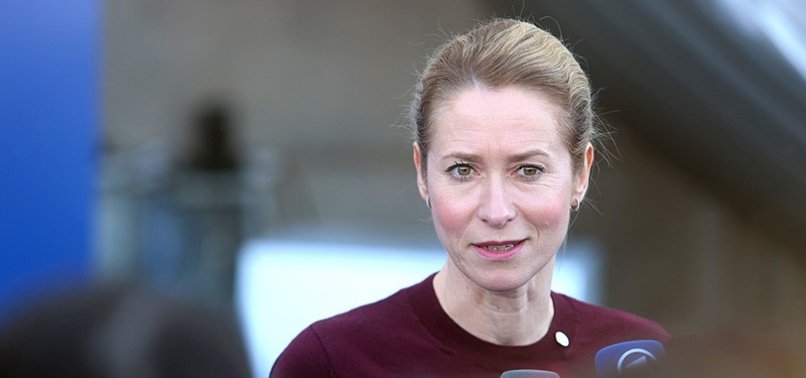
The European Union‘s top diplomat, Kaja Kallas, warned on Thursday against speculation about who might represent the EU in any peace talks between Russia and Ukraine.
“It’s a trap that Russia wants us to walk into, that we discuss who talks to them, and they are already picking who is suitable, who is not. Let’s not walk into that trap,” Kallas said on the sidelines of an EU foreign ministers’ meeting in the Cypriot port city of Limassol.
Instead, EU countries should agree on a list of demands to put to Russia, to be met in return for lifting EU sanctions on Moscow, as well as on a negotiating strategy, she said.
Earlier this month, Moscow suggested naming former German chancellor and Kremlin friend Gerhard Schröder as mediator. Kallas however was quick to dismiss the proposal.
Other floated names include Finnish President Alexander Stubb, former European Central Bank president Mario Draghi or former German chancellor Angela Merkel.
“Negotiations (are) always a team effort. You have ‘good cops’, you have ‘bad cops’, you have a strategy,” said Estonian Kallas, who worked as a lawyer before going into politics.
The substance of the negotiations is much more important than who is taking part, she said.
Kallas also made clear the EU will never be able to play a classic neutral mediator role in efforts to end the war, which has lasted more than four years and was instigated by Russia.
The EU clearly wanted to help Ukraine in the negotiations, Kallas told journalists after the foreign ministers meeting, and was also defending its own security interests.
Kallas’ comments come against the backdrop of a debate over whether the EU should play a greater role in diplomatic efforts to end the Ukraine war, given the lack of progress so far in US President Donald Trump’s peace initiative.
The former Estonian prime minister also stressed that all EU efforts must complement those of Washington.
“We are not coming in instead of the United States,” she said.
US-led efforts to bring an end to Russia’s war again Ukraine have so far failed to yield tangible results and, due to the Iran conflict, no longer appear to be at the top of Washington’s agenda.
Ukrainian President Volodymyr Zelensky has called for greater EU involvement.
EU demands to Russia could include the obligation to respect international agreements, limitations to its military and the withdrawal of Russian troops in Georgia and Moldova, Kallas said.
“It’s a maximalist approach, but so is Russia’s approach so far,” she said.
All issues concerning the sovereignty of Ukraine can only be negotiated and agreed on by Kiev, Kallas stressed.
Preparations for additional sanctions against Russia are meanwhile under way, said German Minister of State for Europe Gunther Krichbaum.
“The aim is to get Russia to step back from this spiral of escalating violence,” Krichbaum said.
Recent large-scale Russian strikes, including the use of hypersonic missiles, had shown “that Russia appears to have no intention whatsoever to curb its aggression, quite the contrary.”
“The pressure on Russia must increase, and that is so important,” he said.
Turning to the war in Iran and the conflict in the Middle East, EU foreign ministers discussed recent developments with their Indian and Saudi counterparts, Subrahmanyam Jaishankar and Faisal bin Farhan Al-Saud.
Trade between Europe, the Gulf countries and India has been affected by the war in Iran and the blockade of the Strait of Hormuz.
Recent geopolitical tensions, however, have intensified relations between the three partners. The EU has repeatedly declared its solidarity with the Gulf states when they came under retaliatory strikes from Iran.
India and the EU also announced a far-reaching free trade agreement in January.
Kallas said that she was hoping for a deal between the United States and Iran to end the conflict and to reopen the Strait of Hormuz.
“It is not in anybody’s interest that this war continues,” she said.
Alluding to recent strikes despite a ceasefire, Kallas said that the two sides were currently in a “very dangerous zone” between peace and war, where fighting can quickly erupt.