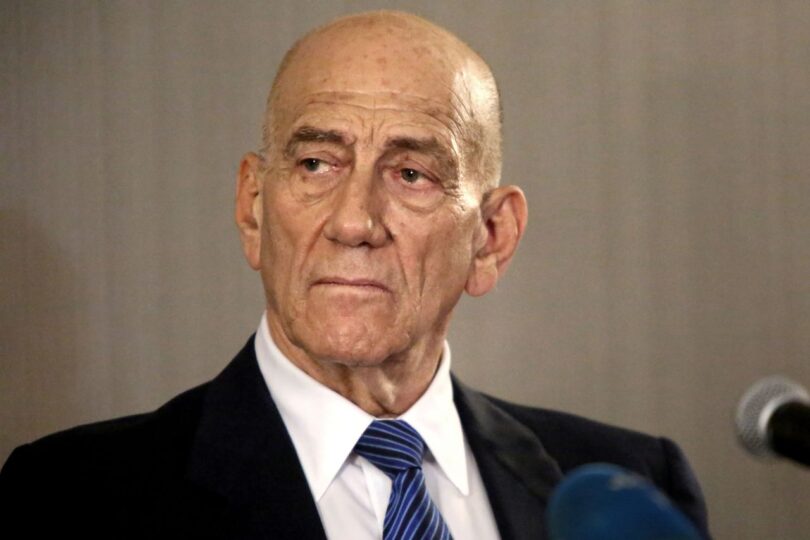
Turning to Lebanon, Olmert said there is a framework that could eventually lead to peace negotiations between Israel and Lebanon.
“There are some minor territorial issues that can undoubtedly be resolved,” he said.
Early on Thursday, a joint Lebanese-US-Israeli statement announced that Beirut and Tel Aviv had agreed during talks in Washington to implement a ceasefire based on a complete halt to Hezbollah fire and the withdrawal of all Hezbollah members from the area south of the Litani River.
Lebanese President Joseph Aoun said the US would determine the timing and mechanism for implementing the ceasefire, which could begin within 24 hours of receiving approval.
“Our problem is that we (Israelis) have a government that wants war in Lebanon, a government that wants to stay there,” Olmert said.
“It is a government under pressure from a group of lunatics who believe that southern Lebanon, eastern Syria, Gaza, and perhaps Yemen in the future are all lands given to them by God.”
He argued that part of any agreement with Lebanon should involve coordinated cooperation between Israel and the Lebanese government to disarm Hezbollah.
The Lebanese government is already pursuing a plan to place all weapons under state control, including Hezbollah’s arms, but the group insists it is a resistance movement against Israeli occupation and has rejected disarmament.
Hezbollah Secretary-General Naim Qassem has described direct negotiations with Israel as “absurd, humiliating and disgraceful,” saying any outcome would be “completely unacceptable” to broad segments of Lebanese society.
Olmert also said that if US President Donald Trump reaches an agreement with Iran to end the war between Washington and Tehran, it could create a framework for cooperation on the Hezbollah weapons issue.
“Our ground operations in southern Lebanon continue without practical value,” he said. “Israel should not have entered there. Our ground presence has brought no strategic benefit.”
Israel occupies areas in southern Lebanon, some held for decades and others seized during the 2023–2024 conflict. During the current offensive, Israeli forces advanced more than 10 kilometres into Lebanese territory, marking their deepest incursion since 2000.
Related