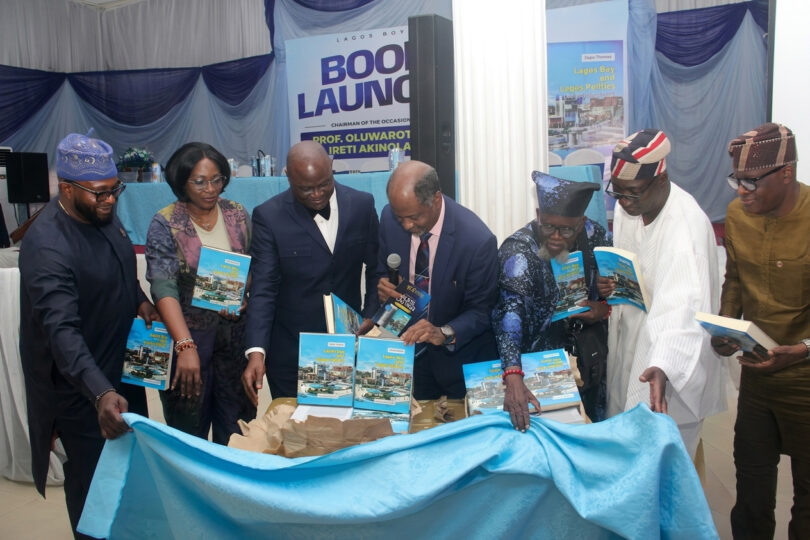
Professor Dapo Thomas has lifted the lid on one of Lagos politics’ defining succession stories, revealing in his new autobiography how Babatunde Fashola (SAN) emerged as former Lagos State governor Bola Tinubu’s preferred successor despite stiff resistance from influential figures within the then Action Congress of Nigeria (ACN).
In his 445-page autobiography, Lagos Boy and Lagos Politics, Thomas, who served as an aide to Tinubu during his administration, recounted the events that culminated in Fashola’s emergence as the party’s governorship candidate ahead of the 2007 Lagos governorship election.
According to Thomas, several prominent ACN leaders, including Olatunji Hamzat, Bushura Alebiosu, Ajisebutu, Baba Taiwo and Baba Pupa, repeatedly met with Tinubu in a bid to persuade him to abandon Fashola’s candidacy in favour of more established politicians within the party.
Despite their objections and calls for an open primary, Tinubu remained steadfast in his decision, insisting on Fashola as his preferred successor.
Thomas disclosed that before Fashola’s name gained prominence, several political heavyweights were being considered for the governorship ticket. Among those reportedly interested were Aro Lambo, Oyinlomo Danmole, Rahman Owokoniran, Kunle Lawal, Tola Kasali, Tokunbo Afikuyomi, Jimi Agbaje and Hakeem Gbajabiamila.
He said Gbajabiamila was widely believed to have enjoyed Tinubu’s backing until an incident at the Governor’s Office changed the political dynamics.
According to the memoir, Gbajabiamila confronted Fashola, then Chief of Staff, over an alleged exclusion from a meeting with renowned scholar Professor Akin Mabogunje. Thomas described the confrontation as a public display of anger that unfolded in Tinubu’s presence.
Thomas recalled that despite Tinubu’s attempts to calm the situation, the disagreement escalated before both men were asked to leave the governor’s office.
He wrote that the incident altered perceptions within Tinubu’s inner circle, with Fashola, whose name had barely featured among the leading contenders, suddenly emerging as a strong favourite for the governorship ticket.
As preparations for the 2007 election gathered momentum, Thomas said he led a team assigned to evaluate the Tinubu administration’s 10-point development agenda and produce a governance document that would serve as a policy guide for the eventual governorship candidate.
The team met weekly, reviewing government performance across key sectors including education, healthcare, transportation, agriculture, housing, environment, revenue generation and infrastructure.
Thomas said the assignment was so sensitive that he personally typed and compiled the document without involving his secretary.
He also revealed that Tinubu had initially proposed him as Director-General of the Fashola Campaign Organisation during a private meeting involving Gbenga Ashafa, Mutiu Are and Kunle Odufuwa.
However, according to him, Fashola requested that Fuad Oki be appointed instead.
Thomas said the decision did not affect his relationship with Fashola or his commitment to completing the governance blueprint prepared for the campaign.
He further recounted disagreements with Fashola over administrative decisions, including the distribution of official vehicles to members of his team, noting that Tinubu eventually intervened and approved a different arrangement.
Despite internal disagreements and resistance from some party leaders and aspirants, Thomas said work on the campaign strategy continued until the document was completed in October 2006.
Following Fashola’s emergence as the ACN governorship candidate after the December 2006 primaries, Thomas presented the 97-page governance document to Tinubu, who retained two copies and instructed that another be handed to Fashola.
The former aide described the document as a comprehensive governance blueprint that later guided the incoming administration.
Fashola went on to win the April 14, 2007 governorship election, polling 599,300 votes to defeat the Peoples Democratic Party (PDP) candidate, Musiliu Obanikoro, who secured 383,956 votes.
Gbajabiamila, who left the ACN to contest on the platform of the Alliance for Democracy (AD), finished a distant third with 13,576 votes.
Thomas’ memoir offers a rare insider account of one of the most consequential succession battles in Lagos politics, detailing the internal negotiations, disagreements and strategic decisions that preceded Fashola’s rise to the state’s highest office.