
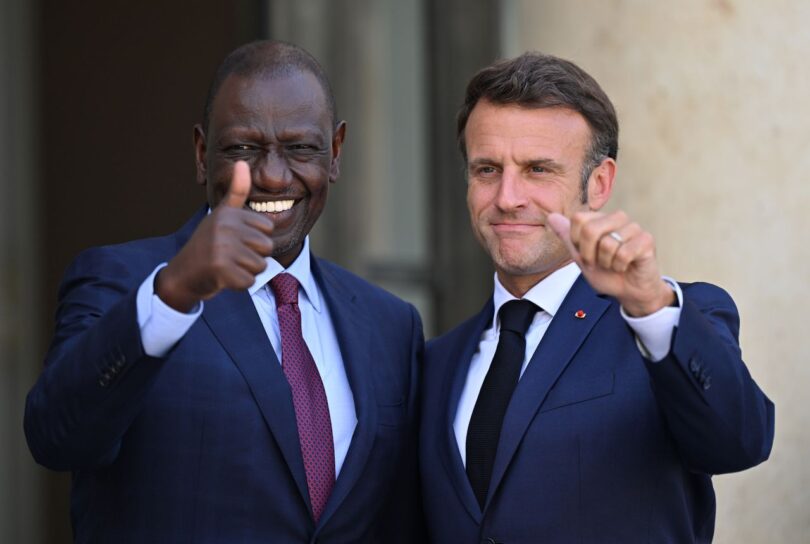
French President Emmanuel Macron seems to be guaranteed a warm official welcome when he arrives in Kenya’s capital, Nairobi, next month for the Africa-France summit, despite the growing anti-France sentiments across the continent.
Ahead of the summit, one major talking point has been the venue choice, seen as a counterbalance to France’s waning influence in its former West African colonies, where nations like Côte d’Ivoire, Senegal, Burkina Faso, Niger and Mali have asserted greater sovereignty and severed ties with Paris.
The so-called ‘Africa Forward Summit’ is scheduled to take place from 11 to 12 May and will besummit the first such held outside a former French colony, as Kenya was colonised by Britain and remains an English-speaking country.
France’s courtship of Kenya is more than a shift towards East Africa due to its dwindling standing in West Africa, according to some observers.
“What we are seeing is a global competition for sea links and maritime entrenchment,” one analyst, who wishes to remain anonymous, tells TRT Afrika.
“There is a general geopolitical shift slightly towards maritime consolidation. The battle today is shaping around sea links, waterways and choke points. So, it makes sense for France to take East Africa seriously,” he adds.
Lessons from Iran war
Analysts say the ongoing US-Israel war on Iran serves as a reminder to global powers that control of key economic nerves, particularly access to sea, is crucial in modern geopolitics.
“Iran’s war has reminded the world that the contest today is not simply about who can fire the longest range of ballistic missiles against the other, but who controls chokepoints and can cause greater harm,” the analyst observes.
Iran has recently restricted the movement of ships through the Strait of Hormuz, which handles more than 20 percent of the world’s crude oil shipments, causing global market shocks. Iran’s move was in response to US-Israel joint strikes on Tehran in late February, which triggered the ongoing war.
Kenya’s coastline extends from Somalia to Tanzania, covering about 600 kilometres. Its location in the western Indian Ocean gives it access to routes connecting to the Gulf of Aden and the Red Sea.
“There is a maritime component to Kenya’s strategy. It’s not a coincidence that immediately it began framing its place in the region in maritime terms that is when France started taking it seriously,” the analyst says.
Amid a public backlash, Kenya’s President William Ruto defended the relations with France.
“At the summit, we will actively engage on key issues, including reforming the international financial architecture and strengthening secure, sustainable economic partnerships,” Ruto said after a meeting with French ambassador to Nairobi Arnaud Suquet in early April.
Kenya-France defence pact
There has been a flurry of activities in the lead-up to the Nairobi conference. Early this month, Kenya’s parliament approved a five-year defence agreement with France that is automatically renewable upon completion.
It covers peacekeeping operations in the region, maritime security in the Indian Ocean, intelligence sharing and disaster response. Reports say hundreds of French soldiers have since landed at the port of Mombasa, and there is talk of a naval base in the works.
But the deal has drawn concern over a clause that gives immunity to French soldiers if accused of crimes committed on Kenyan soil. Human rights campaigners say the clause is not supported by Kenyan law and raises questions about transparency and accountability.