
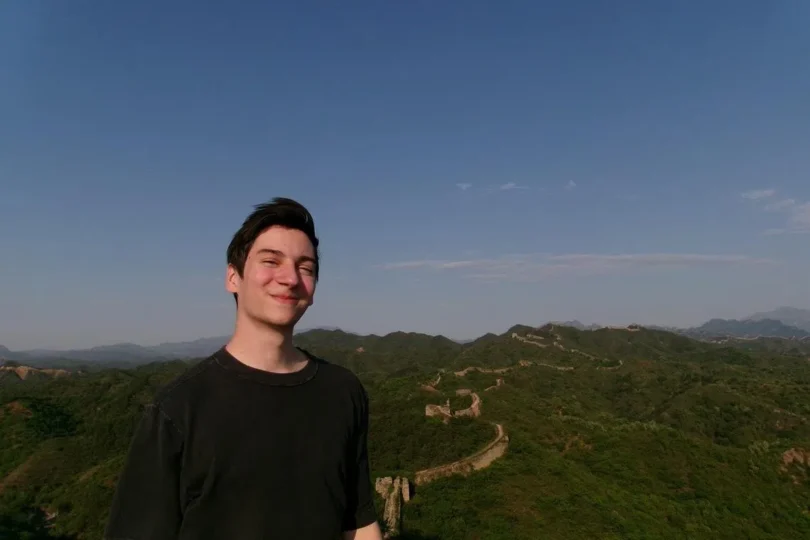
In January 2026, Peter Boehm left his home in Michigan and flew more than 10,000km to China. He would spend the next five months on an exchange at Capital Normal University in Beijing.
“I remember just staring out the window of the taxi and looking at all the high-rises, the skyscrapers, like I’d never seen skyscrapers before,” recalled Boehm, who recently finished his second year of university.
Even in a city of 21 million people, the sense of community was tangible. “People don’t go to parks at night in the US. It’s kind of a sketchy environment to be in. But parks at night in China are just alive with music and dancing.”
Boehm started learning Mandarin in high school to challenge himself and later chose to attend Middlebury College, a liberal arts school in Vermont, for its Chinese-language programme. He went to China to immerse himself in the language and to understand the country first-hand.
“I have grandparents who can remember stuff like the Red Scare,” Boehm, 21, said, referring to periods of anti-communist anxiety in the US. “Growing up at a different time, when we didn’t have an existential threat of something like the Soviet Union, it felt very strange to label this country as an enemy just because it’s a communist, socialist country.”
In a moment of simmering US-China tensions, stories like Boehm’s are increasingly rare. According to a recent report from the US-China Education Trust non-profit organisation, the number of Americans studying in China has dropped from about 11,000 in 2019 to less than 2,000 in 2026. The number of Chinese students in the US is also declining, from a peak of 372,532 in 2019 to 2020, to 265,919 in the 2024 to 2025 academic year.
Some US students no longer have access to joint US-China educational programmes, which are under greater scrutiny from the US government. Others wonder if studying in China could make it harder to get security clearance to work in government. And some simply view China as a competitor.
A long view of US-China exchange programmes
Cold War America was both apprehensive and curious about China.
Relations between the two countries ground to a halt after the communists won the Chinese civil war, but contact resumed in the late 1960s. “The security logic now was, China’s on our side against the Soviet Union,” explained David Lampton, a professor emeritus of China studies at Johns Hopkins University. The US developed exchange programmes, scholarships and language courses to build American expertise on China.
China, for its part, emerged from the Cultural Revolution in 1976 with a dwindling pool of educated workers. “It needed help to get up on its intellectual feet,” Lampton said. Then paramount leader Deng Xiaoping and other reformists were moderately successful in attracting American talent: about 3,500 US citizens visited the People’s Republic of China for academic purposes between 1979 and 1983.
Lampton himself travelled to China in October 1976, one month after former Chinese leader Mao Zedong’s death. He recalls noticing the lack of safety measures in Chinese factories, the lack of indoor plumbing and the reluctance of patients to consume domestically produced drugs. “You get a sense of empathy, and empathy doesn’t mean sympathy,” Lampton said. “Empathy means you know, sort of in the core of your being, how people are going to react.”
The following decades were marked by an unusual openness in US-China relations. “For many Americans coming of age in the 2000s, China represented a land of great opportunity,” said Amy Gadsden, former special adviser for China at the US State Department. American youth flocked to China, eager to learn Chinese and engage with a rising world power. From 1995 to 2012, the number of US citizens studying in China increased more than tenfold.
This surge in student exchange was short-lived, for reasons that are still debated.
Sun Chenghao, a senior fellow at Tsinghua University’s Center for International Security and Strategy, points to trade restrictions imposed soon after US President Donald Trump’s inauguration in 2017. “From the Chinese perspective, we were on the receiving end of the so-called trade war and tariff war,” he said, arguing that these disputes took a toll on the movement of students.
Other academics reach back further. “There were, right at the very beginning, restrictive aspects to Xi Jinping’s movement into power,” said Lampton, who cites increased barriers to American scholars conducting field research and visiting archives in China. “There’s a feeling in the United States that there’s inequity here.”
Then came the Covid-19 pandemic, which had lasting consequences for educational exchange globally. At the height of the pandemic, there were as few as 300 American students and scholars in China. Numbers have risen since then, but have yet to approach the peak in 2012.
Chilling effect
What are American students so worried about?
Gadsden, now executive director of China initiatives at the University of Pennsylvania, said American students have grown anxious about the professional consequences of going on exchange. “We get this question all the time: ‘If I want to go work for the US government, will I be able to get a security clearance if I’ve studied in China?’”
Beverly Cheung, a University of Utah student, spent a semester at Tsinghua University in 2025, an experience she called the highlight of her undergraduate career. But she was the only student from her school there. “I know a lot of students from my university do exchange semesters in Spain, France and Italy. China’s definitely not one of the popular ones,” she said. She believes her peers are deterred by language barriers and “underlying political stereotypes” about China, which she attributes partly to Utah’s political conservatism.

Beverly Cheung, a student from Utah, at a lake in Guilin in June 2025.
PHOTO: COURTESY OF BEVERLY CHEUNG
Other students worry about security risks, including the possibility of detention by the Chinese authorities, according to Neysun Mahboubi, director of the Penn Project on the Future of US-China Relations. “When you bring these kinds of points up with either US officials or Chinese officials, they will often say this is a minuscule percentage of the total,” he said. “What they don’t appreciate is that people are already on edge.”
Even for Americans who remain enthusiastic about travelling to China, opportunities for exchange are shrinking.
In September 2024, the US House Select Committee on the Chinese Communist Party published a 113-page report titled “CCP On The Quad”. The document, citing several US-China educational partnerships, accused the Communist Party of China (CPC) – which it calls the CCP – of using American talent to train Chinese students and scholars in critical fields like semiconductor development and artificial intelligence.
Lampton, the professor from Johns Hopkins, said the messaging from the federal government has had a chilling effect. Many US universities depend on federal funding and are wary of investigations into perceived ties with the CPC. “Universities aren’t necessarily expanding their exposure to China, to put it mildly,” he said.
Within a month of the publication of CCP On The Quad, Georgia Institute of Technology and University of California, Berkeley, decided to end partnerships with Chinese universities. The University of Michigan, Eastern Michigan University and Oakland University followed suit in 2025.
The intensity of Washington’s approach has raised some eyebrows. Scott Kennedy, a China expert at the Center for Strategic and International Studies, said Chinese access to military or dual-use technology is a legitimate concern, but that blanket restrictions on educational exchange can backfire. “The US government has seemed to believe that overreacting carries no costs, relative to underreacting. I think that’s a mistake,” he said.
Future prospects
In August, 22-year-old Alex Tseng will depart for Beijing as part of the Schwarzman Scholars programme, one of the few remaining options for funded study in China. A recent graduate of Princeton University, Tseng plans to work in clean-energy development and is undeterred by American anxieties about China. “I do believe there are a lot of critics of going to study in China because the US is currently so pro-competition,” he said. “But I think that’s false logic. The US is going to lose many of those battles, and we need to get real about collaborating with China where needed.”
Tseng is part of a wave of American students making a cautious return to China. According to Kennedy, the number of American exchange students and scholars has gradually increased since 2024, though it remains well below the pre-pandemic level.
Experts say the future of US-China educational exchange depends on the wider relationship between the two countries. “At least this year, I think the relations will be quite stable,” said researcher Sun, pointing to the upcoming summit between Trump and Xi in September. But Sun also describes a deep-seated set of disputes – on tariffs, export controls and fentanyl – that stand in the way of a lasting detente.
Conversely, the US-China relationship may be shaped by trends in student exchange. Lampton warned of a looming decline in American knowledge of China, in fields ranging from intelligence to agriculture to energy, as the current generation of experts retires. “The real question is, how are we going to manage this very complex, economically and strategically important relationship if we’re not turning out the kind of expertise we used to?”
One cause for optimism is recent polling showing that American perceptions of China have become more positive in recent years. According to a Pew Research Center survey from March 2026, the proportion of Americans who have a favourable view of China has almost doubled since 2023, from 14 per cent to 27 per cent. That change is especially marked among younger Americans. Only about 20 per cent of adults under 50 said China is an enemy of the US, compared with 38 per cent of those 50 or older.
Ali Wyne, a researcher of US-China relations at the International Crisis Group, attributed this generational difference to a mix of social and technological changes. Economic pessimism among young Americans has made them “more willing to consider the merits of alternative development models”, such as China’s, Wyne wrote in an e-mail to The Straits Times. Social media platforms have also given young Americans new “windows into China’s culture and development”.
For the next cohort of Americans to develop deep knowledge of China, both governments will need to facilitate the flow of students and scholars, said Lampton. But there is a catch: The students who are best equipped to build expertise on China may come back with views that run counter to Washington’s.
Coco Zhang, an American student at Duke Kunshan University, near Shanghai, said her education has made her question America’s treatment of China as its “biggest foreign adversary”. In June, she visited Kentucky’s House of Representatives to advocate greater community and tribal rights in the context of critical mineral reshoring. “The first thing they brought up when I asked ‘Do you know what critical minerals are?’ is that China controls all of it. Obviously, they’re aligned with the Trump administration’s views that China’s the bad guy.”

American student Coco Zhang harvesting rice at an organic farm in Kunshan, Jiangsu, in October 2025.
PHOTO: COURTESY OF COCO ZHANG
Zhang added: “I still really do care about communities, and I definitely still want to be a policymaker. Given everything I know about the US and China now, it’s just harder for me to imagine working under a very partisan administration.”
Cheung, the student from Utah, used to dream of becoming a foreign service officer, but now wants to work in the tech sector. “I realised that I didn’t want to have to represent, or be neutral, or non-partisan, for the government, even if I did disagree or if I morally thought that things were incorrect within the administration,” she said.
As America looks to train its next generation of China experts, it may be right to think that a kind of subversion is under way – not because American research is quietly advancing China’s technological ambitions, but because living in China can leave students sceptical about the assumptions baked into US foreign policy. The question is whether American institutions will make room for young people with new and complex views of China.
For Cheung, one of the hardest parts of the exchange was coming back home. She felt out of place in Utah – too Chinese for her surroundings, and distant now from the friends she left behind. “I felt very different from the person that I was when I left,” she said.