
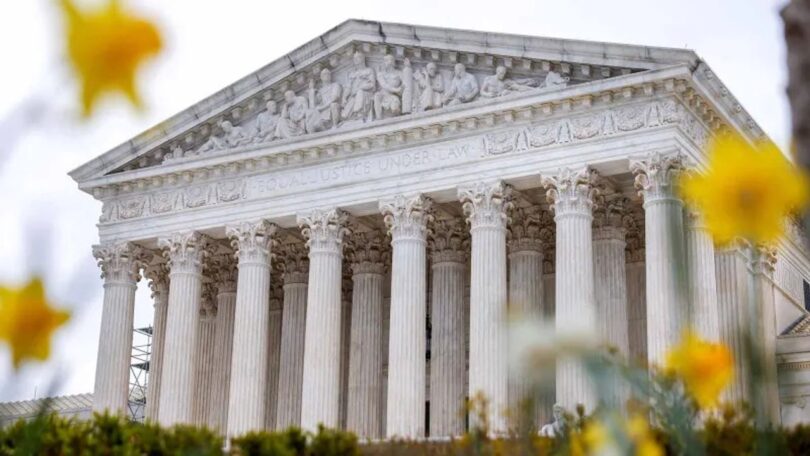
Washington, DC — In a 6–3 ruling this week, the US Supreme Court struck down Louisiana’s second majority-Black congressional district, ruling that the state had relied too heavily on race when drawing the map, even though lawmakers said they were trying to comply with Voting Rights Act of 1965, a law designed to protect minority voting power.
Justice Samuel Alito held that such use of race overstepped constitutional limits, a conclusion sharply rejected in dissent by Justice Elena Kagan, who warned that the decision marks a significant narrowing of the protections long associated with the landmark civil rights law.
The decision lands in Washington not with immediate disruption, but with a slow legal and political ripple.
Political science Professor Paul M. Collins Jr., an expert on legal studies at the University of Massachusetts Amherst, says the practical effect will be felt through state-level map-drawing.
“Moving forward, I think state legislators are going to use the decision to justify partisan gerrymandering, likely giving a disproportionate number of House seats to Republicans (relative to support for Republicans) at the ballot box. So, the longer-term consequence is likely to be that Republicans are over-represented in Congress.”
He links that directly to representation in Congress, not just legal theory.
“My read of the Court’s opinion is that partisan gerrymandering is fine. So, as long as state legislatures can justify redistricting as being done for partisan purposes, the Court seems okay with it. I think a result of this is that we will see fewer Black and Latino members of Congress,” Collins told TRT World.
The key constraint, he adds, is timing. Most states are unlikely to redraw maps immediately ahead of the next election cycle.
“There simply isn’t enough time for a large-scale redistricting effort prior to the November midterm elections. I believe the 2028 election will be when we really see the effects of this decision.”
Intent over outcomes
The legal impact is already being tested through ongoing voting rights cases, where the standard for challenges has shifted.
David Levine, Raymond L Sullivan professor of law at the University of California, College of the Law, told TRT World that cases built on the previous legal test are now on weaker ground.
“The case will certainly have an immediate impact on any ongoing litigation under Section 2 of the Voting Rights Act. Any case which is premised on the now inadequate effects standard will have to be revised or dismissed in light of the new intent standard.”
That change matters because it alters what courts will look for.
Instead of examining outcomes, judges are now required to focus more heavily on intent when evaluating whether voting rights have been violated.
Related